

Holding Bitcoin on a platform does not eliminate counterparty risk
Imagine a situation that seems almost impossible to many users.
You enter your exchange.
You see your balance.
You have Bitcoin, USDT, Ethereum, and other assets.
Everything seems normal.
Until one day the platform announces it has financial problems.
Then withdrawal restrictions come in.
Later, investigations appear.
And finally, the word that no user wants to read comes up:
insolvency.
Then a question appears that goes far beyond technology:
What happens to the cryptocurrencies I had inside that platform?
The answer cannot be reduced to:
“They are yours, so they just have to give them back to you.”
But it does not necessarily mean:
“You lost them automatically.”
The outcome depends on something fundamental:
what legal relationship existed between the user and the platform, how the assets were custodied, what the contracts said, where the company was domiciled, and which legislation applies.
And here appears one of the most important concepts in the crypto world:
Custody risk.
Owning cryptocurrencies does not only mean assuming price risk
When a person buys Bitcoin, they usually think of one risk:
“Will Bitcoin go up or down?”
But there are other risks.
We may have:
Market risk
The price may fall.
Technological risk
A hack, failure, or vulnerability may occur.
Operational risk
There may be an error in withdrawals, transfers, or systems.
Security risk
An account can be compromised.
Counterparty risk
The company you operate with may have problems.
And this last one is often left forgotten.
Because when we use a centralized exchange, we are not only interacting with blockchain.
We are also relying on a company.
What does it really mean to hold Bitcoin on an exchange?
This is one of the first questions we must ask ourselves.
If you have a self-custody wallet, you normally control the keys needed to authorize transactions.
But when you hold assets inside an exchange, the situation may be different.
The platform may hold custody or manage the mechanisms that allow the assets to move.
Then three different levels appear:
Blockchain → Exchange → User
The blockchain records certain transactions.
The exchange maintains a contractual and operational relationship with the user.
And the user has certain rights over the balance or assets depending on the structure used.
That is why:
The balance that appears on your screen does not necessarily equal having the private keys to the assets.
So is the exchange the owner of my cryptocurrencies?
We should not automatically answer yes.
This is one of the most delicate issues.
The fact that an exchange has technical custody does not necessarily mean that, legally, it can dispose of the client's assets as if they were its own assets.
But we also cannot automatically claim the opposite.
It all depends on the structure.
You have to analyze:
the contract with the user;
the custody terms;
the jurisdiction;
the applicable legislation;
the way the assets are recorded;
whether there is asset segregation;
how reserves are maintained;
what rights the client has;
and what happens in case of insolvency.
That is why, when we talk about exchanges, the fine print can be as important as the technology.
What does “segregation” of assets mean?
Let's imagine two models.
Model A
Clients' assets are clearly separated from the company's own assets.
Model B
Clients' and the company's assets are mixed, or the legal relationship is not clearly structured as separate custody.
In the event of insolvency, the difference can be enormous.
In the first scenario, there may be a clearer legal basis to claim the return of certain assets.
In the second, a much more complex dispute may arise.
But there is a fundamental clarification:
A platform saying it holds reserves does not automatically mean that the user has an absolute guarantee of recovery.
You have to analyze what assets exist, where they are, who controls them, and what legal rights each client has.
What happens if the exchange used its clients' assets?
Here we enter an even more delicate situation.
Suppose a user deposits:
1 BTC
on a platform.
And the platform uses those assets to:
loans;
financing operations;
investments;
staking;
yield strategies;
guarantees;
or activities with third parties.
If the operation goes wrong, a question appears:
Who bears the loss?
The user might think:
“I only left my Bitcoin there.”
But legally it will be necessary to determine what service was actually contracted.
It is not the same:
simple custody
that
asset loan
that
staking
that
yield product
that
with asset use by the platform.
Each structure can have different consequences.
And here a fundamental difference appears
When someone says:
“I have my cryptocurrencies on an exchange.”
we should ask:
“In which product?”
Because it is not necessarily the same thing to have:
BTC in a spot account
than having:
BTC committed in a yield product.
The word “exchange” can conceal multiple contractual relationships.
What happens when insolvency arrives?
In general terms, when a company enters insolvency proceedings, it is no longer simply a matter of each client being able to withdraw their money as if nothing had happened.
In Paraguay, Bankruptcy Law No. 154/1969 establishes that a declaration of bankruptcy implies insolvency and that the procedure aims to realize and liquidate the debtor's property, rights, actions, and obligations, with legal exceptions. It also provides for the bankrupt's dispossession and the administration of the assets by the trustee.
But here we must make a very important legal clarification:
Paraguayan Bankruptcy Law was not specifically designed for crypto exchanges.
That is why we cannot simply say:
“Law 154 says exactly what happens to your Bitcoin in Binance.”
It does not say so.
What it does provide is the general Paraguayan insolvency framework.
If a foreign platform enters insolvency in another jurisdiction, the laws of the country where the company is incorporated and the applicable international rules will probably be decisive.
What if the exchange is in another country?
This is one of the major risks that users often forget.
You may be sitting in Paraguay.
But the company may be incorporated in another country.
So a question arises:
Where would the user have to make a claim?
The answer may depend on:
company domicile;
contract;
jurisdiction clauses;
corporate structure;
location of certain assets;
insolvency procedure;
local legislation;
recognition of foreign decisions.
That is why using an international platform also implies an international legal dimension.
The “screen” problem
There is something psychologically powerful about exchanges.
You open the app and see:
0.35 BTC
That creates the feeling of immediate ownership.
But a screen is not a deed.
The interface shows information about a relationship with the platform.
The real legal question is:
What right does that balance represent?
It can represent an obligation of the platform toward the user.
Custody may exist.
There may be a right to restitution.
There may be another contractual structure.
And that difference can become decisive if the company stops complying.
Why does self-custody change the problem?
If you use a self-custody wallet, you eliminate part of the counterparty risk associated with an exchange.
You do not depend on a company allowing you to withdraw your assets.
But another set of risks appears.
Now you are responsible for:
the keys;
the seed phrase;
security;
backup copies;
devices;
transactions;
addresses;
and recovery.
That is:
less dependence on third parties, but more personal responsibility.
Exchange versus self-custody
We can summarize it like this:
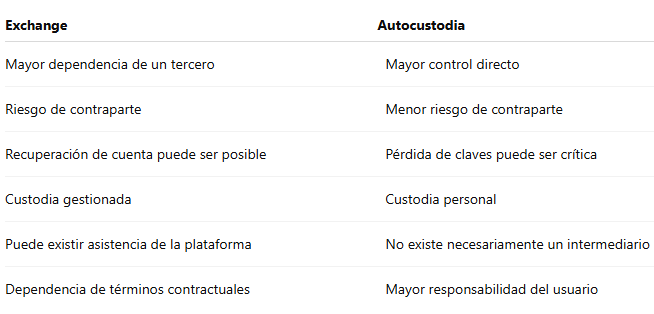
No model eliminates all risks.
It simply distributes the risks differently.
Does Paraguay have regulation on cryptoassets?
Here we need to update a claim that was repeated for years:
“In Paraguay cryptocurrencies are not regulated.”
Put that way, it is too broad today.
Paraguay maintains the BCP's position that Bitcoin and other private cryptocurrencies are not legal tender and have no state guarantee.
But, on the other hand, Law No. 6960/2022 incorporated virtual asset service providers —VASPs— as obligated entities within the Paraguayan anti-money laundering and anti-terrorist financing regime.
In addition, the Securities Superintendency issued a specific warning in 2025 stating that cryptocurrencies are neither registered nor authorized by that Superintendency or by the BCP and that they do not have state backing.
Therefore, the legal reality is more precise:
Paraguay does not treat all cryptocurrencies as legal tender, nor is there a single regime that automatically turns all cryptoassets into regulated securities, but there are rules that cover certain activities related to virtual assets.
And the new Securities Market Law?
An important evolution appears here.
Securities and Products Market Law No. 7572/2025 expanded and modernized the Paraguayan regime.
The law includes within the definition of securities certain investment agreements in collective projects with an expectation of gains and negotiable rights intended to raise funds from the public.
In addition, it expressly contemplates securities issued, recorded, transferred, or stored through distributed ledger technologies (DLT).
This is very important for understanding the future.
Because blockchain does not automatically mean:
“outside regulation”.
If a tokenized structure meets certain legal characteristics, it may fall within the corresponding regulatory perimeter.
Does this automatically protect an exchange user?
No.
And it is very important not to sell a false sense of security.
The existence of regulation over certain activities:
does not mean that every Bitcoin deposited on an exchange has a state guarantee.
The BCP continues to expressly state that private cryptocurrencies do not have state guarantee.
That is why:
regulation ≠ investment guarantee.
They are completely different concepts.
What should a user ask before leaving large amounts on an exchange?
We can make a kind of “legal checklist”.
1. Who exactly is the company?
Not just the trade name.
The legal entity has to be identified.
2. In which country is it incorporated?
This may determine which legislation and courts could intervene.
3. What contract did I accept?
The terms of service may contain fundamental clauses.
4. Who controls the keys?
The platform?
A custodian?
The user?
5. Are the assets segregated?
This can be crucial in the event of insolvency.
6. Can the platform use my assets?
You need to understand exactly what we are authorizing.
7. What happens if the platform goes bankrupt?
The answer should be contractually addressed and will depend on the applicable legislation.
8. What happens with withdrawals?
Are there limits?
Is there freezing?
Are there special conditions?
9. Which entity regulates or supervises the activity?
We must not confuse tax registration, financial license, securities authorization, and anti-money laundering obligations.
They are different things.
The user should think like a lawyer before thinking like a trader
This may be one of the best lessons from this article.
Before asking:
“How much can Bitcoin go up?”
we should also ask:
“What happens if the company holding my assets ceases to exist?”
Because we can be right about Bitcoin and wrong about the counterparty.
A new way to understand crypto risk
The risk is not only in:
Bitcoin.
It may also be in:
the platform,
the custodian,
the contract,
the infrastructure,
security,
the jurisdiction,
liquidity
and
the custody structure.
That is why a mature crypto portfolio should not analyze profitability alone.
It should also analyze who controls the assets and what happens if something goes wrong.
Conclusion
When you see your Bitcoin in an app, you are seeing a balance.
But behind that balance there may be a complex legal, technological, and financial relationship.
The important question is not only:
“How much do I have?”
It is also:
“Where is it custodied, who controls it, and what rights do I have if the platform fails?”
Self-custody is not necessarily better for everyone.
An exchange is not necessarily insecure by definition either.
What matters is understanding what risk you are assuming.
Because in the crypto world there is a huge difference between:
having exposure to Bitcoin
and
having direct control over Bitcoin.
And there is also a difference between:
being a client of a platform
and
having a legal guarantee of asset recovery.
Blockchain technology can allow transfers without intermediaries.
But when we choose to use an intermediary, we re-enter a very familiar area of Law:
contracts, obligations, custody, liability, insolvency, and jurisdiction.
And that is where one of the most important questions in the digital economy begins:
When your money is on a platform, do you really know what right you have over it?
Interesting questions
If an exchange goes bankrupt, do I automatically lose my Bitcoin?
Not necessarily. It will depend on the custody structure, contract, applicable law, and insolvency situation. There is no universal answer.
Does an exchange guarantee my cryptocurrencies?
It should not be assumed. In Paraguay, the BCP states that private cryptocurrencies do not have state guarantee.
Is it safer to hold cryptocurrencies in your own wallet?
Self-custody eliminates part of the counterparty risk, but transfers greater responsibility to the user regarding the keys and security.
If the exchange has reserves, does that mean my funds are guaranteed?
Not necessarily. You need to know exactly what “reserves” means, how they are custodied, whether they are segregated, and what rights the client has.
What happens if the exchange is foreign?
The jurisdiction, the contract, and the laws of the country where the entity operates can be decisive.
Does Paraguay regulate exchanges?
Paraguay has rules that cover certain activities of virtual asset service providers in anti-money laundering matters, but that does not mean that every international exchange is automatically authorized or supervised by the BCP. Law 6960/2022 incorporated VASPs as obligated entities.
Is holding Bitcoin on an exchange the same as holding it in your own wallet?
Not from the point of view of technical control. In an own wallet, the user can directly control the keys; in a custodial service, that control may be in the provider's hands.



#CryptoLaw #CryptoSecurity #SelfCustody #DigitalAssets #CryptoEducation