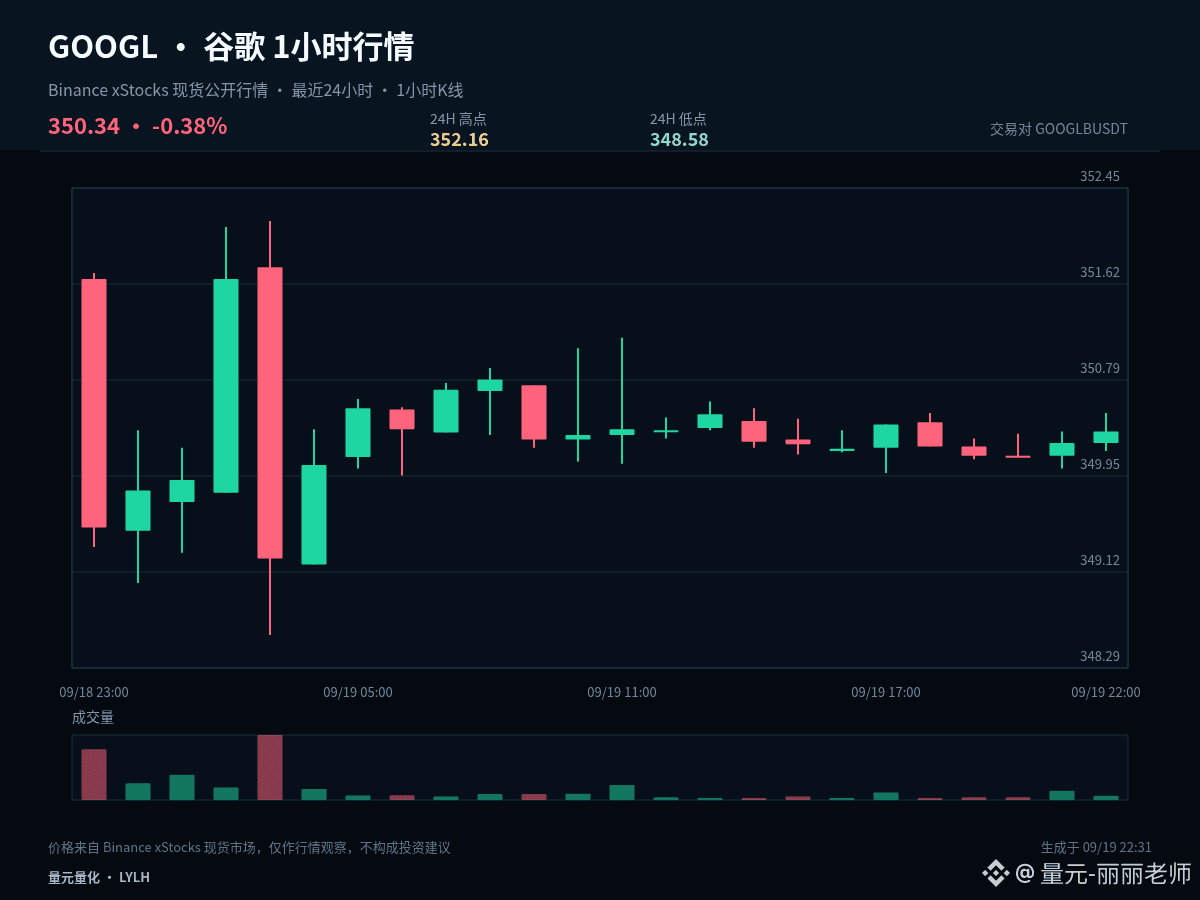
$GOOGLB #GOOGL In the past 24 hours, the low-high amplitude is about 1.0%. Current price: 350.34. This is not a calm range suitable for casual entries. When volatility expands, you should adjust your position first, and only then discuss direction.
$GOOGLB #GOOGL is still rotating within the past 24-hour range, with no clear directional advantage. The middle area is the hardest test of patience; waiting for signals at the boundaries is usually more effective.
Current 1-hour: +0.03%, 24-hour: -0.01%. The two cycles have not formed sufficiently clear alignment in the same direction. In range-bound markets, the tolerance for chasing or killing rallies is lower. It’s better to use confirmation at the upper band for direction and confirmation of support at the lower band. The midline is only used as the strength/weakness divider.
I will take 350.37 as the short-term long/short pivot: if it holds, it means the drawdown is still within a controllable range, and later there may be conditions to test 352.16 again. After a valid breakdown, don’t rush to enter; instead, wait for a new stable structure to appear near 348.58.
The execution principle during high-volatility phases is to reduce single-trade exposure, avoid repeatedly chasing prices back and forth in the middle of the range, and write the invalidation conditions before entering. If price doesn’t provide confirmation, it’s better to do fewer trades than to use a larger position to compensate for uncertainty.
There are three ways the next path can be handled: if price validly holds above 352.16, wait for a pullback that doesn’t break and then reassess continuation; if price breaks down below 348.58, prioritize risk control and wait for new support; if it continues to oscillate around 350.37, treat it as range rotation and don’t repeatedly chase direction in the middle.
The focus of short-term positioning is not predicting every single candlestick. It’s ensuring there’s a basis for entries, trimming, and exits. If there’s no confirmation, trade less; if a key level fails, redo the plan—control single-trade risk first, then talk about potential space afterward.
#SECReceivesAmendedInjectiveETFFiling
$GOOGLB #GOOGL is still rotating within the past 24-hour range, with no clear directional advantage. The middle area is the hardest test of patience; waiting for signals at the boundaries is usually more effective.
Current 1-hour: +0.03%, 24-hour: -0.01%. The two cycles have not formed sufficiently clear alignment in the same direction. In range-bound markets, the tolerance for chasing or killing rallies is lower. It’s better to use confirmation at the upper band for direction and confirmation of support at the lower band. The midline is only used as the strength/weakness divider.
I will take 350.37 as the short-term long/short pivot: if it holds, it means the drawdown is still within a controllable range, and later there may be conditions to test 352.16 again. After a valid breakdown, don’t rush to enter; instead, wait for a new stable structure to appear near 348.58.
The execution principle during high-volatility phases is to reduce single-trade exposure, avoid repeatedly chasing prices back and forth in the middle of the range, and write the invalidation conditions before entering. If price doesn’t provide confirmation, it’s better to do fewer trades than to use a larger position to compensate for uncertainty.
There are three ways the next path can be handled: if price validly holds above 352.16, wait for a pullback that doesn’t break and then reassess continuation; if price breaks down below 348.58, prioritize risk control and wait for new support; if it continues to oscillate around 350.37, treat it as range rotation and don’t repeatedly chase direction in the middle.
The focus of short-term positioning is not predicting every single candlestick. It’s ensuring there’s a basis for entries, trimming, and exits. If there’s no confirmation, trade less; if a key level fails, redo the plan—control single-trade risk first, then talk about potential space afterward.
#SECReceivesAmendedInjectiveETFFiling