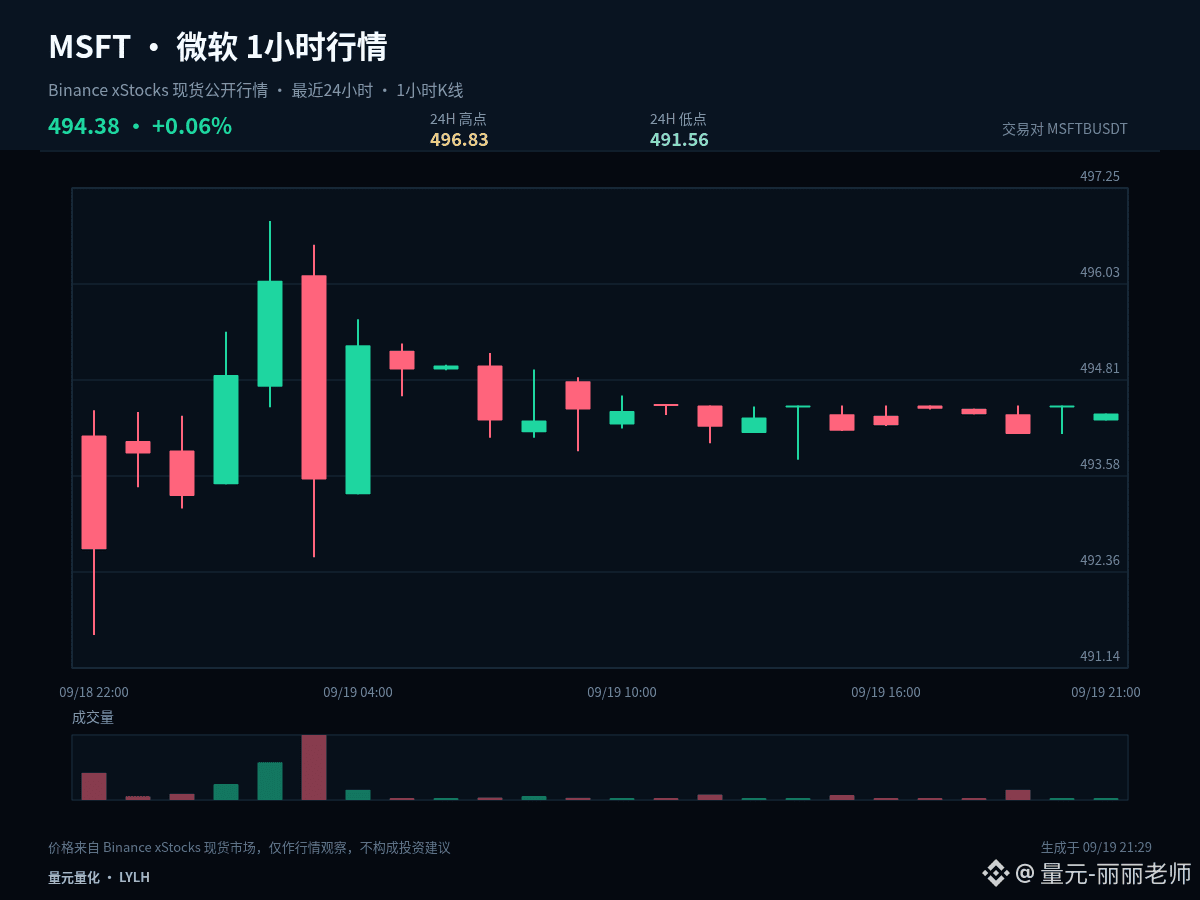
$MSFTB #MSFT Put the intraday conclusion first: if it can’t be reclaimed at 494.195, then you need to keep defending 491.56. Current price: 494.38, 1-hour -0.02%, 24-hour -0.70%.
With the current 1-hour -0.02% and 24-hour -0.70%, the two time frames have not formed a sufficiently clear directional alignment. In a range-bound market, the tolerance for chasing breakouts and reacting to dips is low. It’s more suitable to confirm direction using the upper boundary and confirm support using the lower boundary; the midline is only used to judge strength vs weakness.
For the short term, first watch whether 491.56 can form continuous support, and then whether 494.195 can be reclaimed again. The former determines whether the selloff can slow down; the latter determines whether the rebound can strengthen. Without confirmation on both fronts, it’s not advisable to judge opportunity based on the size of the drop alone.
For execution, set clear conditions: after breaking above 496.83, you need confirmation—not just a momentary spike to chase. After testing 491.56, you need to see whether it can be quickly reclaimed—not just “buy the dip.” If the middle zone doesn’t offer sufficient reward-to-risk, waiting is also part of the strategy.
Existing positions can be handled in stages based on key levels to avoid making all decisions at once. For those without a position, wait for breakout confirmation or a pullback to stabilize. For US stocks/underlyings, also watch for volatility caused by trading session transitions. Your plan should be based on price conditions, not on emotion replacing execution.
Simplifying the conclusion doesn’t mean simplifying risk control. In real execution, you still need to wait for price confirmation, and leave room to exit if the thesis proves wrong. The true disagreement in this行情 is whether it will continue or return to the range. Will you wait for breakout confirmation, or wait for a support pullback? Tell me which price level you’re most focused on.
#HKCompletesFirstHKDStablecoinUseCase
With the current 1-hour -0.02% and 24-hour -0.70%, the two time frames have not formed a sufficiently clear directional alignment. In a range-bound market, the tolerance for chasing breakouts and reacting to dips is low. It’s more suitable to confirm direction using the upper boundary and confirm support using the lower boundary; the midline is only used to judge strength vs weakness.
For the short term, first watch whether 491.56 can form continuous support, and then whether 494.195 can be reclaimed again. The former determines whether the selloff can slow down; the latter determines whether the rebound can strengthen. Without confirmation on both fronts, it’s not advisable to judge opportunity based on the size of the drop alone.
For execution, set clear conditions: after breaking above 496.83, you need confirmation—not just a momentary spike to chase. After testing 491.56, you need to see whether it can be quickly reclaimed—not just “buy the dip.” If the middle zone doesn’t offer sufficient reward-to-risk, waiting is also part of the strategy.
Existing positions can be handled in stages based on key levels to avoid making all decisions at once. For those without a position, wait for breakout confirmation or a pullback to stabilize. For US stocks/underlyings, also watch for volatility caused by trading session transitions. Your plan should be based on price conditions, not on emotion replacing execution.
Simplifying the conclusion doesn’t mean simplifying risk control. In real execution, you still need to wait for price confirmation, and leave room to exit if the thesis proves wrong. The true disagreement in this行情 is whether it will continue or return to the range. Will you wait for breakout confirmation, or wait for a support pullback? Tell me which price level you’re most focused on.
#HKCompletesFirstHKDStablecoinUseCase