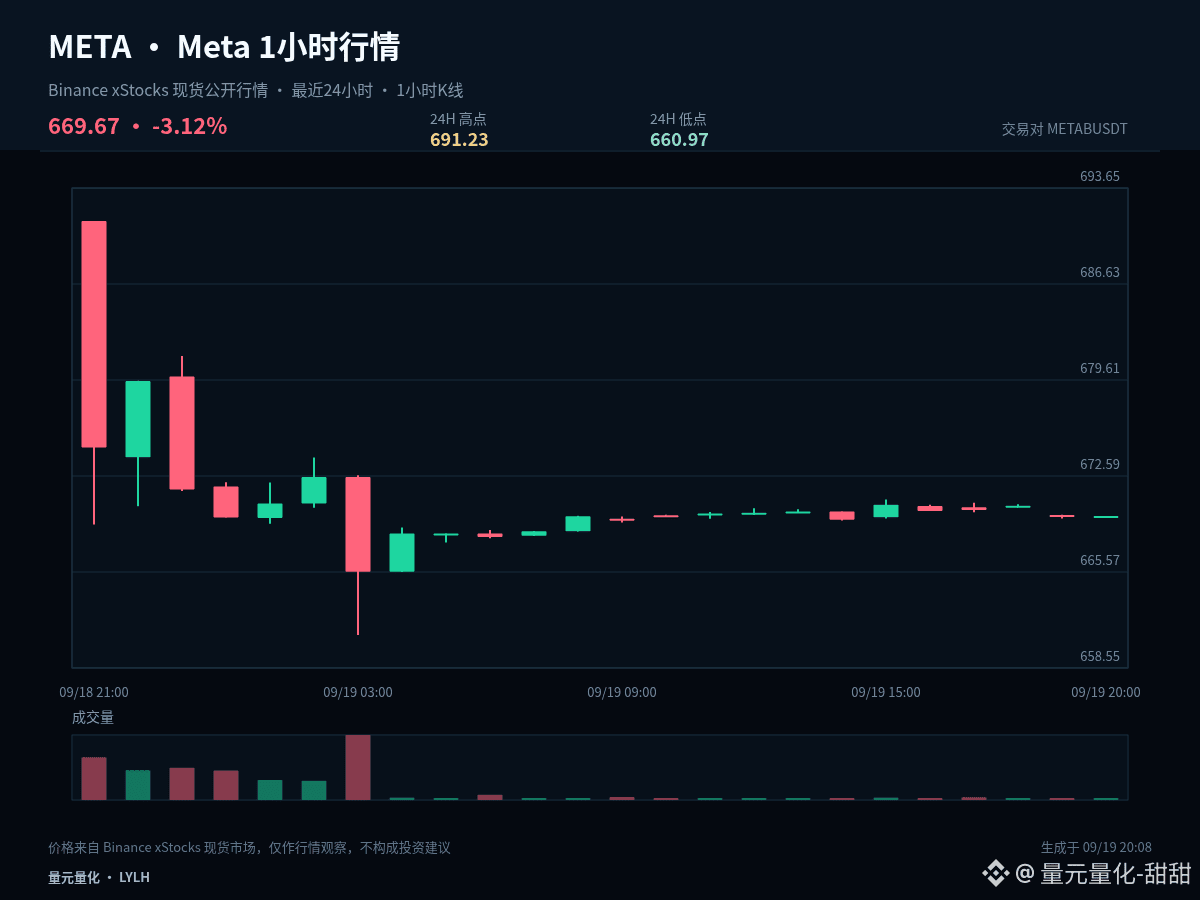
$METAB #META In a strong market, pullbacks often reveal the true underlying support more clearly than an accelerated rally. Current performance: 0.00% in the past 1 hour, -3.31% in the past 24 hours. We need to determine whether this is a normal cooldown or a structural weakening.
Current: 0.00% in the past 1 hour, -3.31% in the past 24 hours. Across these two timeframes, there isn’t sufficiently clear alignment in the same direction. In a range-bound market, the margin for chasing breakouts and then getting stopped is lower; it’s better to confirm direction using the upper boundary and confirm support using the lower boundary. The midline should only be treated as the line between strength and weakness.
The short-term initiative has not been clearly broken. 676.1 is the primary criterion for the quality of the pullback. If it holds, then test 691.23 again—this is more of a bullish consolidation. If it breaks below the midline and keeps staying there, shift your observation focus downward to 660.97.
Set clear execution conditions: after a break above 691.23, you need confirmation—not just a momentary spike before you chase. After testing down to 660.97, you need to see whether price can quickly reclaim the level—not just “buy the dip” blindly. When the middle region doesn’t offer sufficient payoff odds, waiting is also part of the strategy.
For existing positions, handle them in stages based on key levels to avoid making all decisions at once. For those currently in cash, wait for breakout confirmation or a pullback that stabilizes. For US stock instruments, also be mindful of volatility caused by trading session transitions; your plan should be based on price conditions, not emotion replacing execution.
The focus of a short-term position isn’t to predict every single candlestick, but to ensure that entering, trimming, and exiting are all backed by evidence. Do less without confirmation; if key levels fail, redo the plan. Control single-trade risk first—then discuss potential upside or room forward.
#HKCompletesFirstHKDStablecoinUseCase
Current: 0.00% in the past 1 hour, -3.31% in the past 24 hours. Across these two timeframes, there isn’t sufficiently clear alignment in the same direction. In a range-bound market, the margin for chasing breakouts and then getting stopped is lower; it’s better to confirm direction using the upper boundary and confirm support using the lower boundary. The midline should only be treated as the line between strength and weakness.
The short-term initiative has not been clearly broken. 676.1 is the primary criterion for the quality of the pullback. If it holds, then test 691.23 again—this is more of a bullish consolidation. If it breaks below the midline and keeps staying there, shift your observation focus downward to 660.97.
Set clear execution conditions: after a break above 691.23, you need confirmation—not just a momentary spike before you chase. After testing down to 660.97, you need to see whether price can quickly reclaim the level—not just “buy the dip” blindly. When the middle region doesn’t offer sufficient payoff odds, waiting is also part of the strategy.
For existing positions, handle them in stages based on key levels to avoid making all decisions at once. For those currently in cash, wait for breakout confirmation or a pullback that stabilizes. For US stock instruments, also be mindful of volatility caused by trading session transitions; your plan should be based on price conditions, not emotion replacing execution.
The focus of a short-term position isn’t to predict every single candlestick, but to ensure that entering, trimming, and exiting are all backed by evidence. Do less without confirmation; if key levels fail, redo the plan. Control single-trade risk first—then discuss potential upside or room forward.
#HKCompletesFirstHKDStablecoinUseCase