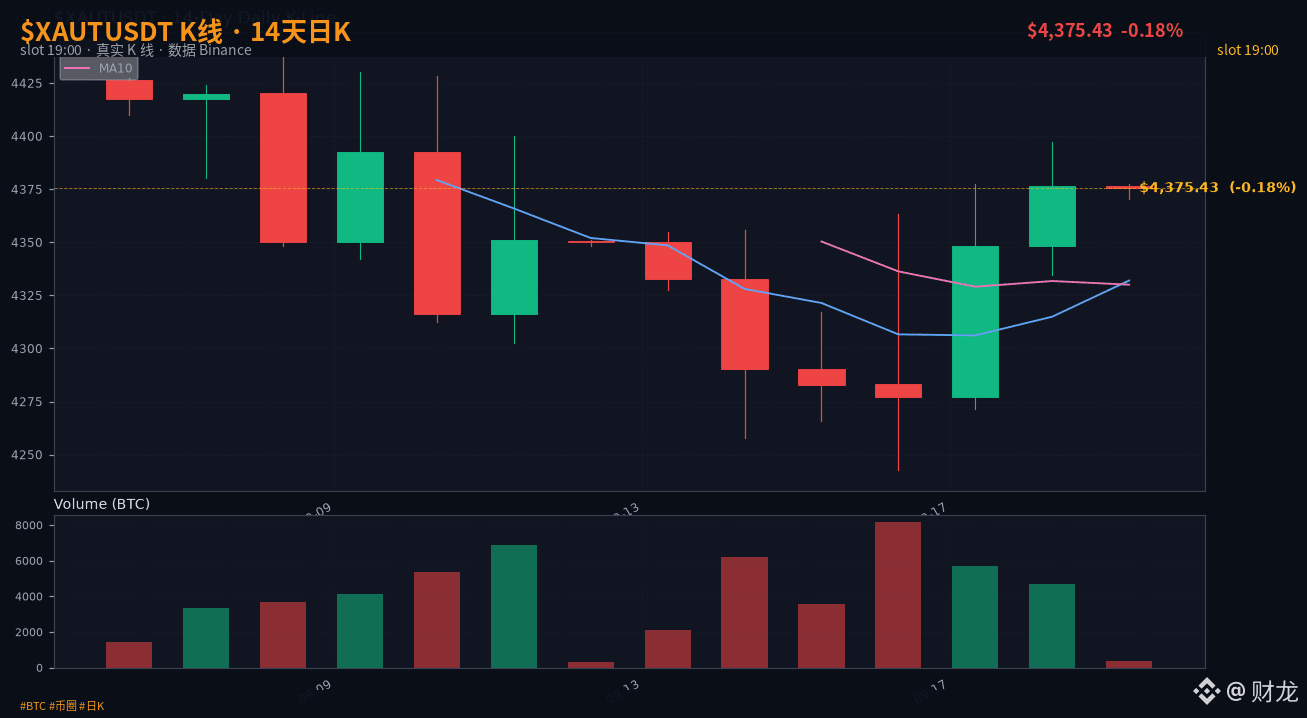

$XAUT At $4,375, it slipped slightly by 0.16% over 24 hours, getting squeezed into a narrow range between $4,347 and $4,394—within less than $50. During the day, it didn’t break either direction. $BTC surged up to $81,230, up 3.72% in 24 hours. F&G 71 sits in the greed zone, and capital has clearly been flowing toward risk assets.
In the macro picture, there are two main lines. First, the US dollar index has been hovering around the 100 mark, back and forth. Second, the 10-year Treasury yield has been stuck near the high end at 4.94%, and real rates haven’t made room for gold, so in theory gold should be under pressure under this kind of textbook allocation. But the market didn’t follow through—central banks’ demand picked up the other side. According to the World Gold Council, global gold ETFs saw net inflows of $18 billion in August. North America and Europe together contributed 90% of the funds, setting a new record for the strongest single month in history. China’s central bank gold reserves stand at 76.73 million ounces, up by 650,000 ounces from the end of July. It has been increasing for 22 consecutive months. In the first eight months, the pace of month-by-month additions rose from 400,000 ounces up to 650,000 ounces—its marginal acceleration is clearly visible.
The logic is straightforward: Western capital is rotating back into ETFs, while central banks’ long-term buying continues to add—these two lines keep gold propped up above $4,350. But with real yields staying high and BTC rallying, any demand for safe-haven assets gets diverted again, capping upside. Only if gold breaks above $4,400 is there room to talk about $4,500. If it falls back below $4,340, it likely returns to the $4,300 area to grind out a base. In September, this range will most likely be churning until the Fed’s next statement.
#黄金险守4350美元关口 #央行连续22个月增持 #Gold
In the macro picture, there are two main lines. First, the US dollar index has been hovering around the 100 mark, back and forth. Second, the 10-year Treasury yield has been stuck near the high end at 4.94%, and real rates haven’t made room for gold, so in theory gold should be under pressure under this kind of textbook allocation. But the market didn’t follow through—central banks’ demand picked up the other side. According to the World Gold Council, global gold ETFs saw net inflows of $18 billion in August. North America and Europe together contributed 90% of the funds, setting a new record for the strongest single month in history. China’s central bank gold reserves stand at 76.73 million ounces, up by 650,000 ounces from the end of July. It has been increasing for 22 consecutive months. In the first eight months, the pace of month-by-month additions rose from 400,000 ounces up to 650,000 ounces—its marginal acceleration is clearly visible.
The logic is straightforward: Western capital is rotating back into ETFs, while central banks’ long-term buying continues to add—these two lines keep gold propped up above $4,350. But with real yields staying high and BTC rallying, any demand for safe-haven assets gets diverted again, capping upside. Only if gold breaks above $4,400 is there room to talk about $4,500. If it falls back below $4,340, it likely returns to the $4,300 area to grind out a base. In September, this range will most likely be churning until the Fed’s next statement.
#黄金险守4350美元关口 #央行连续22个月增持 #Gold