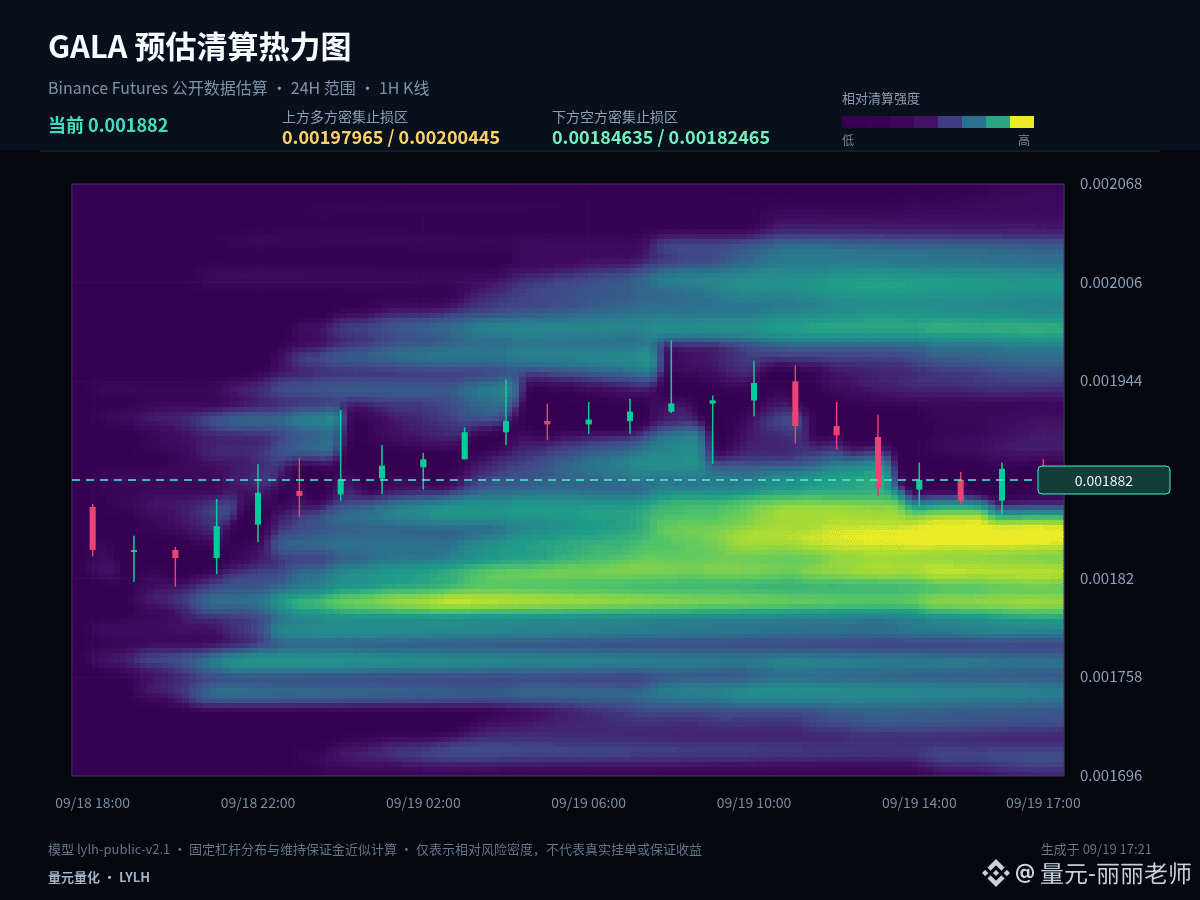
$GALA #GALA Still repeatedly changing hands within the past 24-hour range; directional advantage is not obvious. The mid-range position is the toughest test of patience—waiting for boundary signals is usually more effective.
Current 1 hour: -0.42%, 24 hours: +3.52%. The two timeframes have not formed enough clear, same-direction coordination. In a range-bound market, the tolerance for chasing and selling is low. It’s more suitable to use upper-bound confirmation for direction and lower-bound confirmation for absorption. The midline should be used only as the line separating strength from weakness.
Key levels: 0.0018915 is the midline that weak trend repair must reclaim. If price cannot stand back above it, any rebound should be viewed as a technical repair. Below, 0.001814 still has the possibility of being tested again; only after reclaiming the midline do you have the right to further observe 0.001969.
For execution, set clear conditions: after breaking above 0.001969, you need confirmation—not just chasing a momentary spike. After dipping to 0.001814, you need to see whether it can quickly recover—not simply buying because it’s falling. When the mid-range does not offer sufficient reward-to-risk, waiting itself is part of the strategy.
For those with existing positions, focus on managing based on whether support has failed, rather than being carried along by every fluctuation. For those with no positions, prioritize waiting for a breakout + retest or support confirmation. For spot, you can scale in batches; for futures, shorten the decision chain—first determine the stop-loss level, then decide whether to participate.
Your trading plan must include invalidation conditions. If your judgment is correct, you can take profit in stages; if it’s wrong, you must be allowed to exit. Don’t use adding positions to cover the fact that the original logic has changed. The market will update, and your view should adjust in line with price evidence.
#PolygonToDeployContractBurning100MPOL
Current 1 hour: -0.42%, 24 hours: +3.52%. The two timeframes have not formed enough clear, same-direction coordination. In a range-bound market, the tolerance for chasing and selling is low. It’s more suitable to use upper-bound confirmation for direction and lower-bound confirmation for absorption. The midline should be used only as the line separating strength from weakness.
Key levels: 0.0018915 is the midline that weak trend repair must reclaim. If price cannot stand back above it, any rebound should be viewed as a technical repair. Below, 0.001814 still has the possibility of being tested again; only after reclaiming the midline do you have the right to further observe 0.001969.
For execution, set clear conditions: after breaking above 0.001969, you need confirmation—not just chasing a momentary spike. After dipping to 0.001814, you need to see whether it can quickly recover—not simply buying because it’s falling. When the mid-range does not offer sufficient reward-to-risk, waiting itself is part of the strategy.
For those with existing positions, focus on managing based on whether support has failed, rather than being carried along by every fluctuation. For those with no positions, prioritize waiting for a breakout + retest or support confirmation. For spot, you can scale in batches; for futures, shorten the decision chain—first determine the stop-loss level, then decide whether to participate.
Your trading plan must include invalidation conditions. If your judgment is correct, you can take profit in stages; if it’s wrong, you must be allowed to exit. Don’t use adding positions to cover the fact that the original logic has changed. The market will update, and your view should adjust in line with price evidence.
#PolygonToDeployContractBurning100MPOL