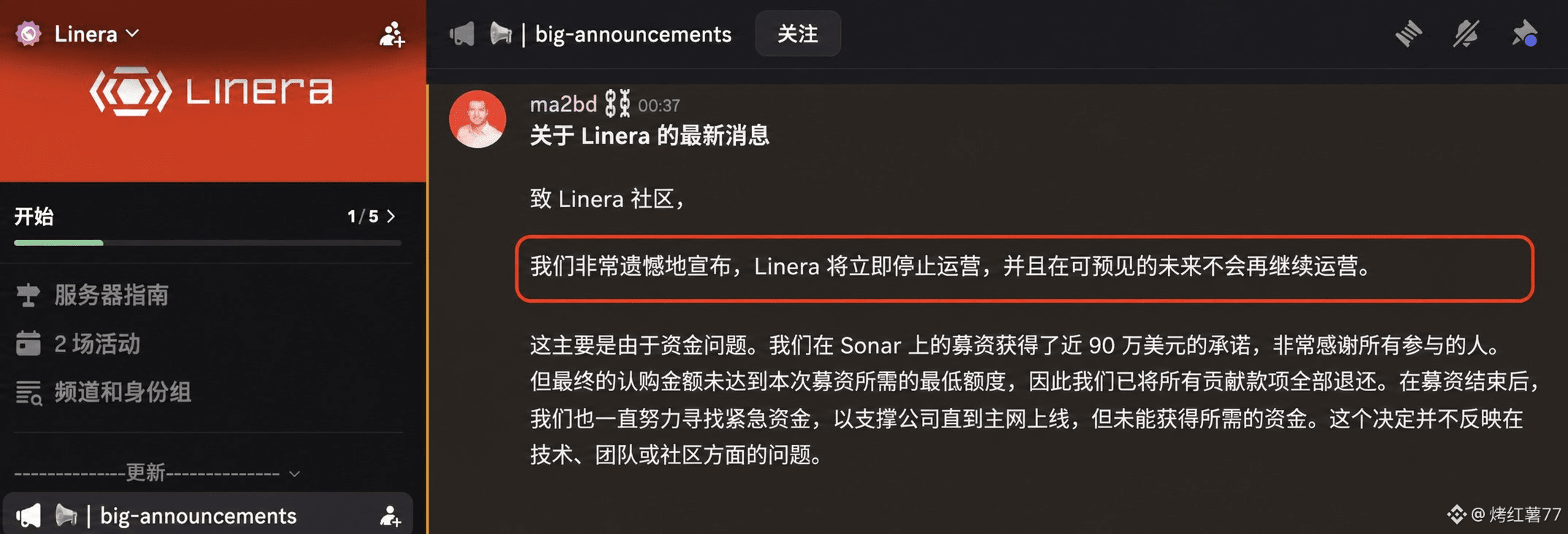
Linera is really gone! a16z led the round, raised and then merged $12 million, but in the end it died on a public offering of just $1.5 million. Only 617 people came, putting together 848,000 U—about 1,375 U per person, not even reaching 57% of the minimum threshold. After the public sale failed and full refunds were issued, the team went back to look for “life-saving money” to “carry it through until the mainnet launch,” but nobody picked it up. The cash runway ran out completely, and they shut down operations directly.
Their pedigree really isn’t bad: the founders came from Meta/Novi. In 2022, a16z led a $6 million investment; in 2023, Borderless led another $6 million—and a16z co-invested as well. They spent four years building a microchain; no mainnet launched, so they pivoted to Linera Markets, trying to frame it as the next Hyperliquid—an application-specific chain, their own products, and earning money through real fees. But Hyperliquid had the product running first, and money flowed in after; Linera told the story first, then relied on the community to keep it alive through repeated rounds.
For an L1 that’s already raised from a16z and worked on it for four years, $1.5 million should be pocket change. Yet the market wasn’t even willing to top up the remaining $650,000. In the last cycle, what mattered was elite schools, Meta background, top-tier VCs, and a sexy architecture. In this cycle, everyone only asks: mainnet—did it launch? users—do they exist? revenue—what’s the income? Why should it take over the story on behalf of old investors at a $160 million FDV? The next Hyperliquid isn’t something written on a PPT; it’s what users trade in real gold and silver.
Now just post a CA and within ten minutes you can raise tens of millions; yet an L1 that a16z backed and that took four years to forge—couldn’t raise $1.5 million U. This is what the real market looks like.
Their pedigree really isn’t bad: the founders came from Meta/Novi. In 2022, a16z led a $6 million investment; in 2023, Borderless led another $6 million—and a16z co-invested as well. They spent four years building a microchain; no mainnet launched, so they pivoted to Linera Markets, trying to frame it as the next Hyperliquid—an application-specific chain, their own products, and earning money through real fees. But Hyperliquid had the product running first, and money flowed in after; Linera told the story first, then relied on the community to keep it alive through repeated rounds.
For an L1 that’s already raised from a16z and worked on it for four years, $1.5 million should be pocket change. Yet the market wasn’t even willing to top up the remaining $650,000. In the last cycle, what mattered was elite schools, Meta background, top-tier VCs, and a sexy architecture. In this cycle, everyone only asks: mainnet—did it launch? users—do they exist? revenue—what’s the income? Why should it take over the story on behalf of old investors at a $160 million FDV? The next Hyperliquid isn’t something written on a PPT; it’s what users trade in real gold and silver.
Now just post a CA and within ten minutes you can raise tens of millions; yet an L1 that a16z backed and that took four years to forge—couldn’t raise $1.5 million U. This is what the real market looks like.