

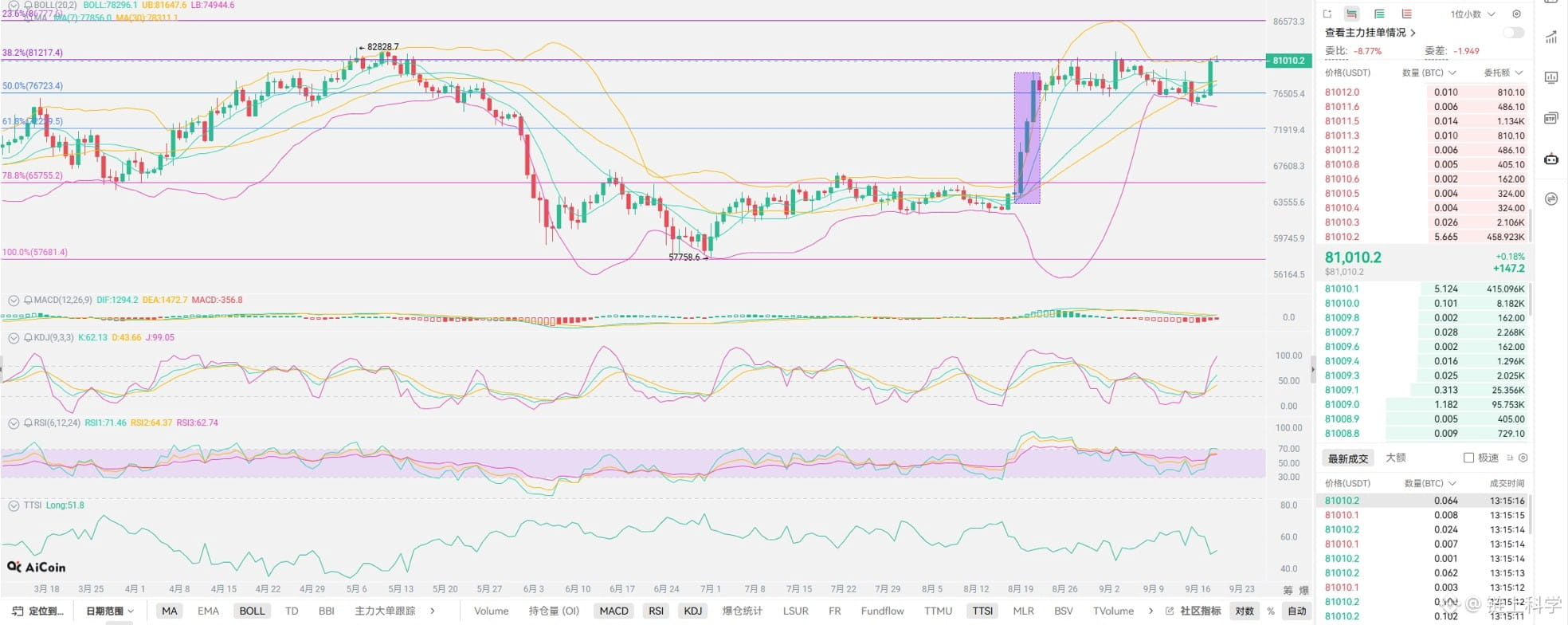

Bitcoin followed the move in the evening, leaving everyone uneasy. The high has already touched 81,732, and there are signs of a breakout to a new high—only about 500 points remain. Many friends want to know the reason. In China, some things genuinely can’t be discussed—for example, on September 23, it was still a case of speculation driven by expectations. There has been no activity domestically, but overseas has been stirred up like crazy. Lao Cui also hasn’t explained this point. With exchanges that are merely formal in nature, and given the premise that there is no movement at home, we can anticipate the end result. This isn’t something that can be resolved by just one or two meetings. But since expectations are being traded and hyped, most users’ thinking will follow the capital, and they hold unrealistic fantasies about the future—always wondering, “Could this time be different? Can they reconcile on memory and graphics cards? Will communication on the energy front be effective? Can both sides put aside their grievances?” Everyone, this is not a simple economic and financial confrontation. This kind of confrontation will continue for a long time—long enough that you’ll all forget we’re still resisting.
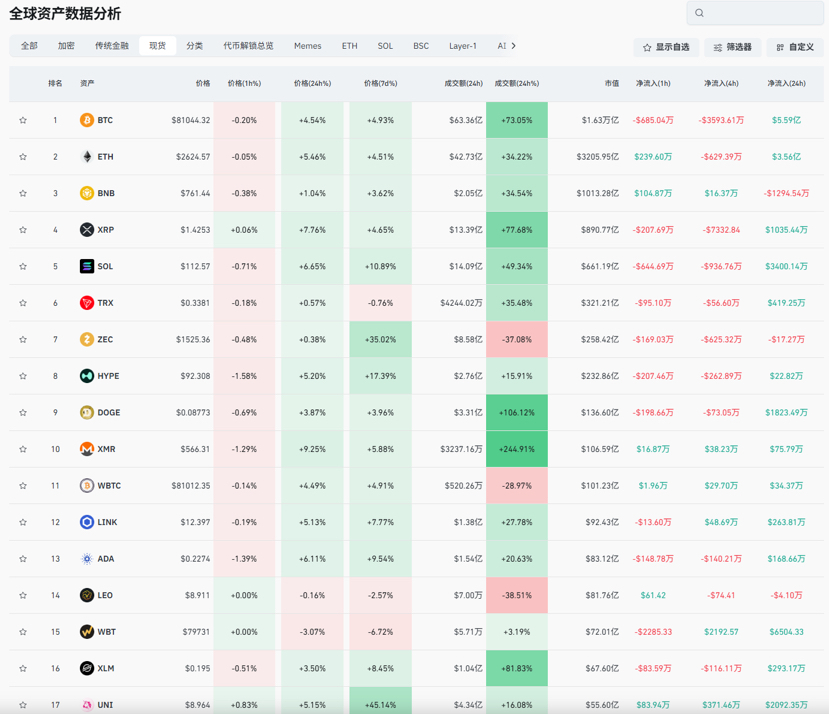
We can’t keep talking in circles. For those with core needs, you can look at Lao Cui’s朋友圈 (friends feed), not his articles. Going back to the crypto market: this time the rally with the broader trend is more influenced by the technology angle, and also by the reasons mentioned above—along with the U.S. reserve/stockpile bill and short-term military impacts. Right now, only these four factors can affect the short-term trend; everyone else can ignore the rest of the message/news flow. Here’s an extremely important issue: after seeing Lao Cui’s view on the crypto space, many friends try to apply the U.S. semiconductor and AI playbook. That’s a completely wrong way of thinking. You should be clear about who your counterparty is if you dare to short semiconductors and AI. Lao Cui is still thinking about what position he can buy more at, and yet you actually have the courage to take on the giants in these fields—admirable. Like yesterday, in Lao Cui’s朋友圈 thinking, the meeting did not release next year’s dot plot. Based on the vote counts, there are major hidden risks—especially since 16 people agreed to raise rates, but no factors about next year’s plan were disclosed. It’s extremely delicate; that is most likely a significant bearish signal that they don’t dare to release at this stage. On the side note: it also serves as a way to buy time for the technology sector—just see whether there is a breakthrough within the next six months.
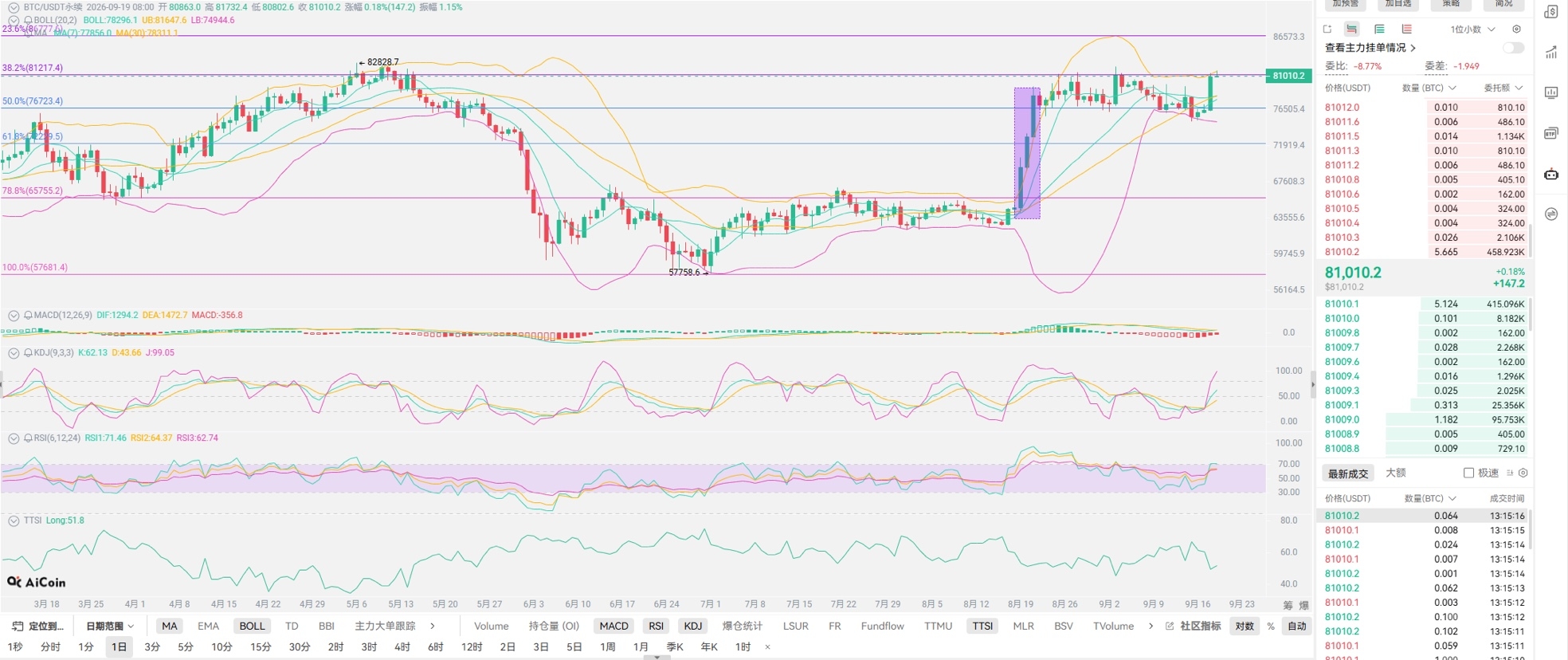
Determine the long-term outlook and the level of the mid-term trend from the message/news flow, but to actually enter the market you need to rely on technical analysis; Lao Cui rarely mentions technical analysis because he thinks it’s a basic piece of knowledge. The strategies he gives are usually based on specific levels derived from technical analysis, not just from the message/news flow. From the daily timeframe, the two candles can be said to support the future direction. The direction of the Bollinger Bands’ opening is clearly bullish; the strong overbought signals from the KDJ and RSI indicate that the short-term trend is under heavy pressure. Interpreted literally, this looks like a pullback after a breakout, and most likely the prior high at 82800 will break through. A message/news catalyst that can change the trend is what signals get released during the meeting—once a bearish message is released, the market will drift lower; that’s the expectation, but it’s not aligned with reality. So the primary resistance level is the earlier high. As for the SOL entry point, Lao Cui has released 30% of the position. His expectation is to make the decision for the next add based on the next round of rate hikes and the appearance of the dot plot; the psychological estimate of timing he discussed with some friends yesterday was to re-enter sometime between late October and early January. As for the price itself, Lao Cui has no psychological price target—only an estimate based on the timeline. Regarding contracts, Lao Cui will still choose to lead with shorts: after pushing up, he will do some short trades in the short term, targeting short-term profits of 500–1000 points.