
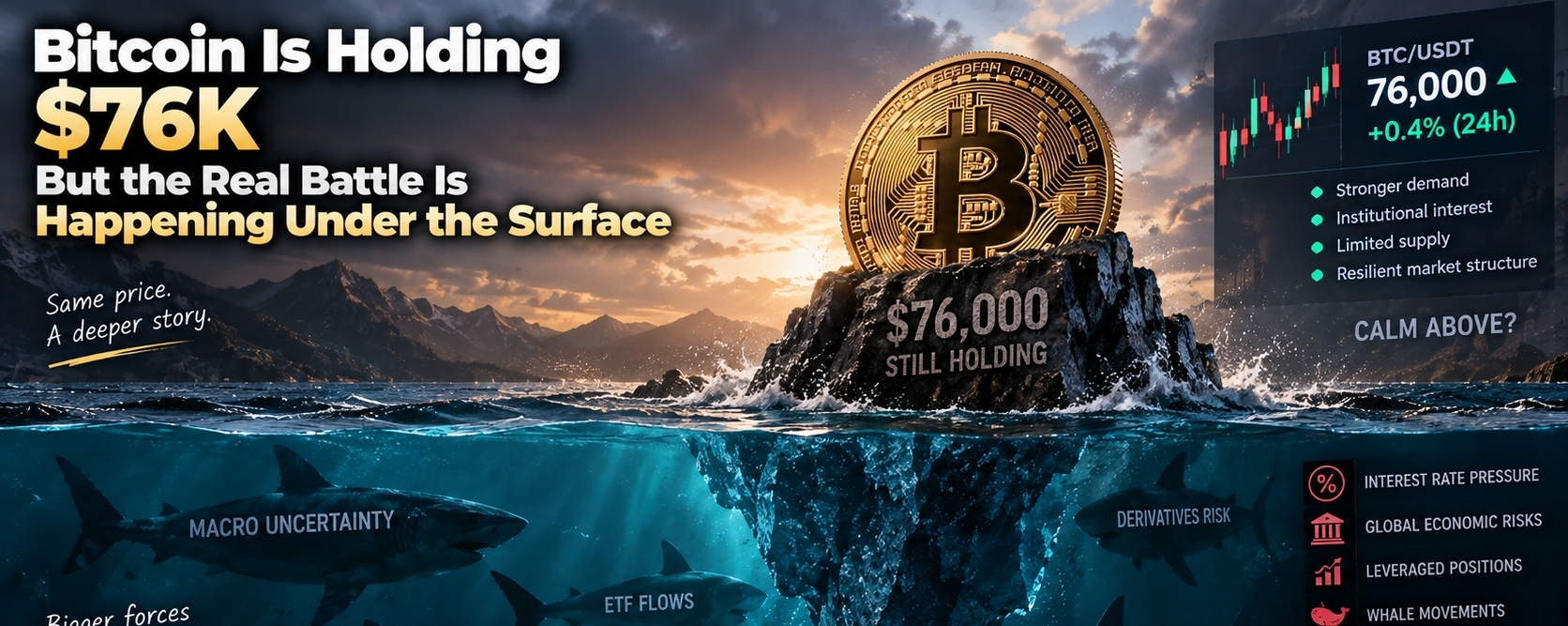


Look at Bitcoin's price and the market almost seems calm.
BTC was trading around $76,000 on September 17, barely moving after the Federal Reserve delivered its first interest-rate hike since 2023.
But underneath that calm price, the market is anything but quiet.
ETF money has been moving out. Leveraged traders are getting liquidated. Treasury yields are reacting to tighter monetary policy. Altcoins are beginning to show selective strength.
Bitcoin may look stable on the surface.
The real battle is happening underneath it.
$76K Is Hiding a Much Bigger Fight
Bitcoin's small daily move doesn't mean buyers and sellers have disappeared.
It means neither side has taken complete control.
BTC gained less than 1% following the Fed decision, while other parts of the crypto market moved much more aggressively. ZEC surged around 23%, SOL gained nearly 3%, and BNB and HYPE advanced more than 2%.
That difference matters.
Bitcoin is currently acting more like the market's anchor while traders search elsewhere for bigger moves.
The longer BTC remains relatively stable, the more attention can shift toward individual altcoins and narratives.
ETF Flows Are Sending a Warning
One of the most important battles is happening away from the chart.
U.S. spot Bitcoin ETFs recorded about $450 million in net outflows on September 15, their largest daily withdrawal since June 25. BlackRock's IBIT accounted for roughly $162 million of those outflows.
That doesn't automatically mean institutional investors are abandoning Bitcoin.
ETF flows can change quickly from one session to another.
But when BTC is holding relatively steady while hundreds of millions of dollars leave ETFs, it raises an interesting question:
Who is absorbing the selling?
If Bitcoin can continue holding despite periods of institutional outflows, that would suggest demand is coming from other parts of the market.
If those buyers disappear while ETF outflows continue, the picture could change quickly.
Leverage Is Building Another Battlefield
Then there is the derivatives market.
Around $345 million in crypto positions were liquidated over 24 hours during the post-Fed move, affecting more than 86,000 traders. Shorts accounted for about $208 million of those liquidations, compared with roughly $137 million for longs.
Bitcoin alone accounted for around $85 million.
This shows why a quiet BTC chart can be misleading.
Price doesn't need to move 10% for traders underneath the market to experience serious volatility.
When leverage becomes crowded, relatively small price movements can trigger forced position closures.
Those liquidations can then accelerate the move.
So one thing worth watching isn't simply whether Bitcoin goes up or down.
It's whether leverage keeps rebuilding around the current range.
The Fed Decision Was Only the Beginning
The market also has a macro problem to solve.
The Fed raised its benchmark rate by 25 basis points to 3.75%–4.00%. Sixteen of 18 policymakers indicated at least one additional increase could come before the end of 2026.
Bitcoin handled the first hike surprisingly well.
But this hike was largely anticipated.
The harder test comes if expectations change.
Another hot inflation reading could increase expectations for tighter policy. Treasury yields could rise again. The dollar could strengthen.
And suddenly the macro environment facing Bitcoin would look very different.
Watch Yields, Not Just Bitcoin
The bond market is becoming increasingly important for crypto.
Immediately after the Fed decision, short-term Treasury yields moved higher as markets processed the central bank's more hawkish stance. By September 17, some yields had begun easing again, while the dollar also pulled back from its initial jump.
Why should crypto traders care?
Because higher yields create competition for capital.
When investors can earn attractive returns from government debt, speculative assets have to work harder to attract money.
Bitcoin holding $76,000 while yields remain elevated is therefore notable.
But if yields make another aggressive move higher, Bitcoin could face another test.
Meanwhile, Altcoins Are Fighting a Different Battle
This is perhaps the most interesting development.
Bitcoin is stable, but capital isn't sitting still.
ZEC's roughly 23% surge dramatically outperformed BTC. SOL, BNB, HYPE, ETH, XRP and DOGE also gained following the Fed decision.
This doesn't confirm a broad altseason.
Instead, it suggests selective rotation.
Traders appear willing to move toward assets with momentum, strong narratives or fresh catalysts even while Bitcoin remains the dominant force in the market.
That creates a very different environment from one where BTC controls every move.
Bitcoin doesn't necessarily have to rally aggressively for altcoins to perform.
Sometimes it simply needs to stop moving.
The $75K Area Is Becoming Important
Bitcoin also briefly slipped below $75,000 earlier this week following the Senate setback for the CLARITY Act before recovering toward $76,000.
That recovery makes the area interesting from a market-structure perspective.
But traders shouldn't treat one price as a magical line.
What matters is how BTC behaves around the broader region.
Do buyers continue stepping in after weakness?
Does selling volume increase?
Does price repeatedly recover after dipping lower?
Or does support eventually stop producing meaningful demand?
The answers can reveal more than simply drawing another horizontal line on the chart.
Bitcoin's Calm Could Be Temporary
This is what makes the current market fascinating.
On the surface, almost nothing is happening.
Bitcoin is sitting around $76,000.
Underneath it, ETF flows are changing, leveraged positions are being cleared, Treasury markets are adjusting to the Fed, and capital is rotating toward selected altcoins.
That tension won't necessarily remain balanced forever.
Eventually, either buyers or sellers could gain control.
Until then, BTC's relatively quiet price shouldn't be mistaken for a quiet market.
Bitcoin is holding around $76K.
But beneath that number, money, leverage and attention are already moving and that battle may decide where the market goes next.