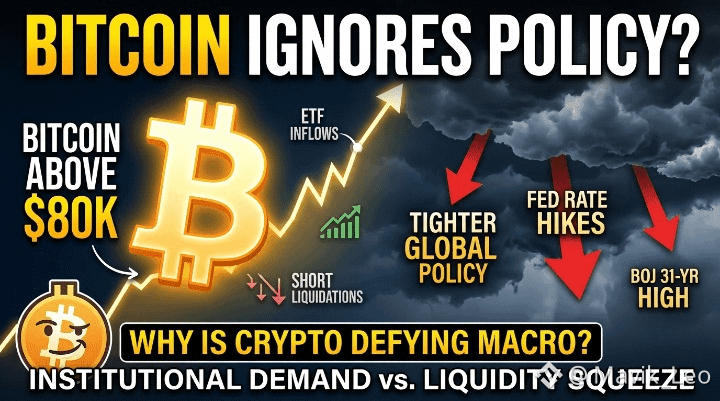
Bitcoin Is Above $80K — But Why Is Crypto Ignoring Tighter Global Policy?
Bitcoin being above $80K is interesting because the global macro backdrop isn't exactly easy for risk assets.
Several major central banks are becoming more cautious on inflation, while higher interest rates can reduce liquidity and make safer assets more attractive. Normally, that should create pressure on Bitcoin and other speculative assets.
So why is BTC holding up?
First, Bitcoin now has stronger institutional access. Spot Bitcoin ETFs have made it easier for traditional investors to gain exposure without directly managing coins. Continued ETF demand can provide buying pressure even when macro conditions are challenging.
Second, markets trade expectations. Investors don't only react to today's interest-rate decision. They also price what they expect central banks to do next. If tighter policy is already priced in, Bitcoin can move higher despite the headline.
Third, positioning matters. After Bitcoin recovered from the mid-$70K area, short liquidations and renewed momentum may have helped push price above $80K.
But I wouldn't assume tighter policy doesn't matter.
Higher yields can pull capital away from risky assets, while persistent inflation could keep central banks restrictive for longer. If global liquidity continues falling, crypto could eventually feel the pressure.
I've also noticed that Bitcoin's short-term relationship with traditional markets can change. Sometimes BTC follows Nasdaq and liquidity closely; at other times, crypto-specific demand becomes the stronger driver.
My view: $80K is less important than whether Bitcoin can hold above it while ETF demand remains healthy and global liquidity stays tight.
If those conditions remain supportive, Bitcoin may continue showing relative strength. If liquidity deteriorates sharply, the current strength could be tested.
Do you think Bitcoin is becoming less sensitive to central-bank policy, or is the impact of tighter liquidity simply delayed?
#Bitcoin❗ #BTC $G $AR $STRK
Bitcoin being above $80K is interesting because the global macro backdrop isn't exactly easy for risk assets.
Several major central banks are becoming more cautious on inflation, while higher interest rates can reduce liquidity and make safer assets more attractive. Normally, that should create pressure on Bitcoin and other speculative assets.
So why is BTC holding up?
First, Bitcoin now has stronger institutional access. Spot Bitcoin ETFs have made it easier for traditional investors to gain exposure without directly managing coins. Continued ETF demand can provide buying pressure even when macro conditions are challenging.
Second, markets trade expectations. Investors don't only react to today's interest-rate decision. They also price what they expect central banks to do next. If tighter policy is already priced in, Bitcoin can move higher despite the headline.
Third, positioning matters. After Bitcoin recovered from the mid-$70K area, short liquidations and renewed momentum may have helped push price above $80K.
But I wouldn't assume tighter policy doesn't matter.
Higher yields can pull capital away from risky assets, while persistent inflation could keep central banks restrictive for longer. If global liquidity continues falling, crypto could eventually feel the pressure.
I've also noticed that Bitcoin's short-term relationship with traditional markets can change. Sometimes BTC follows Nasdaq and liquidity closely; at other times, crypto-specific demand becomes the stronger driver.
My view: $80K is less important than whether Bitcoin can hold above it while ETF demand remains healthy and global liquidity stays tight.
If those conditions remain supportive, Bitcoin may continue showing relative strength. If liquidity deteriorates sharply, the current strength could be tested.
Do you think Bitcoin is becoming less sensitive to central-bank policy, or is the impact of tighter liquidity simply delayed?
#Bitcoin❗ #BTC $G $AR $STRK