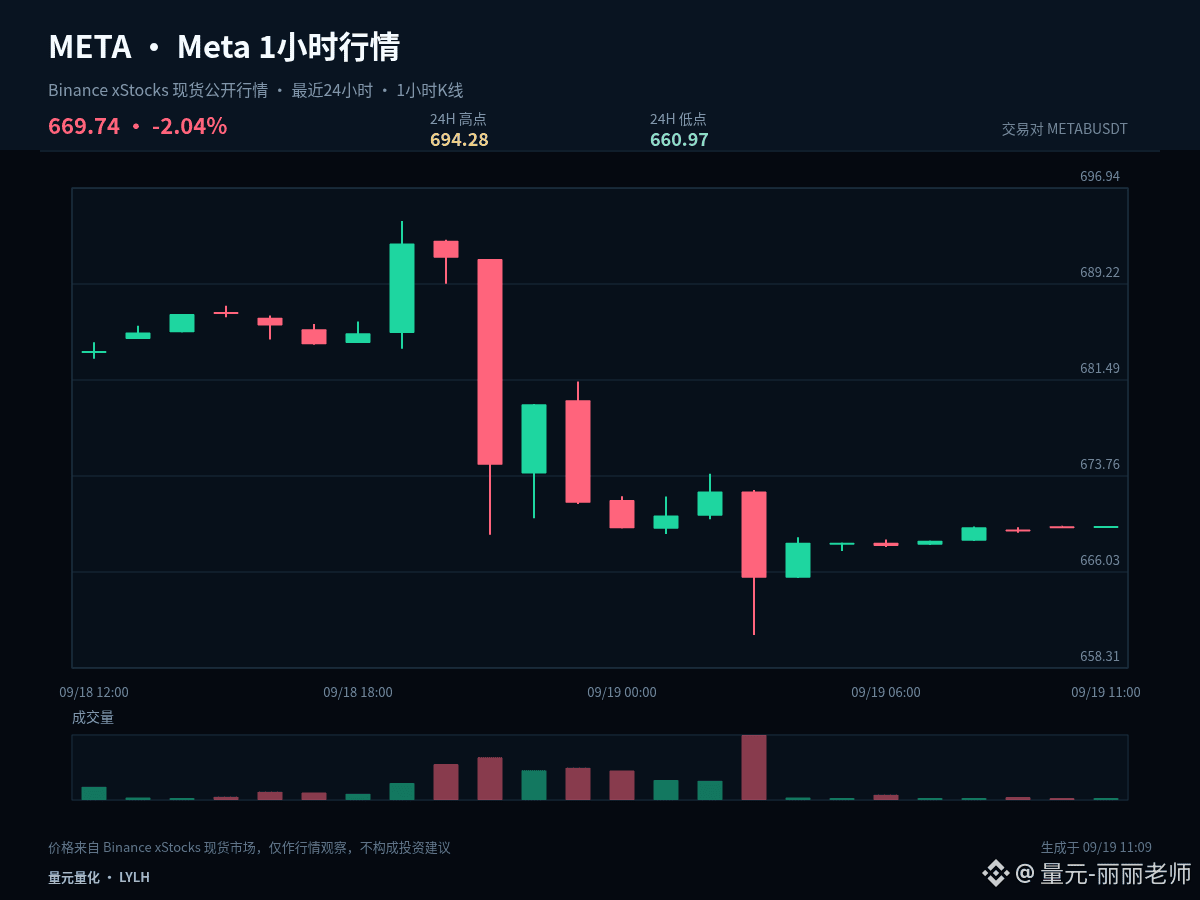
$METAB #META At present, it’s more suitable to confirm a bounce first rather than define a reversal in advance. Current price: 669.74, 1 hour +0.01%, 24 hours -2.05%. Whether the two cycles align again in the same direction is the key focus for what comes next.
Currently, 1 hour is +0.01% and 24 hours is -2.05%, and the two cycles have not formed a sufficiently clear same-direction coordination. In a range-bound market, the tolerance for chasing and killing positions is low. It’s more appropriate to use the upper boundary to confirm direction and the lower boundary to confirm holding/continuation, while the midline only serves as the line dividing strength and weakness.
If the bounce can reclaim 677.625 and then further holds above 694.28, it would indicate that buyer demand is starting to change the prior weakness. But if after pushing up toward the midline it falls back again—especially if it drops again toward 660.97—then it looks more like a failed repair, and you should not continue using the bullish strengthening expectation.
Even if the bounce fails, you still need evidence. Don’t jump straight into shorting just because there was one spike that reversed. A more reasonable sequence is to observe whether the resistance level is rejected, whether the lows shift downward again, and then decide your action based on whether the subsequent rebound recovers key levels.
If you already have positions, handle them in segments based on key levels to avoid making all decisions at once. Those with no positions should wait for breakout confirmation or for a pullback to stabilize. Also be mindful of volatility caused by trading session transitions in U.S. equities. Your plan should be based on price conditions, and emotions should not replace execution.
For short-term positions, the focus isn’t to predict every candlestick. Instead, make sure entries, trimming, and exits all have a basis. Do less without confirmation; if key levels fail, redo the plan. Control single-trade risk first, then talk about further potential space.
#SanDiskToJoinSP100OnSep21
Currently, 1 hour is +0.01% and 24 hours is -2.05%, and the two cycles have not formed a sufficiently clear same-direction coordination. In a range-bound market, the tolerance for chasing and killing positions is low. It’s more appropriate to use the upper boundary to confirm direction and the lower boundary to confirm holding/continuation, while the midline only serves as the line dividing strength and weakness.
If the bounce can reclaim 677.625 and then further holds above 694.28, it would indicate that buyer demand is starting to change the prior weakness. But if after pushing up toward the midline it falls back again—especially if it drops again toward 660.97—then it looks more like a failed repair, and you should not continue using the bullish strengthening expectation.
Even if the bounce fails, you still need evidence. Don’t jump straight into shorting just because there was one spike that reversed. A more reasonable sequence is to observe whether the resistance level is rejected, whether the lows shift downward again, and then decide your action based on whether the subsequent rebound recovers key levels.
If you already have positions, handle them in segments based on key levels to avoid making all decisions at once. Those with no positions should wait for breakout confirmation or for a pullback to stabilize. Also be mindful of volatility caused by trading session transitions in U.S. equities. Your plan should be based on price conditions, and emotions should not replace execution.
For short-term positions, the focus isn’t to predict every candlestick. Instead, make sure entries, trimming, and exits all have a basis. Do less without confirmation; if key levels fail, redo the plan. Control single-trade risk first, then talk about further potential space.
#SanDiskToJoinSP100OnSep21