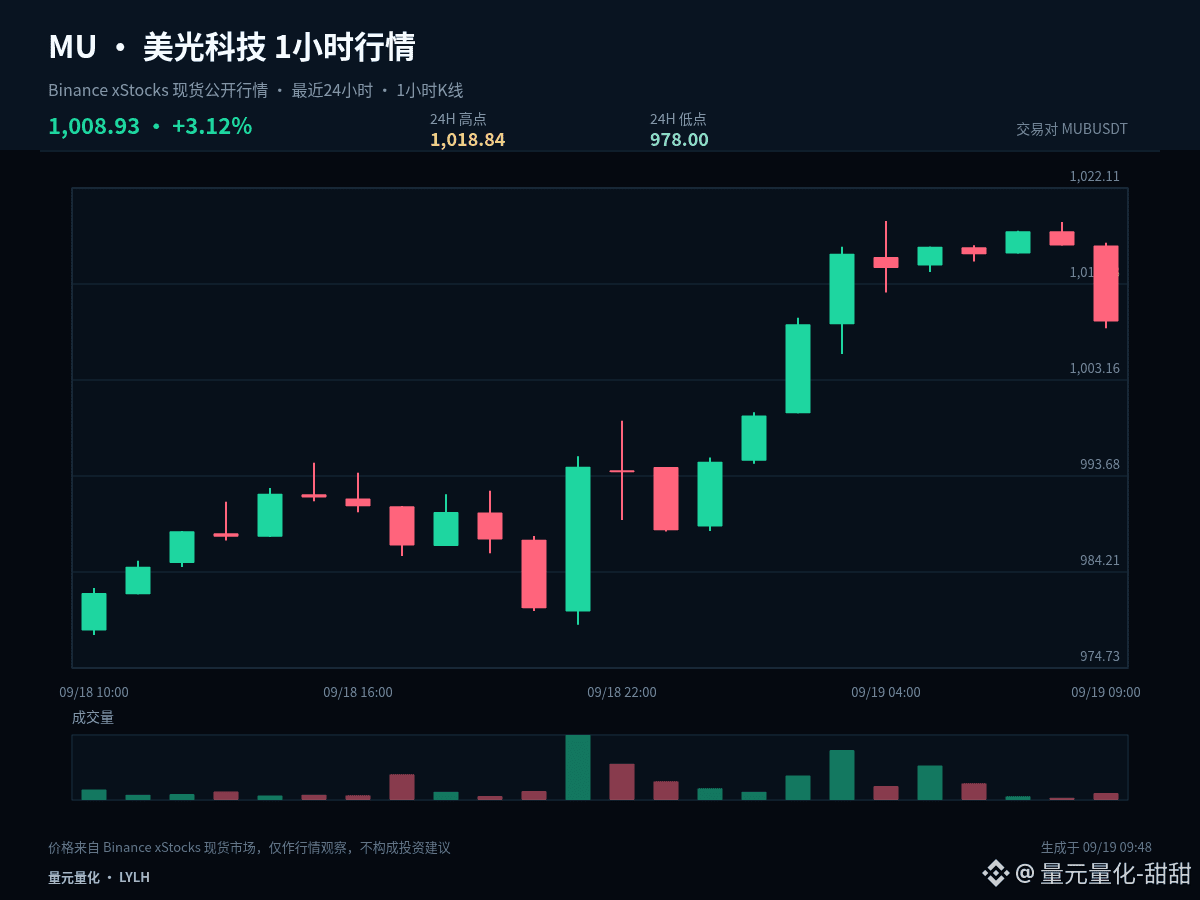
$MUB #MU Current price 1,008.93. In 1 hour: -0.74%; in 24 hours: +3.07%. Instead of deciding to go long or short first, it’s better to list the possible paths and the corresponding actions.
Judging from the time-cycle alignment: over 24 hours it’s still +3.07%, while over 1 hour it has cooled back to -0.74%, which looks more like a pullback within an upward structure. If the pullback doesn’t break the key support, it’s normal rotation. If support is lost and the rebound lacks strength, then short-term control shifts from longs to shorts.
The first path is upward: price needs to break 1,018.84 and form a stable closing above it; only then can a subsequent retest that holds count as a valid confirmation. The second path is downward: once 978 is broken and the subsequent rebound fails to reclaim the level, it signals insufficient follow-through—then you should prioritize defense rather than rushing to add positions.
If price continues to stay between 1,018.84 and 978, then 998.42 serves only as a reference for short-term control. The middle of the range has no clear advantage, so don’t force a trade just for the sake of having a position—wait for the market to choose a direction.
Position management should distinguish between swing (mid-term) and intraday (short-term). For existing swing positions, first assess whether the structure is broken; don’t let repeated signals from a single 1-hour candlestick constantly shake you. For short-term positions, execute around support, resistance, and confirmation by closing price. Those who are currently in cash don’t need to chase price in the middle of the range—waiting for a clearer location usually offers an edge.
The key for short-term positioning isn’t predicting every candlestick; it’s making sure entries, partial reductions, and exits all have a rationale. Do less without confirmation, and when key levels fail, redo the plan. First control per-trade risk, then discuss the potential upside/downside space.
#SanDiskToJoinSP100OnSep21
Judging from the time-cycle alignment: over 24 hours it’s still +3.07%, while over 1 hour it has cooled back to -0.74%, which looks more like a pullback within an upward structure. If the pullback doesn’t break the key support, it’s normal rotation. If support is lost and the rebound lacks strength, then short-term control shifts from longs to shorts.
The first path is upward: price needs to break 1,018.84 and form a stable closing above it; only then can a subsequent retest that holds count as a valid confirmation. The second path is downward: once 978 is broken and the subsequent rebound fails to reclaim the level, it signals insufficient follow-through—then you should prioritize defense rather than rushing to add positions.
If price continues to stay between 1,018.84 and 978, then 998.42 serves only as a reference for short-term control. The middle of the range has no clear advantage, so don’t force a trade just for the sake of having a position—wait for the market to choose a direction.
Position management should distinguish between swing (mid-term) and intraday (short-term). For existing swing positions, first assess whether the structure is broken; don’t let repeated signals from a single 1-hour candlestick constantly shake you. For short-term positions, execute around support, resistance, and confirmation by closing price. Those who are currently in cash don’t need to chase price in the middle of the range—waiting for a clearer location usually offers an edge.
The key for short-term positioning isn’t predicting every candlestick; it’s making sure entries, partial reductions, and exits all have a rationale. Do less without confirmation, and when key levels fail, redo the plan. First control per-trade risk, then discuss the potential upside/downside space.
#SanDiskToJoinSP100OnSep21