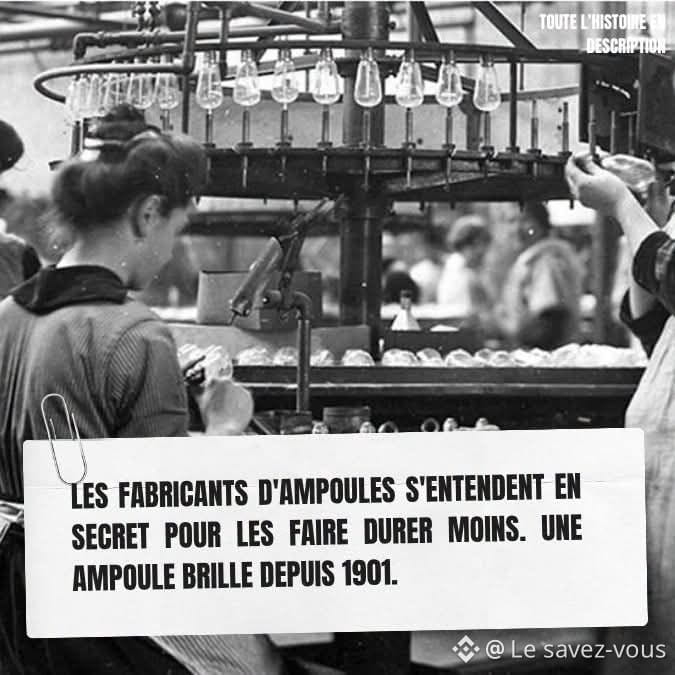
💡 In December 1924, in Geneva, the world’s largest lightbulb manufacturers—Philips, Osram, General Electric, Tungsram, and the Compagnie des Lampes—meet in secret and create the Phoebus cartel.
Officially, the agreement aims to “standardize” electric lighting. In reality, an internal committee, nicknamed the “1,000-Hour Committee,” imposes a maximum lifespan limit on the lightbulbs, even though the best models of the time already lasted about 2,500 hours. Any company that exceeded this threshold faced fines, calculated according to a precise schedule applied by an independent Swiss laboratory.
Result: between 1926 and 1933, the average lifespan of lightbulbs fell by about 1,800 to 1,200 hours. Many industry historians consider this episode the first documented case of organized planned obsolescence on a global scale.
The cartel disappears in 1939, amid antitrust prosecutions in the United States and the Second World War.
Officially, the agreement aims to “standardize” electric lighting. In reality, an internal committee, nicknamed the “1,000-Hour Committee,” imposes a maximum lifespan limit on the lightbulbs, even though the best models of the time already lasted about 2,500 hours. Any company that exceeded this threshold faced fines, calculated according to a precise schedule applied by an independent Swiss laboratory.
Result: between 1926 and 1933, the average lifespan of lightbulbs fell by about 1,800 to 1,200 hours. Many industry historians consider this episode the first documented case of organized planned obsolescence on a global scale.
The cartel disappears in 1939, amid antitrust prosecutions in the United States and the Second World War.