Everyone prices $TAO and $RENDER as two separate AI compute bets.
Run the same lens over both and they turn into one business at two different stages of the same problem.
Start with the trap most holders miss.
Emissions are not revenue.
They are an incentive budget printed to keep supply online.
Revenue is money that comes in because someone actually paid for the work.
On Bittensor the last 30 days were clean.
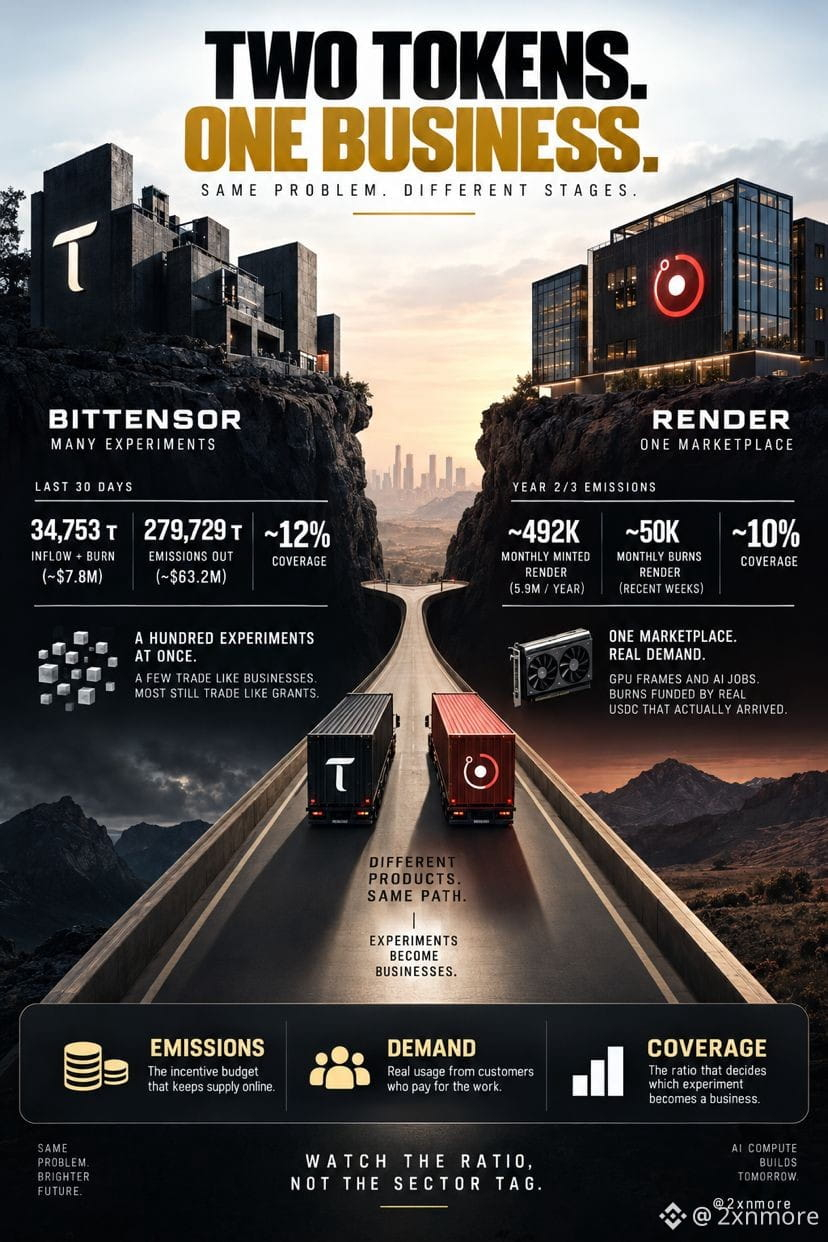
Inflow plus burn: 34,753 τ (~$7.8M)
Emissions out: 279,729 τ (~$63.2M)
Coverage: ~12%
One TAO came back for every eight paid out.
Holders quietly funded the other seven.
Render runs the cleaner version of the exact same machine.
Its Burn-Mint Equilibrium prices jobs in dollars. Most of that cash buys RENDER and burns it. Nodes earn newly minted RENDER on a declining schedule.
Year 2/3 emissions sit near 5.9M RENDER.
That is roughly 492k tokens a month.
Burns have accelerated, but they are still an order of magnitude behind.
Recent on-chain weeks: ~10k RENDER burned against ~113k minted.
Full-year 2025 usage: $2.69M against 5.64M tokens emitted.
Independent reads: monthly burns near 50k versus ~500k minted.
Coverage lands in the same neighborhood, about 10%.
Same ratio, different product.
Render sells one marketplace: GPU frames, and now Dispersed AI jobs. Demand is real. Q2 even ran short of spare cards. The burn is funded by USDC that actually arrived, not by recycled emissions.
Bittensor sells a hundred experiments at once. A few already trade like businesses. Most still trade like grants. It prints more in dollar terms because it is subsidizing many markets at the same time.
That is the part the market still prices badly.
An 80% coverage subnet with a small cap is not the same asset as a 3% coverage subnet eating a giant emission share.
A GPU network burning 10% of what it mints is not the same asset as one that has already flipped BME.
Watch the ratio, not the sector tag.
Budget, Demand, Coverage.
Emissions buy the experiment. Coverage decides which experiment becomes a business.
Run the same lens over both and they turn into one business at two different stages of the same problem.
Start with the trap most holders miss.
Emissions are not revenue.
They are an incentive budget printed to keep supply online.
Revenue is money that comes in because someone actually paid for the work.
On Bittensor the last 30 days were clean.
Inflow plus burn: 34,753 τ (~$7.8M)
Emissions out: 279,729 τ (~$63.2M)
Coverage: ~12%
One TAO came back for every eight paid out.
Holders quietly funded the other seven.
Render runs the cleaner version of the exact same machine.
Its Burn-Mint Equilibrium prices jobs in dollars. Most of that cash buys RENDER and burns it. Nodes earn newly minted RENDER on a declining schedule.
Year 2/3 emissions sit near 5.9M RENDER.
That is roughly 492k tokens a month.
Burns have accelerated, but they are still an order of magnitude behind.
Recent on-chain weeks: ~10k RENDER burned against ~113k minted.
Full-year 2025 usage: $2.69M against 5.64M tokens emitted.
Independent reads: monthly burns near 50k versus ~500k minted.
Coverage lands in the same neighborhood, about 10%.
Same ratio, different product.
Render sells one marketplace: GPU frames, and now Dispersed AI jobs. Demand is real. Q2 even ran short of spare cards. The burn is funded by USDC that actually arrived, not by recycled emissions.
Bittensor sells a hundred experiments at once. A few already trade like businesses. Most still trade like grants. It prints more in dollar terms because it is subsidizing many markets at the same time.
That is the part the market still prices badly.
An 80% coverage subnet with a small cap is not the same asset as a 3% coverage subnet eating a giant emission share.
A GPU network burning 10% of what it mints is not the same asset as one that has already flipped BME.
Watch the ratio, not the sector tag.
Budget, Demand, Coverage.
Emissions buy the experiment. Coverage decides which experiment becomes a business.