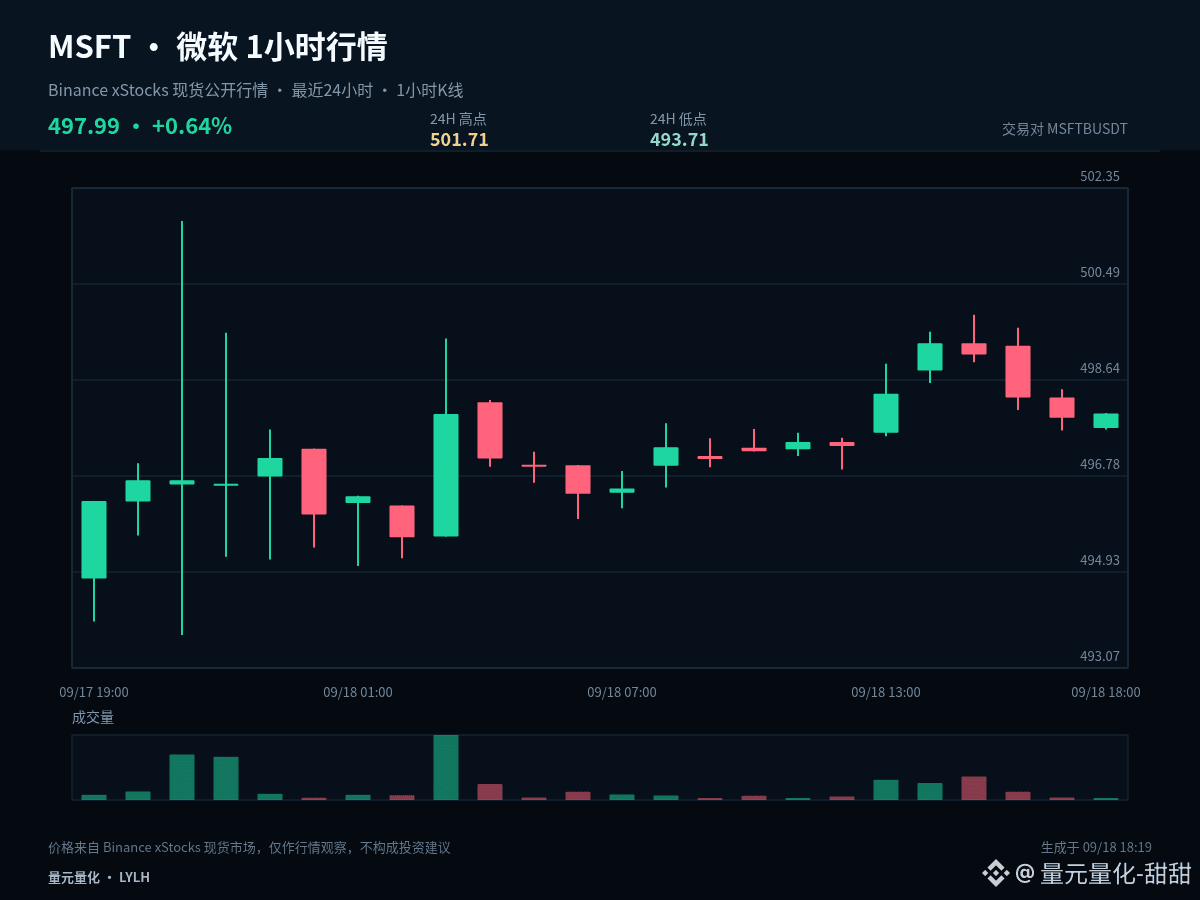
$MSFTB #MSFT If I had to keep just one observation price in this round, I’d choose 497.71. Current price is 497.99; in the last 1 hour +0.02%, in the last 24 hours +0.81%. The gain/loss around the midline can help filter a lot of intraday noise.
As long as the price stays above 497.71, it suggests the pullback is still being controlled by the bulls. The next target is to test the pressure at 501.71. If the price falls back below the midline again, the prior strength will be discounted—and we should also prevent further movement back to 493.71.
Current readings: 1 hour +0.02%, 24 hours +0.81%. The two timeframes have not formed a sufficiently clear same-direction alignment. In a range-bound market, the tolerance for chasing or cutting trades is low. It’s more suitable to confirm direction with the upper boundary, and confirm continuation/holding with the lower boundary. The midline should only be treated as the line separating strength and weakness.
Going forward, handle the path in three ways: if it effectively holds and stands above 501.71, wait for a pullback that doesn’t break, then reassess whether the move can continue; if it breaks down through 493.71, prioritize risk control and wait for new support; if it keeps oscillating around 497.71, treat it as rotation within the range and avoid repeatedly chasing direction from the middle.
For positions you already hold, manage them in stages based on key levels to avoid making all decisions at once. For those who are currently flat, wait for breakout confirmation or for a pullback to stabilize. For U.S. stock-related instruments, also watch for volatility caused by trading session transitions. Your plan should be based on price conditions—don’t let emotions replace execution.
Next, I’ll focus on tracking whether 497.71 can hold or fails. Do you lean more toward first testing 501.71, or first returning to 493.71? Feel free to share your view and rationale.
#SPGlobalToAcquireOpenZeppelin
As long as the price stays above 497.71, it suggests the pullback is still being controlled by the bulls. The next target is to test the pressure at 501.71. If the price falls back below the midline again, the prior strength will be discounted—and we should also prevent further movement back to 493.71.
Current readings: 1 hour +0.02%, 24 hours +0.81%. The two timeframes have not formed a sufficiently clear same-direction alignment. In a range-bound market, the tolerance for chasing or cutting trades is low. It’s more suitable to confirm direction with the upper boundary, and confirm continuation/holding with the lower boundary. The midline should only be treated as the line separating strength and weakness.
Going forward, handle the path in three ways: if it effectively holds and stands above 501.71, wait for a pullback that doesn’t break, then reassess whether the move can continue; if it breaks down through 493.71, prioritize risk control and wait for new support; if it keeps oscillating around 497.71, treat it as rotation within the range and avoid repeatedly chasing direction from the middle.
For positions you already hold, manage them in stages based on key levels to avoid making all decisions at once. For those who are currently flat, wait for breakout confirmation or for a pullback to stabilize. For U.S. stock-related instruments, also watch for volatility caused by trading session transitions. Your plan should be based on price conditions—don’t let emotions replace execution.
Next, I’ll focus on tracking whether 497.71 can hold or fails. Do you lean more toward first testing 501.71, or first returning to 493.71? Feel free to share your view and rationale.
#SPGlobalToAcquireOpenZeppelin