On-chain profitability: what’s really happening with your assets?
I saw “On-chain profitability” on Binance, but you might not fully understand what’s behind this feature.
The mechanics here are different from the standard Simple Earn.
When you subscribe to On-Chain Yields, your assets are used through on-chain protocols / DeFi projects, while Binance handles the integration and on-chain operations.
And the reward depends on the specific protocol. It may be paid out in the form of tokens or points. For supported Binance tokens, the reward can be credited directly to your Spot account; for other assets, Binance may use the specified on-chain address.
And here’s the key point:
On-chain profitability ≠ guaranteed APR.
Binance explicitly states that rewards are not fixed or guaranteed, and that each protocol has its own risks—including smart contract risks, volatility, and possible issues with the protocol itself.
So the scheme is roughly like this:
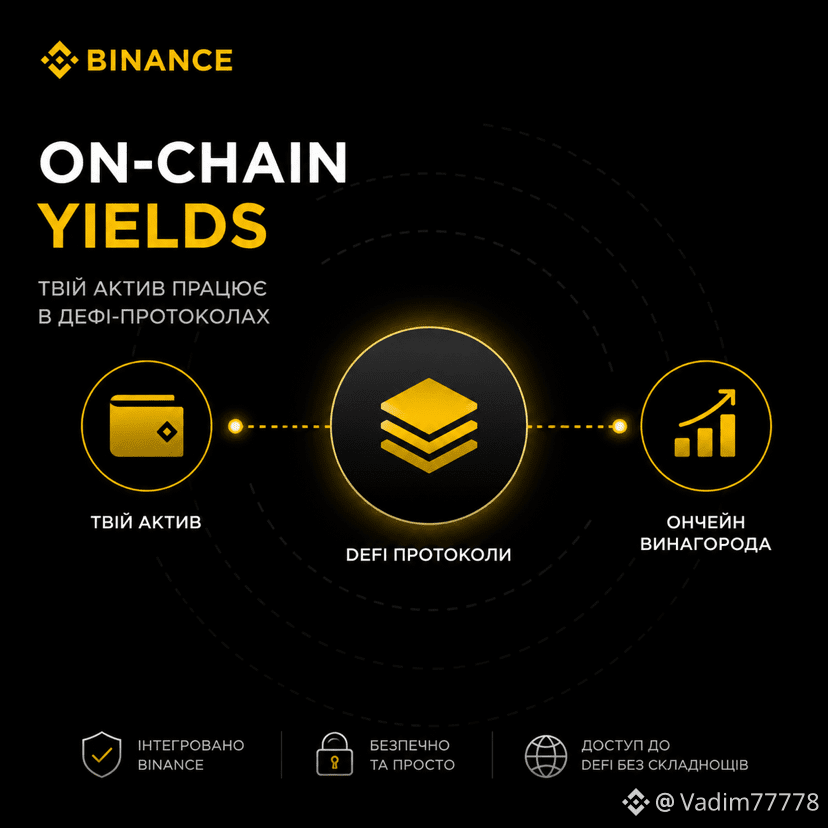
Your asset → DeFi protocol → on-chain rewards → you
At the same time, you don’t need to connect your wallet to every protocol yourself and deal with all the on-chain operations—this is exactly what makes Binance simpler.
I saw “On-chain profitability” on Binance, but you might not fully understand what’s behind this feature.
The mechanics here are different from the standard Simple Earn.
When you subscribe to On-Chain Yields, your assets are used through on-chain protocols / DeFi projects, while Binance handles the integration and on-chain operations.
And the reward depends on the specific protocol. It may be paid out in the form of tokens or points. For supported Binance tokens, the reward can be credited directly to your Spot account; for other assets, Binance may use the specified on-chain address.
And here’s the key point:
On-chain profitability ≠ guaranteed APR.
Binance explicitly states that rewards are not fixed or guaranteed, and that each protocol has its own risks—including smart contract risks, volatility, and possible issues with the protocol itself.
So the scheme is roughly like this:
Your asset → DeFi protocol → on-chain rewards → you
At the same time, you don’t need to connect your wallet to every protocol yourself and deal with all the on-chain operations—this is exactly what makes Binance simpler.