


1. Big headline background: What exactly did the SEC loosen the restraints on?
Last night, the U.S. Securities and Exchange Commission (SEC) officially opened the gate for tokenized equities in the U.S. This is the first time that U.S. regulators have established a formal and lawful channel for “on-chain mapping of real stocks.”
👇 Quick overview of the three core policy elements:
1⃣ 15-year innovation exemption period (exempt from the licensing/“birth certificate”): for up to 5 years, exchanges and market makers can operate without holding the traditional Broker-Dealer or ATS licenses, greatly clearing compliance-related startup costs.
2⃣ “30-day no-objection deemed approval” (Negative Consent): the platform only needs to give the original listed company a written notice 30 days in advance. If the company does not submit an explicit written objection, the tokenized mapping is automatically approved. This greatly compresses the approval process on the asset side, and the resistance to onboarding core blue chips—such as the S&P 500—has dropped sharply.
3) Real stock safekeeping 1:1 (not synthetic assets): must be completed by a compliant custodian to pledge stocks 1:1, together with on-chain reserve proof, so that US stock equity assets with a $50 trillion scale officially become underlying assets that are tradable and pledgeable on-chain.
💡2. Sharp critique: turning good-token news from “stuffing” to “pumping”
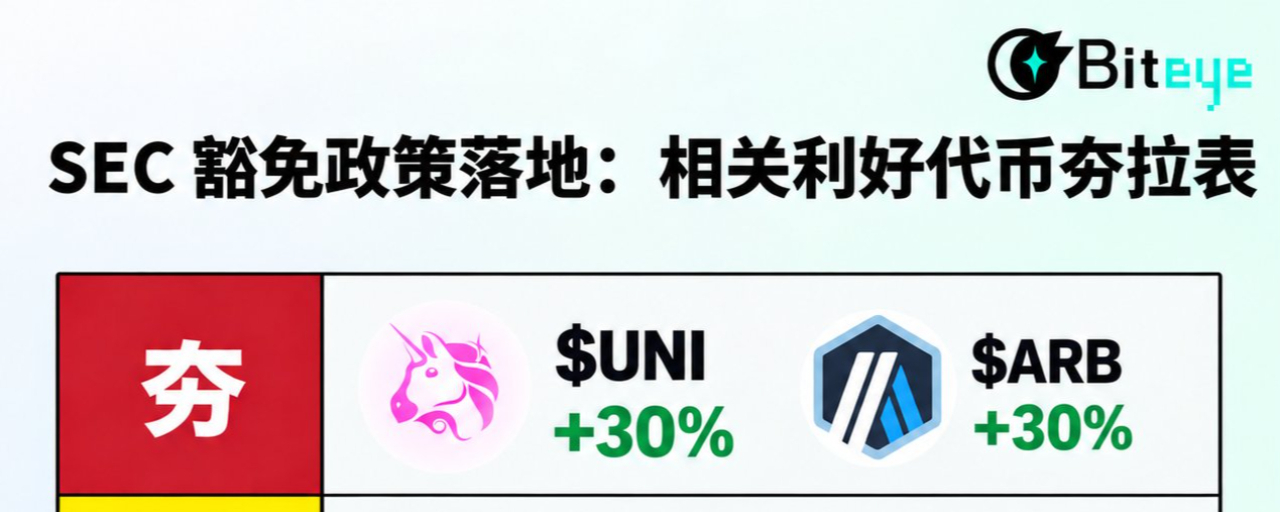
After the news began to ferment, the secondary market didn’t stage an indiscriminate “concept-wide rally.” Instead, it quickly diverged. The editor organized the following “from stuffing to pumping” leaderboard based on the magnitude of the gains and how closely the good news is related.
👑【Pump】 $UNI & $ARB— a second acceleration into a main upswing; the core is the whole-market pricing
$UNI (Uniswap)| the core liquidity matching engine for tokenized US stocks
Key data: the high touched $8.88 (pre-policy $6.2–$6.7)| 24h +30% | trading volume $1.5B+
Logic:
1) The liquidity endgame monopolist: putting US stocks on-chain is, in essence, spot trading. Regardless of which market maker maps Apple or Nvidia onto the chain through a 30-day implied mechanism, the world’s largest spot depth pool running 24/7 will inevitably first choose Uniswap. The market anchors it as the “on-chain Nasdaq.”
2) Dual catalyst resonance: besides the trading volume explosion expectation brought by the SEC exemption, the outlook is further boosted by the recent fermentation of expectations around Robinhood trading revenue and protocol fee burning. Big capital doesn’t care about costs—buying fills the order book, and the rally accelerates into a “true vacuum.”
$ARB (Arbitrum)| the biggest L2 settlement hub for tokenized US stocks
Key data: current price $0.212 | 24h +28.1% | circulating market cap ~ $1.43B | trading volume $72M+
Logic: Robinhood’s official self-custody wallet has already defaulted to Arbitrum as the core network for low-cost on-chain swaps and cross-chain exchanges. Meanwhile, the leading asset pools of most compliant tokenized US stock pioneers (e.g., Backed Finance, etc.) were all launched and settled on Arbitrum.
Arbitrum is the biggest L2 winner under this round of policy tailwinds.
🥈【Peacocking among the peacocks】
$ONDO / $HYPE/ $BP — a structural carnival for strong tokens
$ONDO (Ondo Finance)| RWA’s cornerstone; big capital keeps healthy turnover
Key data: current price $0.392 | 24h +11.8% | circulating market cap ~ $1.91B | trading volume $240M+
Logic: Backed by top-tier asset managers from Wall Street and a BlackRock background, it naturally expands from tokenized US Treasuries to tokenized US stocks. Over two days, it surged on increased volume by +11% to +13%. While there wasn’t a violent straight-up breakout, the slope shifted from steep to gentler—this is a typical pattern of big money having fully rotated positions. Realized profits from earlier longs and new long-term capital are battling each other, building a solid platform for a second push.
$HYPE (Hyperliquid)| a sentiment amplifier for derivatives
Key data: current price $86.55 | 24h +9.2% (two-day cumulative ~+10%) | trading volume $1.27B | circulating market cap ~ $19.2B
Logic: The SEC exemption is for spot mapping, and there’s no direct linkage to high-leverage perpetual futures contracts. But as the liquidity leader for on-chain derivatives,
$HYPE
Perfectly absorbed the spillover speculative preference after the spot surged. The intraday chart carved out a deep V-shaped repair, acting as an excellent barometer of market sentiment.
$BP (Backpack)| a pure-blood small-cap vanguard—watch out for a capacity ceiling
Key data: current price $0.536 (touched high $0.548)| 24h +18.7% | circulating market cap ~ $130M | trading volume $3.7M+
Logic: Focused on compliant trading and self-custody entry—it’s the most direct pure candidate that fits the SEC exemption provisions. The token supply is light and the positioning structure is good. Speculators showed extreme elasticity, hitting close to +19% in the first wave of attacks. But constrained by a market cap of $130M, the pool can’t accommodate continuous adds by $10B-scale institutional money. After topping out near $0.548, it entered consolidation at high levels.
⚖️【NPC】
$PYTH / $LINK— the logic is all right, but the coin price moves only slightly; a “public utility pipe”
$PYTH
(Pyth Network)| The narrative is perfect, but it lacks a closed loop for value capture
Key data: current price $0.0585 | 24h +8.5% (two-day cumulative ~+9%) | circulating market cap ~ $460M | trading volume ~ $33M
Logic: Directly connected to top US stock market makers like Jane Street and Virtu, it has an irreplaceable high-frequency advantage for price feeding during US stock market hours. But because the tokenomics don’t have a strong binding mechanism that directly turns “price feeding calls” into “token burning/dividends,” and given long-term inflation expectations, the board is simply passively tracking the broader market’s repair.
$LINK
(Chainlink)| indispensable infrastructure; a value trap in the secondary market
Key data: current price $11.72 | 24h +5.3% (two-day cumulative ~+4.5%)| circulating market cap ~ $8.75B | trading volume $370M+
Logic: Whether it’s cooperation with DTCC, CCIP cross-chain messaging, or Proof of Reserve reserve proofs, the real on-chain US stocks technology absolutely cannot bypass Chainlink. But even if a water company is more important than a city, it’s still hard to turn it into a hype target.
$LINK
The deep bag-holders trapped over a multi-year cycle. Whenever there’s a major industry tailwind, they invariably turn into an exit window for getting out at breakeven. Secondary-market upside elasticity is trash across the board.
🪨【Finished pumping】
$ETH / $SOL / $AVAX— elephant L1s are being dulled; capital is extremely averse to the “far-off water” kind of opportunity
$ETH
(Ethereum)| The elephant whose value capture is extracted by L2
Key data: current price ~ $2,475 | 24h +1.8% | circulating market cap ~ $280B |
Logic: Although the vast majority of tokenized stocks are still issued in ERC-20 form, the fragmentation of L2 prevents the mainnet from capturing any meaningful explosion in actual fees. Over two days, it only gained about +1% to +2%. With such a huge volume base, there’s no ripple in the face of good news.
$SOL
(Solana)| Inventory advantage can’t be converted into a spot explosion
Key data: current price $104.7 | 24h +4.5% | circulating market cap ~ $61B | trading volume $3.5B+
Logic: The $100B market cap has greatly diluted the beta of a single event; there are already offshore US stock token holdings on-chain, and there’s a lack of an expectation gap. Liquidity in the market is still trapped in meme-coin in/out swapping, failing to form a coordinated push to lift the native token. In two days, it only tracked upward by 3.5%.
$AVAX
(Avalanche)| The institutional subnet narrative collapses; it can only passively follow the rally
Key data: current price $7.84 | 24h +5% | circulating market cap ~ $3.46B | trading volume $280M
Logic: Avalanche has spent years promoting Evergreen’s compliant institutional subnets and the Spruce testnet, but the secondary market is extremely practical: it would rather buy a DEX that can generate real gold-and-silver trading fees tomorrow (
$UNI
), and also unwilling to buy into a compliant sub-network that might only be built by institutions three years from now. It only inched up by 2.5% over two days, completely turning into a follower of the broad market.
⚠️3. Warm reminder
1) The main line doesn’t fear heights; respect liquidity black holes ($UNI). When big capital rallies together in the main upswing wave, it often prints heights beyond expectations. Don’t blindly buy laggards just because “it already went up too much” — especially public chains and infrastructure whose so-called “catch-up” is merely delayed.
2) Division of labor for the “upper class”: small caps prevent deterioration; the mid-card rotates—watch $BP as it spikes and then falls back; beware liquidity being sucked away by the dragon.
$ONDO is steady and turns over thoroughly—it's the first receiving position when the main upswing dragon rests.
3) Recognize NPCs and public-chain traps: In an event-driven market, distinguish between “industry importance” and a token’s “ability to ignite.” Stay away from public pipes that have no value capture and where the payout cycle drags on, leading to a dulled broad market.