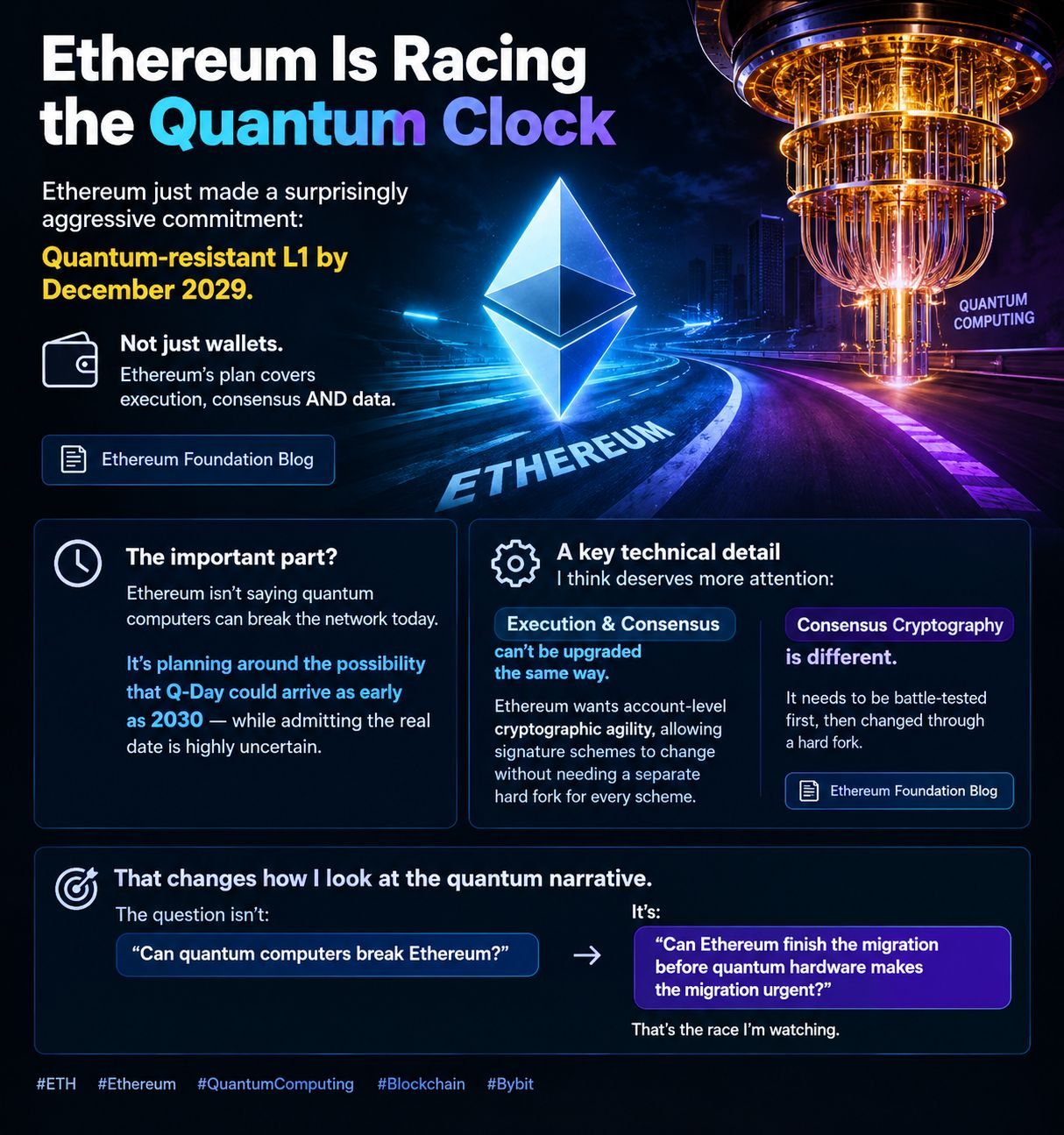
Ethereum Is Racing the Quantum Clock
Ethereum just made a surprisingly aggressive commitment:
Quantum-resistant L1 by December 2029.
Not just wallets.Ethereum’s plan covers execution, consensus AND data.
The interesting part? Ethereum isn't saying quantum computers can break the network today.
It's planning around the possibility that Q-Day could arrive as early as 2030 — while admitting the real date is highly uncertain. And there’s a technical detail I think deserves more attention:
Execution and consensus can't be upgraded the same way. Ethereum wants account-level cryptographic agility, allowing signature schemes to change without needing a separate hard fork for every scheme.
But consensus cryptography is different.
It needs to be battle-tested first, then changed through a hard fork.
That changes how I look at the quantum narrative.
The question isn't: “Can quantum computers break Ethereum?”
It's:“Can Ethereum finish the migration before quantum hardware makes the migration urgent?”
That’s the race I’m watching.$ETH
Ethereum just made a surprisingly aggressive commitment:
Quantum-resistant L1 by December 2029.
Not just wallets.Ethereum’s plan covers execution, consensus AND data.
The interesting part? Ethereum isn't saying quantum computers can break the network today.
It's planning around the possibility that Q-Day could arrive as early as 2030 — while admitting the real date is highly uncertain. And there’s a technical detail I think deserves more attention:
Execution and consensus can't be upgraded the same way. Ethereum wants account-level cryptographic agility, allowing signature schemes to change without needing a separate hard fork for every scheme.
But consensus cryptography is different.
It needs to be battle-tested first, then changed through a hard fork.
That changes how I look at the quantum narrative.
The question isn't: “Can quantum computers break Ethereum?”
It's:“Can Ethereum finish the migration before quantum hardware makes the migration urgent?”
That’s the race I’m watching.$ETH