

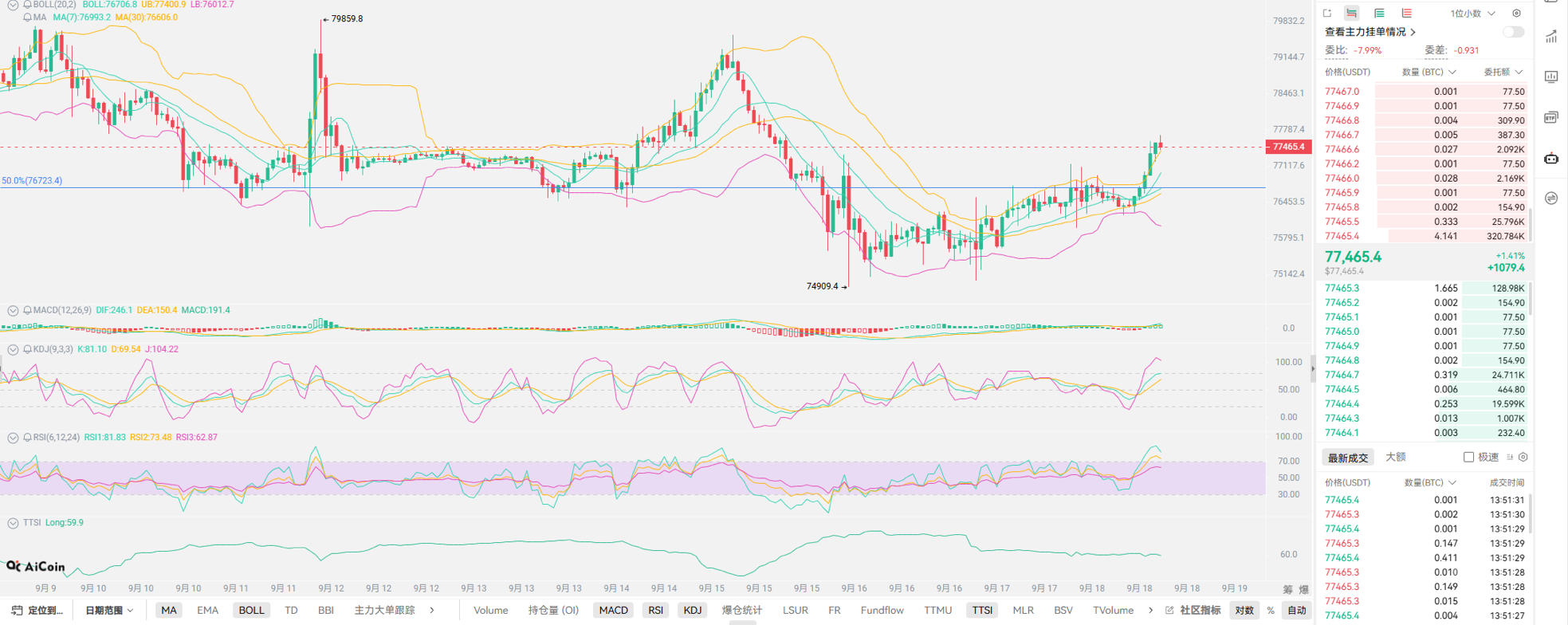

The breakout in small-cap coins is truly very fierce. Even Lao Cui finds it hard to believe. The rebound in the U.S. stock market, on the other hand, is pretty unfazed. Today, I’ll talk about this a bit: the SEC has approved tokenized stocks for limited on-chain trading. This is indeed a milestone. Coins with tokenized pathways saw a wave of rebound in the morning; surprisingly, Bitcoin’s rise wasn’t that noticeable. This officially marks the legalization of publicly listed companies getting involved in the crypto token space. A support point for the bull market has arrived—it's support, not a turning point. Many friends are using certain platforms to start hyping tokens of overseas companies. This line directly hits the pain point and can help avoid a lot of unnecessary trouble. That’s the advantage of the crypto world. As for the U.S.’s advantage, it’s nothing more than being able to better harvest overseas assets, improve global liquidity, and attract global capital. For the U.S. stock market, this is a huge piece of good news. It also lines up perfectly with Micron’s 512GB memory breakthrough, and a short-term rebound has kicked off. Remember: this breakthrough is also good news for the crypto market.
Some of the points mentioned above cannot be expanded in detail. If you’re interested, you can communicate with Lao Cui. In short, these two positive factors have driven the rise in this move, but they won’t last. Micron’s mass production is scheduled for the second half of 2027, and it’s still in the validation stage for now. It’s more like the beginning of a story. Lao Cui is also very emotional—thinking back to the memory era when his work used to be measured in megabytes, and now continued breakthroughs are approaching 1TB. It feels a bit like being an outcast who can’t keep up with the times. Everyone needs to remember one thing: the tokens issued by the U.S. stock market, in essence, have little connection to the crypto world. Only coins like SOL, which have a token channel capability, when trading increases, naturally more usage is involved, and thus it becomes more valuable. How much explosive power this kind of good news can have is something you’ll only understand when a bull market arrives—meaning how strong the bull market’s driving force can be to lift them another level. For example, as Lao Cui previously estimated, SOL’s historical high should be between 300 and 500. With this current breakthrough, the projection for the high end can be pushed higher—roughly between 350 and 500—which provides a kind of ability to support a lower bound.
So, the coins that don’t benefit from the U.S. issuing tokens will naturally be discarded by the times. For example, coins like the Trump coin: many friends recently want to short it. The thinking is correct, but it just needs a good timing. Lao Cui’s approach is more trend-based. Within the rate-hike cycle, at high levels, there’s no appeal for individuals. No matter how strong the breakout capability is, it cannot change the environment of the rate-hike cycle. Lao Cui also mentioned this yesterday: one rate hike can’t explain too much— the key is how long the rate-hike cycle can last. Financial markets often “trade expectations.” If a rate hike fully matches market expectations, then when it’s actually announced, the market may have already priced it in—so you might instead see a rebound after the “shoe drops.” But if the rate hike is larger than expected or the statements are more hawkish than expected, that’s what triggers a second shock. Right now we’re in a phase of rebound—except this rebound has support from both tech breakthroughs and strategy-level factors.
This can also说明 that some things: the Americans both want to tighten monetary policy to resolve inflation, and also want the stock market to remain strong. These are all idealized goals—how can one find a way to have both? During the rebound phase, some friends think risk is coming, while Lao Cui feels this is an opportunity. The higher the position, the more upside the next round will have; everyone just needs to short at high levels to achieve a perfect profit. Especially with breakthroughs in small-cap coins, everyone can observe Bitcoin’s trend. It’s clear that Bitcoin has been weak recently, and there’s even a serious liquidity shortage in circulation. The coins that broke out yesterday are basically close to their recent highs; only Bitcoin has faced heavy pressure and hasn’t broken 78,000. Today’s core issue is to observe: at these high levels, will Bitcoin follow up or stay put? As long as Bitcoin doesn’t follow through higher, then the next phase will once again enter a pressure stage.
Lao Cui summarizes: everyone, distinguish the connection between U.S. stock-market tokens and the crypto world. Most of the time, the U.S. stock market and the crypto world are not synchronized. What Lao Cui wants to say is: the Americans will try to save the U.S. stock market, but they may not necessarily try to save the crypto world. This implies that during the downward phase, the depth of the crypto market will be far greater than that of the U.S. stock market. Short-term correlation doesn’t mean the narrative will be the same later. This kind of phase rebound will, at most, last until around the next rate-hike strategy cycle—just like what Lao Cui mentioned yesterday: this year, will it break out to what position? Lao Cui can’t predict it, but Lao Cui is clear about one thing: the position of the next rate hike will definitely be lower than the current price. That’s the charm of a trend—judging by the trend, this year won’t enter a bull market phase. As long as this pressure environment doesn’t change, the crypto world will always remain at the bottom of investors’ universe. Right now all markets are in a rebound phase—even buying U.S. Treasury yields are higher than in the crypto market—so capital won’t step in! Everyone doesn’t need to worry too much. On the trend level, Lao Cui won’t make a mistaken call!