
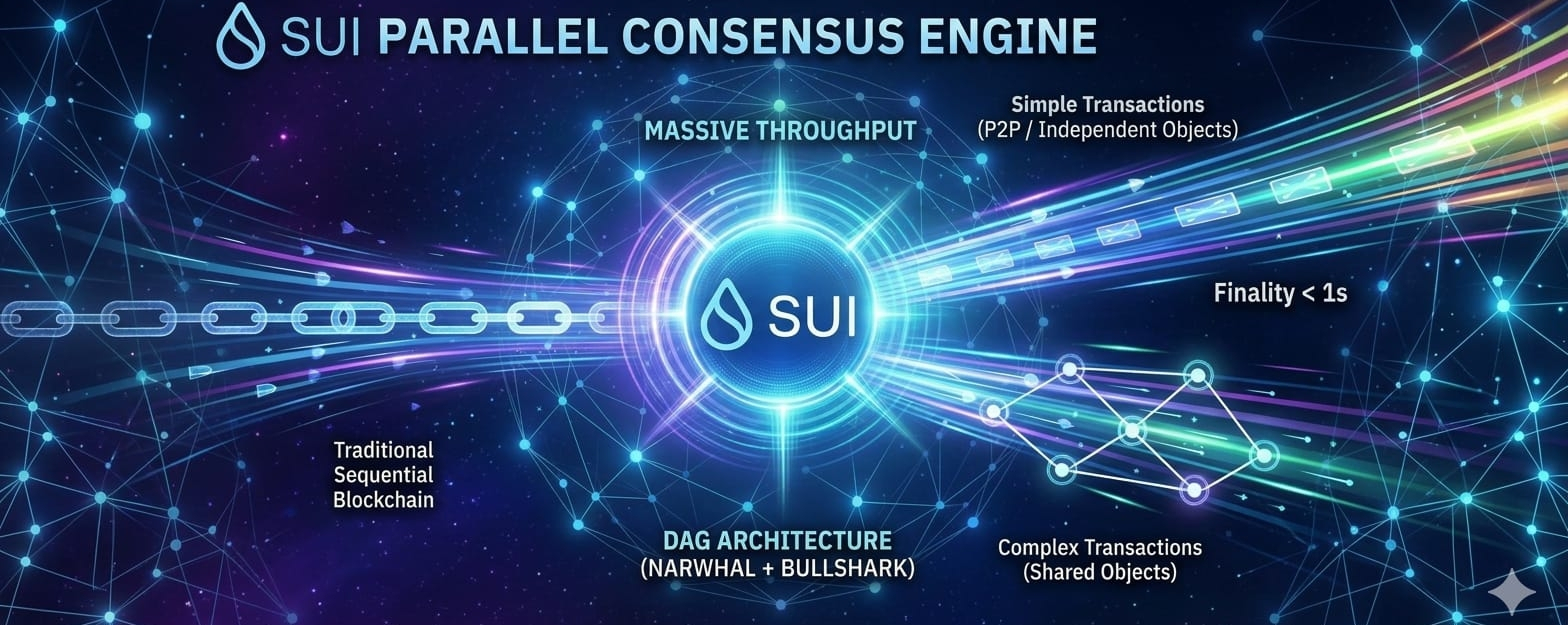

One of the biggest weaknesses of traditional Layer 1 blockchains is sequential processing: transactions are packaged and executed one by one (or in linear blocks), which saturates the network and drives up fees when demand is high. $SUI breaks this paradigm with a consensus architecture designed for massive parallelization.
How does Sui’s consensus engine work?
Unlike networks that enforce a strict global order for all transactions, Sui splits transactions into two logical categories based on their data dependency:
Simple Transactions / No dependencies (e.g., P2P transfers or calls to independent objects):
These transactions completely skip traditional consensus.
Validators only need to verify the transaction’s validity independently and quickly, enabling near-instant finality (less than one second) and practically unlimited horizontal throughput.
Complex Transactions (that involve shared objects):
For transactions that require shared state across multiple users (such as a liquidity pool in a DEX), Sui uses a DAG-based consensus engine (Directed Acyclic Graph) called Narwhal and Bullshark.
Narwhal acts as the data availability manager (ensuring transactions are broadcast without bottlenecks), while Bullshark orders transactions asynchronously only when it is strictly necessary.
Why does this matter to investors and the ecosystem?
Linear Scalability: With a greater number of validator nodes joining the network, Sui’s processing capacity increases. The network does not become slower as adoption grows.
Smooth User Experience (UX): Eliminates frustrating waits and enables the execution of high-performance applications (such as on-chain games or high-frequency real-time order books) without network congestion.
#Sui #Layer1 #CryptoEducation #BİNANCESQUARE #Web3
