
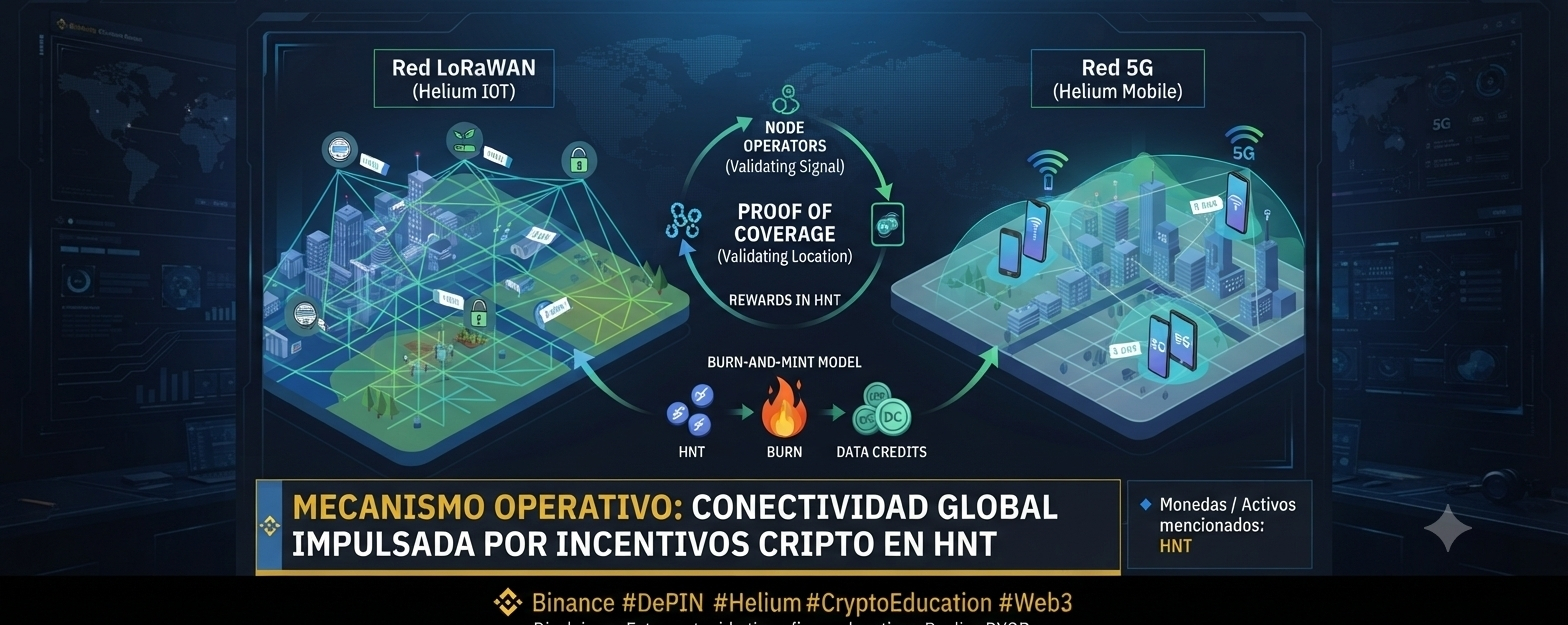

The core of Helium’s success and scalability does not lie in the corporate purchase of traditional infrastructure, but rather in the smart application of HNT tokenomics as a physical deployment engine. Instead of requiring millions of dollars in centralized cellular tower infrastructure, the Helium network uses HNT incentives to motivate individuals and companies to build connectivity from the ground up.
1. Dual Wireless Networks (LoRaWAN and 5G)
Helium's infrastructure primarily operates on two complementary layers supported by its ecosystem:
LoRaWAN Network (Helium IoT): Specifically designed for low-energy Internet of Things (IoT) devices, such as agricultural sensors, asset trackers, and smart meters. It offers massive coverage with minimal data usage backed by HNT.
5G Network (Helium Mobile): Focused on mobile traffic offloading for smartphones. It allows users to share their high-speed mobile data coverage through compatible nodes and strengthen the decentralized network.
2. The Incentive Cycle and Proof of Coverage
The system is sustained by a unique consensus mechanism known as Proof of Coverage, designed to cryptographically verify that Hotspots are truly providing wireless signal at the locations they claim:
Mining for Utility: Node operators don’t spend energy solving complex, useless mathematical puzzles; their HNT rewards come from validating the network and transferring real device data.
Burn-and-Mint Model (Burn and Mint): To use the Helium network, companies and developers must burn data credits obtained by burning the native token HNT, which dynamically balances the economic supply and sustains the ecosystem in the long term.
HNT
#Binance #DePIN #Helium #CryptoEducation #Web3
Disclaimer: This content is strictly for educational and informational purposes. It does not constitute financial advice or an investment recommendation. Always do your own research (DYOR).