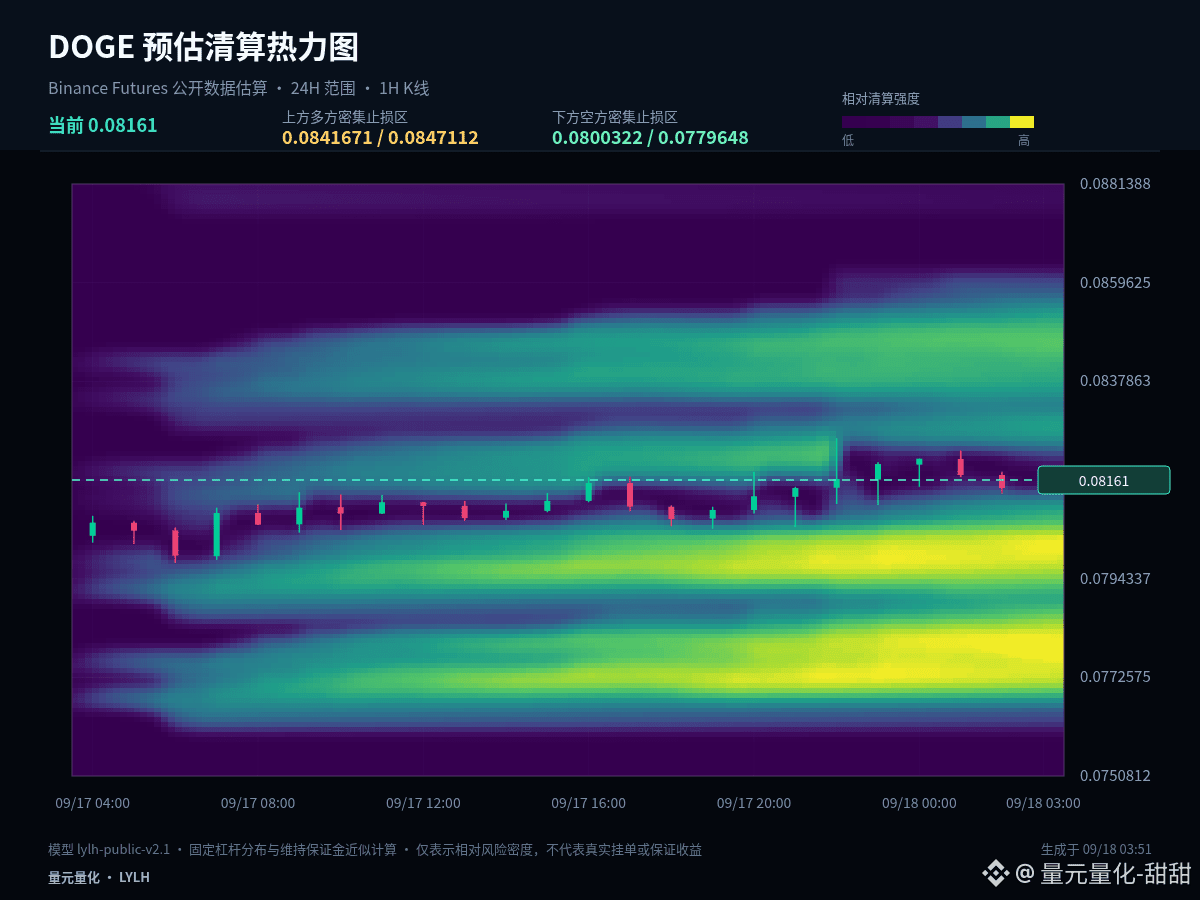
$DOGE #DOGE Currently it’s more suitable to first do a rebound confirmation rather than defining a reversal in advance. Current price is 0.08165, 1 hour +0.25%, 24 hours +1.52%. Whether the two time periods realign in the same direction is the key focus for what comes next.
At present, the 1-hour +0.25% and the 24-hour +1.52% do not form a sufficiently clear same-direction alignment between the two cycles. In a range-bound market, the tolerance for chasing and killing is low. It’s better to use the upper band to confirm direction and the lower band to confirm acceptance; the midline only serves as a boundary between strength and weakness.
If the rebound can reclaim 0.081175 and further hold above 0.08255, it indicates that buy-side demand is starting to change the prior weak structure. But if price rises to test the midline and then falls back again—especially if it drops back toward 0.0798—that is more like a failed repair, and you should not continue to rely on the “strengthening” expectation.
Even if you confirm the rebound has failed, you still need evidence. You shouldn’t go straight into shorting just because of one high-and-reversal move. A more reasonable sequence is to observe whether the resistance level is rejected, whether the lows shift down again, and then decide your action based on whether the subsequent pullback can reclaim key levels.
Position sizing needs to distinguish spot from futures. Existing spot positions can be managed in segments around key levels without constantly flipping direction due to frequent changes on a single 1-hour candlestick. If you’re in cash, waiting for confirmation and then scaling in is more comfortable. Futures emphasize entry location and invalidation conditions; when volatility increases, you should actively reduce position size to avoid turning short-term judgment into passive holding.
The point with futures is not to predict every candlestick, but to ensure there is a basis for entry, trimming, and exiting. If there’s no confirmation, do less. If a key level fails, redo your plan—control single-trade risk first, and only then discuss the potential upside/downside space.
#ParadigmDisclosesZECHolding
At present, the 1-hour +0.25% and the 24-hour +1.52% do not form a sufficiently clear same-direction alignment between the two cycles. In a range-bound market, the tolerance for chasing and killing is low. It’s better to use the upper band to confirm direction and the lower band to confirm acceptance; the midline only serves as a boundary between strength and weakness.
If the rebound can reclaim 0.081175 and further hold above 0.08255, it indicates that buy-side demand is starting to change the prior weak structure. But if price rises to test the midline and then falls back again—especially if it drops back toward 0.0798—that is more like a failed repair, and you should not continue to rely on the “strengthening” expectation.
Even if you confirm the rebound has failed, you still need evidence. You shouldn’t go straight into shorting just because of one high-and-reversal move. A more reasonable sequence is to observe whether the resistance level is rejected, whether the lows shift down again, and then decide your action based on whether the subsequent pullback can reclaim key levels.
Position sizing needs to distinguish spot from futures. Existing spot positions can be managed in segments around key levels without constantly flipping direction due to frequent changes on a single 1-hour candlestick. If you’re in cash, waiting for confirmation and then scaling in is more comfortable. Futures emphasize entry location and invalidation conditions; when volatility increases, you should actively reduce position size to avoid turning short-term judgment into passive holding.
The point with futures is not to predict every candlestick, but to ensure there is a basis for entry, trimming, and exiting. If there’s no confirmation, do less. If a key level fails, redo your plan—control single-trade risk first, and only then discuss the potential upside/downside space.
#ParadigmDisclosesZECHolding