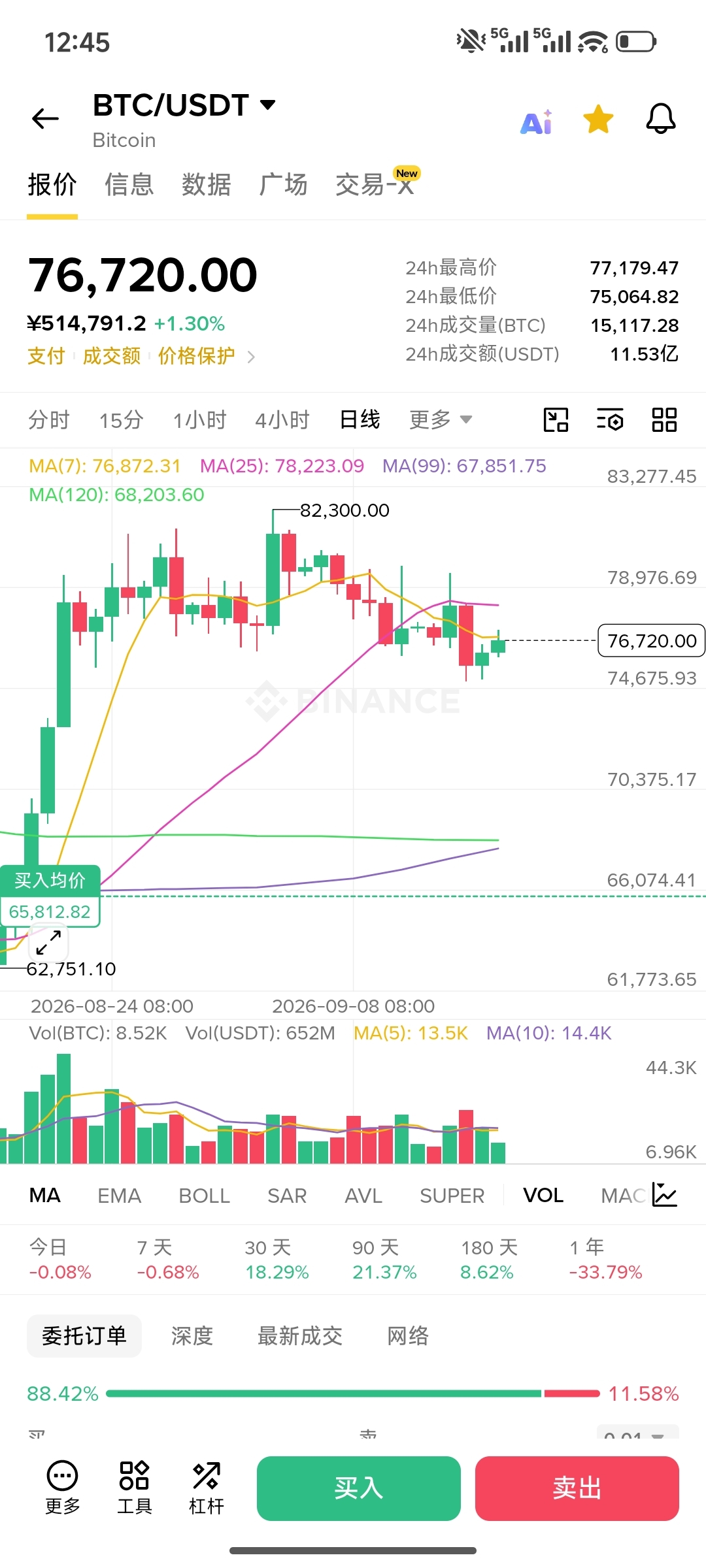

Late on September 17, 2026, the CLARITY Act’s procedural vote had already cooled for more than thirty hours.
49 to 50. With eleven votes short of the 60 needed to begin the debate.
A single procedural veto left the market with no clear direction. Bitcoin hovered around 76,500, repeatedly moving back and forth: the active buy orders above tried to break through the integer level, only to be pushed back by selling pressure; sell orders from below pressed right up to the support edge, but there weren’t enough follow-through trades to drive it through. Market depth remained, but the real willingness to absorb was gradually thinned by round after round of test orders.
No one is willing to be the first to admit the judgment is invalid.
Buying on the cheap fears catching a falling knife; looking overhead fears being in the empty space at the start of a rebound. Army forces and air forces confront each other across a narrow price band; open positions have not withdrawn meaningfully, and the funding rate hasn’t tilted enough. Everyone’s eyes are fixed on one place: if 76,500 is breached effectively, the cluster of stop-losses for the shorts will link up into a steep slope; if support fails, the longs’ dip-buying will instantly turn into liquidation fuel.
A fifteen-minute K-line stabbed upward.
The upper shadow was long, yet the body was pressed back to where it started.
The screen dimmed for a moment.
When I opened my eyes again, the wind was all sand.
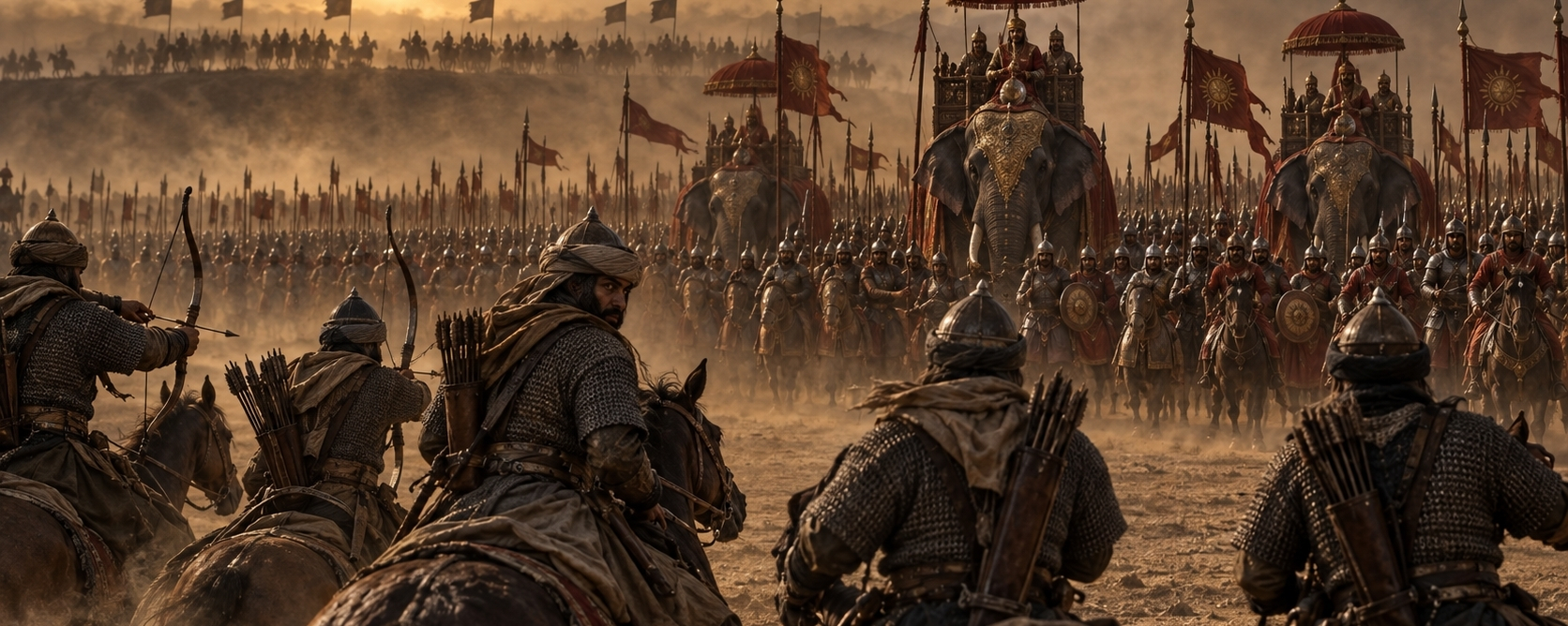
Sand grains slapped against the face—fine and hard. The ground wasn’t a carpet, wasn’t wooden flooring; it was yellow earth trampled firm by thousands of iron boots and horse hooves. Ahead there was a shallow depression. The two armies lined up on either side of it. No one crossed that border, which wasn’t even that deep.
The elephant formation on the east fell silent in the heat haze.
Giant elephants had copper armor over their foreheads. On the wooden towers atop the elephants’ backs stood spearmen. Red parasols sat high above; the rims barely moved. Behind the elephant formation came heavy cavalry—armor plates blackened by sweat, long spears held level, spear tips forming a line with no gaps. They didn’t charge, yet it was more suffocating than a charge. Horses pawed in place; the riders tightened the reins again and again, as if only one more command was needed and the entire front line would tip forward.
There were no elephants on the west.
Only light cavalry.
They spread out far, like dark blotches moving endlessly through a veil of dust. Short bows hung at hand, arrowheads pressed along the side of the saddle. Every so often, a small squad would edge closer—not charging, not engaging—just releasing a round of arrow rain from outside the line of sortie, then turning away and disappearing into farther sandstorm.
The heavy cavalry on the east was forced to adjust their formation.
They gathered to the left, and then the light cavalry from the west appeared from the right. They tried to push forward using a wedge formation; the mounted archers immediately fell back, keeping the distance always in the range where long spears could not make effective contact. Every advance was brief; every withdrawal was clean. None of it looked like a true retreat.
That wasn’t escape.
It was about verifying the resilience of the front line—measuring the pursuit threshold, repeatedly probing each flank that might collapse.
Just like those moments on the screen called “breakthrough.” Price crosses a threshold by half an inch, and trading volume suddenly amplifies: buy orders have just surged in, and sell pressure comes down from higher levels. Price falls below the support line—panic positions start loosening, and the counter-support arrives just in time. Every fluctuation is enough for some people to place bets early, yet not enough for either side to complete confirmation.
The battlefield was the same.
After the first round of arrow rain fell, the heavy cavalry didn’t go into chaos. After the second, the elephant formation still held steady. In the third, the eastern vanguard began probing forward, and the light cavalry withdrew as a whole—retreating just enough to make people believe it was a gap that could be torn open.
Someone issued the command to pursue.
The heavy cavalry pressed over the depression.
Dust suddenly rose, half-shrouding the banner behind the formation. Spears thrust forward, hooves quickened, and the wedge of hundreds finally pierced empty space. But the light cavalry on the west did not break. They simply scattered to the sides, like water being split by a blade. Arrows flew from the rear side—landing between the horse’s neck, shoulder armor, and the banner pole. Before the pursuit formation had even unfurled, the back began turning to search for comrades.
At this moment, the line hadn’t collapsed.
It only produced an extremely subtle delay.
But real collapse often begins with this kind of delay: the vanguard thinks the rear is still there; the rear thinks the vanguard has already pulled away. The left wing believes the right wing will fill in, but the right wing is waiting for a new command. No one runs first, yet order has already loosened ahead of people’s minds.
In the dust, someone shouted a name so loud it broke their voice.
“Prithviraj—”
I suddenly understood where I was standing.
1192. Tarein.
Later people would name it the “Second Battle of Tarein”—a calm, almost indifferent label—capturing the entire day on this plain: the holding actions, the probes, the pursuit, and the withdrawal. But anyone caught within it would never feel it was calm.
The commander on the east had won a battle here last year. His army formation excelled at frontal striking: the elephant formation pressed the center; heavy cavalry tore open the contact line, then drove the push home with numerical advantage. But this time, the commander on the west didn’t give him that chance. He refused to commit the main force to a front-line engagement; he only had the light cavalry keep cutting, wearing down, and luring.
The true main force never showed up.
It hid behind an embankment farther out.
At first, people thought it was only about supplies. Later the wind changed; the sand and dust cleared a little, and only then did they see those horses had never broken into sweat, and the riders had not participated in any probing attempt. The armor remained intact; the bowstrings hadn’t slackened; the banner poles were held extremely low.
That was a reserve force.
Its meaning isn’t in the number of people, but in timing. Every feigned retreat ahead, every flank-shot, every contact that seems pointless—it's all to make the opponent spend through their own integrity first. When the gap appears between the elephant formation and the heavy cavalry, when the pursuers separate from the foot soldiers, when everyone thinks the situation will remain locked and unchanged, the reserve will move along that gap into the opening.
On the slope of earth, someone raised a flag.
The sound of hooves was dull at first, then gathered into a low, vibrating pulse—passing through the ground, through armor, through the chest.
The screen lit up at that moment.
76,500 is still there.
No breakthrough, no pullback. Red and green still tangled within the same price band, as if nothing had happened. But beneath the order book, the dense zone of stop-losses and liquidations still hovered; above, the pressure from short covering still hadn’t faded.
What truly makes people uneasy is never that the price is temporarily unmoving.
No—what you don’t know is that one side’s reserve force is already mounted.