The Fed should still have one more rate hike this year
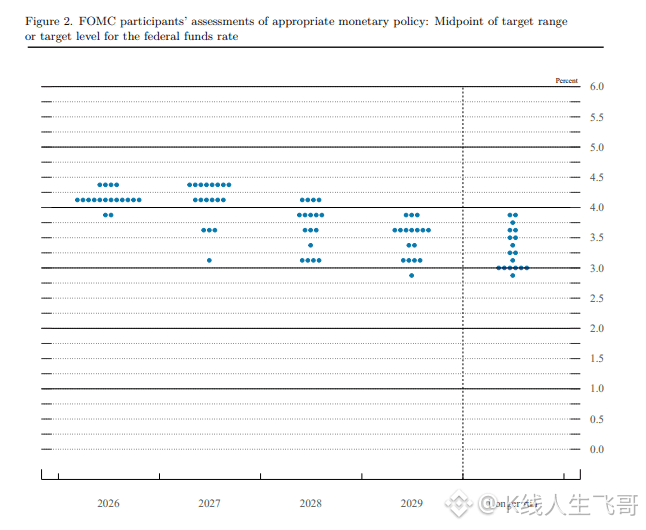
According to the latest released interest rate dot plot, among the 18 policymakers, 12 voted that the target rate range by end-2026 will be 4%–4.25%. This suggests that before the year ends, there is likely to be another 0.25% rate hike—possibly in October, or possibly in December, depending on inflation data.
As for 2027, half of the policymakers think rates will reach 4.5% (another 0.25%), while the other half believe rates will be kept unchanged or cut.
For the farther future—2028 and 2029—most policymakers expect rates to keep trending downward, eventually finding equilibrium in the 3%–3.5% range.
But everyone should pay attention to this:
Once the Fed begins a sustained cycle of rate hikes, the market will not immediately pivot to rate cuts.
The logic is actually very simple:
Rate-hike policy itself has built-in continuity. Before the hikes are officially implemented, the market may still entertain some optimism. But once the hike takes effect, large funds will start withdrawing gradually.
Because large funds need time to build positions and exit; they can’t operate the way retail investors do, with casual moves.
If rate hikes or cuts happen frequently and arbitrarily, it would blow up these large funds. And many of these large funds are international investors, for whom stability is very important—so they generally won’t easily change their cycle.
However, the departure of large funds won’t immediately trigger a massive sell-off and sharp plunge.
The reason is simple:
If they dumped quickly and decisively, there would be no chance to complete distributing the holdings. Instead, it would cause a stampede effect, leading to everyone being unable to sell.
So the market would rather move in this kind of pattern: modest up-and-down rallies—using rising prices to slowly distribute shares, meaning raising prices to offload.
Note that the essence of “raising prices to distribute” is not to make everyone profit. It’s to attract retail investors to step in, and then ultimately complete the bag-holding.
And only after all the shares have been distributed does the market truly come under pressure to fall.
So what people are earning right now, in essence, is the money from this round of “pump-and-distribute.”
That’s why I still believe the current market is worth comparing to 2023: a bear market turning into a bull market. There will be major fluctuations in the middle, and the market will keep washing back and forth. Will there be a pullback? There definitely will be.
According to the latest released interest rate dot plot, among the 18 policymakers, 12 voted that the target rate range by end-2026 will be 4%–4.25%. This suggests that before the year ends, there is likely to be another 0.25% rate hike—possibly in October, or possibly in December, depending on inflation data.
As for 2027, half of the policymakers think rates will reach 4.5% (another 0.25%), while the other half believe rates will be kept unchanged or cut.
For the farther future—2028 and 2029—most policymakers expect rates to keep trending downward, eventually finding equilibrium in the 3%–3.5% range.
But everyone should pay attention to this:
Once the Fed begins a sustained cycle of rate hikes, the market will not immediately pivot to rate cuts.
The logic is actually very simple:
Rate-hike policy itself has built-in continuity. Before the hikes are officially implemented, the market may still entertain some optimism. But once the hike takes effect, large funds will start withdrawing gradually.
Because large funds need time to build positions and exit; they can’t operate the way retail investors do, with casual moves.
If rate hikes or cuts happen frequently and arbitrarily, it would blow up these large funds. And many of these large funds are international investors, for whom stability is very important—so they generally won’t easily change their cycle.
However, the departure of large funds won’t immediately trigger a massive sell-off and sharp plunge.
The reason is simple:
If they dumped quickly and decisively, there would be no chance to complete distributing the holdings. Instead, it would cause a stampede effect, leading to everyone being unable to sell.
So the market would rather move in this kind of pattern: modest up-and-down rallies—using rising prices to slowly distribute shares, meaning raising prices to offload.
Note that the essence of “raising prices to distribute” is not to make everyone profit. It’s to attract retail investors to step in, and then ultimately complete the bag-holding.
And only after all the shares have been distributed does the market truly come under pressure to fall.
So what people are earning right now, in essence, is the money from this round of “pump-and-distribute.”
That’s why I still believe the current market is worth comparing to 2023: a bear market turning into a bull market. There will be major fluctuations in the middle, and the market will keep washing back and forth. Will there be a pullback? There definitely will be.