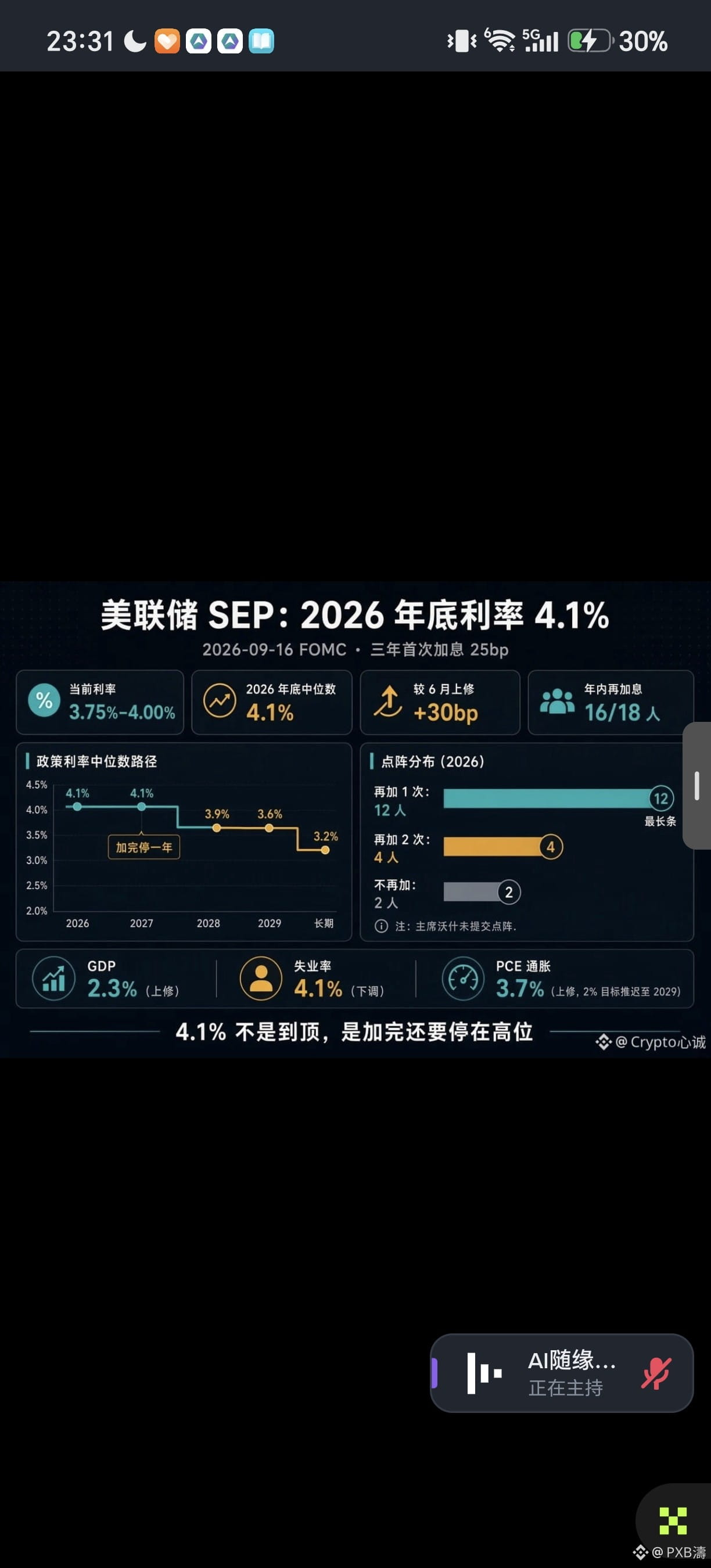
“The Fed’s SEP expects a 4.1% rate in 2026
In the Fed’s SEP, the median year-end 2026 interest-rate level was revised up from 3.8% to 4.1%. After just adding 25bp to a target range of 3.75%–4.00%, 16/18 people in the dot plot still expect another round of tightening; the median for mid-2027 remains 4.1%.
Growth was revised upward, the unemployment rate was revised downward, and the inflation target was pushed back to 2029. This is not ‘it’s topped out after the hikes’; it’s ‘hike, then stay at a high level.’ The dot plot will change, and if inflation doesn’t come down, 4.1% won’t be only a forecast.” This refers to: In its Summary of Economic Projections (SEP), the Federal Reserve raised its expectations for the federal funds rate at the end of 2026; policymakers project the median rate to be about 4.1%, higher than the previous 3.8%.
Several key points in the passage are:
25bp equals 0.25 percentage points. The interest rate has just been raised to the target range of 3.75%–4.00%.
The dot plot reflects each Fed official’s individual estimate for future rates; “16/18 people still need to add one more time” means most officials at the time thought another at least 0.25 percentage-point rate hike was still possible.
Even by the end of 2027, the median in the forecast remains 4.1%, indicating that policy rates may stay relatively high for a longer period rather than quickly returning to a low-rate environment.
“Growth revised upward, unemployment rate revised downward” means officials believe the economy and employment are more resilient than previously expected; this reduces the need for immediate large rate cuts.
“Inflation target pushed back to 2029” indicates that the pace of bringing inflation back to the Fed’s roughly 2% goal may be slower, so high interest rates may need to be maintained longer to curb price pressures.
In short, the core message of this statement is a more hawkish signal: whereas markets may have expected that after rate hikes end, the Fed would quickly pivot to rate cuts, this forecast suggests that rates may need to rise a bit more and then stay high for longer. However, both the SEP and the dot plot are forecasts, not commitments; the future will still be adjusted as inflation, employment, and economic data evolve.
In the Fed’s SEP, the median year-end 2026 interest-rate level was revised up from 3.8% to 4.1%. After just adding 25bp to a target range of 3.75%–4.00%, 16/18 people in the dot plot still expect another round of tightening; the median for mid-2027 remains 4.1%.
Growth was revised upward, the unemployment rate was revised downward, and the inflation target was pushed back to 2029. This is not ‘it’s topped out after the hikes’; it’s ‘hike, then stay at a high level.’ The dot plot will change, and if inflation doesn’t come down, 4.1% won’t be only a forecast.” This refers to: In its Summary of Economic Projections (SEP), the Federal Reserve raised its expectations for the federal funds rate at the end of 2026; policymakers project the median rate to be about 4.1%, higher than the previous 3.8%.
Several key points in the passage are:
25bp equals 0.25 percentage points. The interest rate has just been raised to the target range of 3.75%–4.00%.
The dot plot reflects each Fed official’s individual estimate for future rates; “16/18 people still need to add one more time” means most officials at the time thought another at least 0.25 percentage-point rate hike was still possible.
Even by the end of 2027, the median in the forecast remains 4.1%, indicating that policy rates may stay relatively high for a longer period rather than quickly returning to a low-rate environment.
“Growth revised upward, unemployment rate revised downward” means officials believe the economy and employment are more resilient than previously expected; this reduces the need for immediate large rate cuts.
“Inflation target pushed back to 2029” indicates that the pace of bringing inflation back to the Fed’s roughly 2% goal may be slower, so high interest rates may need to be maintained longer to curb price pressures.
In short, the core message of this statement is a more hawkish signal: whereas markets may have expected that after rate hikes end, the Fed would quickly pivot to rate cuts, this forecast suggests that rates may need to rise a bit more and then stay high for longer. However, both the SEP and the dot plot are forecasts, not commitments; the future will still be adjusted as inflation, employment, and economic data evolve.