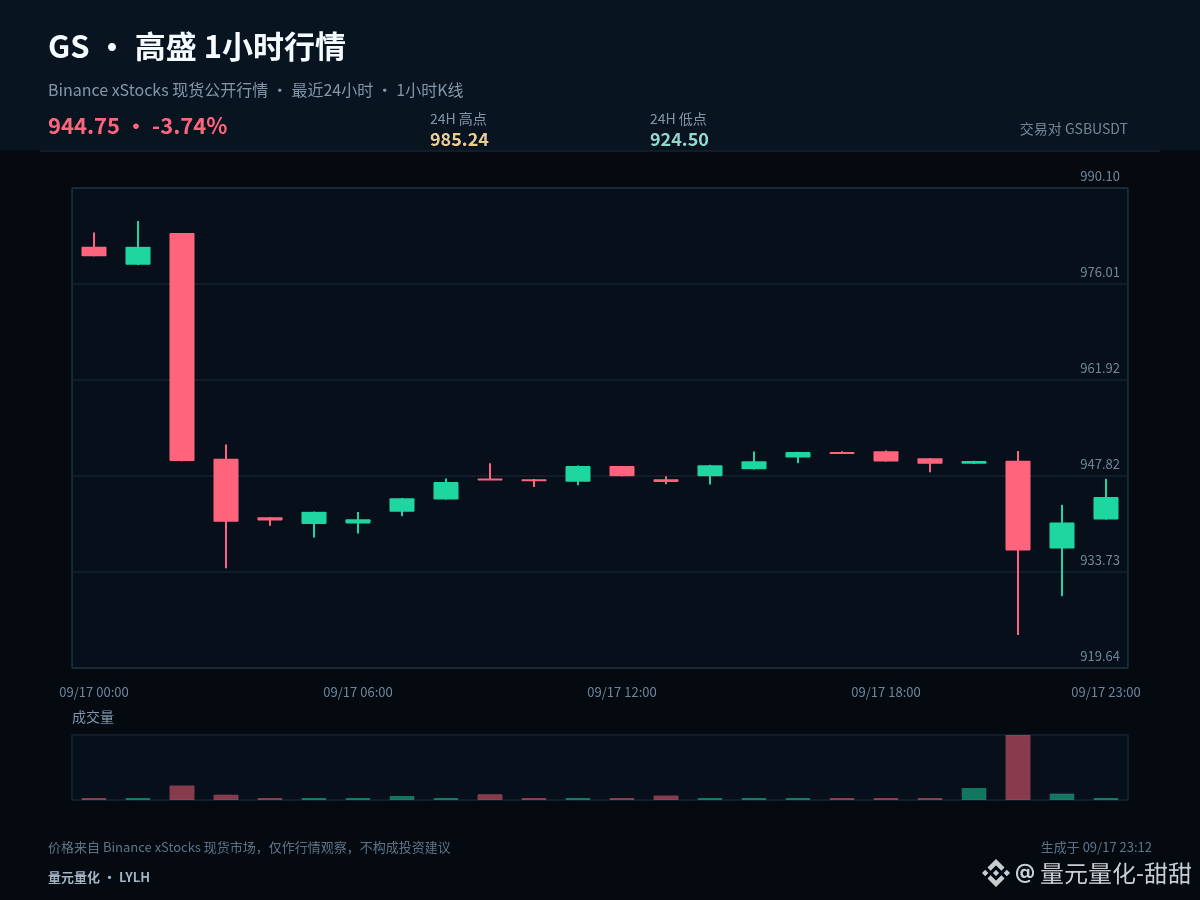
$GSB #GS Can this market trend continue? It doesn’t depend on how much it has risen before, but on whether the trend can complete the cycle of “advance, consolidation, and re-confirmation.” Currently, the 1-hour change is +0.40%, and the 24-hour change is -3.74%.
Currently, the 1-hour is +0.40% and the 24-hour is -3.74%. The two timeframes have not formed sufficiently clear alignment in the same direction. In a range-bound market, the tolerance for chasing or selling in panic is low. It’s more suitable to confirm direction using the upper boundary, confirm support using the lower boundary and the lower-boundary bounce/hold. The midline is only used as the line dividing relative strength and weakness.
The first condition for an ongoing structure is that 954.87 is not broken down effectively. The second condition is that the price can retest and regain a stable position above 985.24. If, after the advance, the price stays below the midline for a long time, it indicates that the active buy-side momentum is weakening. If 924.5 is further lost, then the earlier assumption of continuation needs to be canceled.
The next path can be handled in three ways: if price effectively holds above 985.24, wait for a pullback that doesn’t break and then reassess continuation; if price breaks down below 924.5, prioritize controlling risk and wait for new support; if it continues to range around 954.87, treat it as turnover/rotation within the range and don’t repeatedly chase direction from the middle position.
For existing positions, you can manage them in segments based on key levels to avoid making all judgments at once. For those currently in cash, wait for breakout confirmation or a stabilization after a pullback. For U.S. stock targets, also be mindful of volatility caused by trading session transitions. Your plan should be based on price conditions—not on emotions replacing execution.
The focus of a short-term position isn’t to predict every single candlestick. It’s to ensure there’s a basis for entry, trimming, and exiting. If there’s no confirmation, do less. If a key level fails, redo the plan. First control per-trade risk, then talk about potential upside/downside space.
#ParadigmDisclosesZECHolding
Currently, the 1-hour is +0.40% and the 24-hour is -3.74%. The two timeframes have not formed sufficiently clear alignment in the same direction. In a range-bound market, the tolerance for chasing or selling in panic is low. It’s more suitable to confirm direction using the upper boundary, confirm support using the lower boundary and the lower-boundary bounce/hold. The midline is only used as the line dividing relative strength and weakness.
The first condition for an ongoing structure is that 954.87 is not broken down effectively. The second condition is that the price can retest and regain a stable position above 985.24. If, after the advance, the price stays below the midline for a long time, it indicates that the active buy-side momentum is weakening. If 924.5 is further lost, then the earlier assumption of continuation needs to be canceled.
The next path can be handled in three ways: if price effectively holds above 985.24, wait for a pullback that doesn’t break and then reassess continuation; if price breaks down below 924.5, prioritize controlling risk and wait for new support; if it continues to range around 954.87, treat it as turnover/rotation within the range and don’t repeatedly chase direction from the middle position.
For existing positions, you can manage them in segments based on key levels to avoid making all judgments at once. For those currently in cash, wait for breakout confirmation or a stabilization after a pullback. For U.S. stock targets, also be mindful of volatility caused by trading session transitions. Your plan should be based on price conditions—not on emotions replacing execution.
The focus of a short-term position isn’t to predict every single candlestick. It’s to ensure there’s a basis for entry, trimming, and exiting. If there’s no confirmation, do less. If a key level fails, redo the plan. First control per-trade risk, then talk about potential upside/downside space.
#ParadigmDisclosesZECHolding