Grayscale Holdings Data Analysis🔥 Big Bitcoin + Ethereum almost cover the entire treasury!
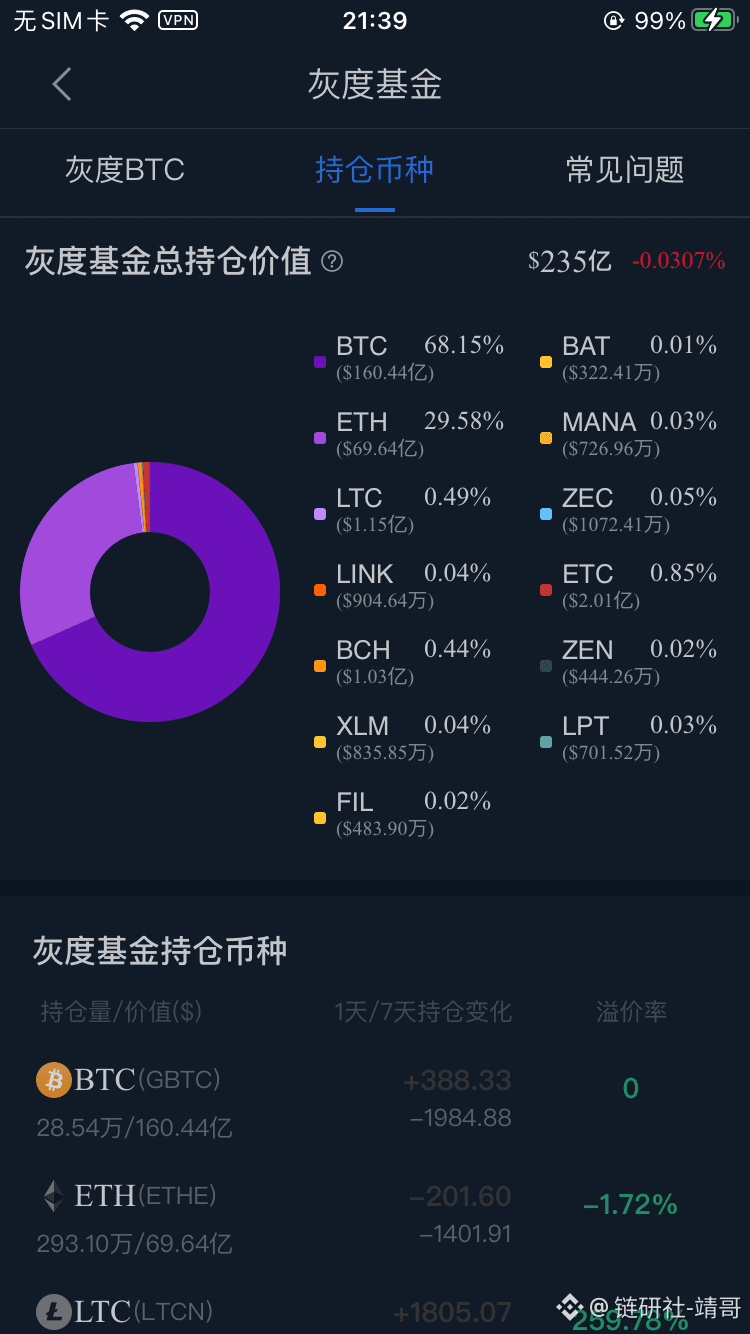
Total Grayscale holdings: $23.5 billion. Take one quick look at the pie chart’s key conclusion:
Grayscale’s “core holdings” are basically two champions—BTC and ETH. The combined share of all other coins is pitifully small.
• BTC: 68.15%, worth $16.044 billion, the #1 largest position absolutely
• ETH: 29.58%, worth $6.964 billion, firmly in second place
👉 BTC + ETH together account for as much as 97.73%. The remaining dozen-plus altcoins add up to only a little over 2%.
✅ 1. Grayscale’s investment logic is extremely conservative—it only bets on the two main crypto assets
Even when the market cycles through various hot topics like altcoins, public chains, and narrative coins, Grayscale hasn’t moved to overweight those. Coins that everyone often talks about—LINK, FIL, MANA, ZEC—have all holding proportions below 0.1%. They’re only small-position allocations and hardly affect the overall net value.
In simple terms: Grayscale’s gains and losses are completely tied to Bitcoin and Ethereum’s price action. No matter how much altcoins pump, their impact on Grayscale’s overall return is negligible.
✅ 2. Institutional capital is very cautious about altcoins
Many retail investors rush into altcoins and position themselves around hot narratives, but Grayscale—the leading long-established institution—hasn’t taken large positions. Institutional capital values liquidity and long-term consensus more. Small-cap coins can’t absorb capital on the scale of tens of billions.
✅ 3. The main potential selling pressure is mainly concentrated in BTC and ETH
If large-scale redemptions occur later, the main outflow of shares will be BTC and ETH. Other small coins are too tiny— even if they’re fully liquidated, they won’t cause much of a shock to the order book.
👉 Watch Grayscale’s redemptions: focus on the capital flows for BTC and ETH. The other altcoins don’t need to be treated as the main reference for Grayscale holdings.
✅ 4. Small-cap coin holdings can be seen as an institution’s “watch position”
Coins like LINK, LTC, and ETC may have light allocations, but at least there is some exposure. This indicates institutions are staying attentive—though they’re not yet at the stage of heavy weighting.
Summary: Grayscale’s massive $23.5 billion asset pool, in essence, is a combination of BTC + ETH. Real money is voting with its positions: in the eyes of institutions, the truly core assets in the crypto market are only BTC and ETH.
💬 Do you think Grayscale will increase its allocation to altcoins next? Let us know your thoughts in the comments!
Follow along and keep tracking institutional fund flows like Grayscale! $ETH $BTC $ZEC
Total Grayscale holdings: $23.5 billion. Take one quick look at the pie chart’s key conclusion:
Grayscale’s “core holdings” are basically two champions—BTC and ETH. The combined share of all other coins is pitifully small.
• BTC: 68.15%, worth $16.044 billion, the #1 largest position absolutely
• ETH: 29.58%, worth $6.964 billion, firmly in second place
👉 BTC + ETH together account for as much as 97.73%. The remaining dozen-plus altcoins add up to only a little over 2%.
✅ 1. Grayscale’s investment logic is extremely conservative—it only bets on the two main crypto assets
Even when the market cycles through various hot topics like altcoins, public chains, and narrative coins, Grayscale hasn’t moved to overweight those. Coins that everyone often talks about—LINK, FIL, MANA, ZEC—have all holding proportions below 0.1%. They’re only small-position allocations and hardly affect the overall net value.
In simple terms: Grayscale’s gains and losses are completely tied to Bitcoin and Ethereum’s price action. No matter how much altcoins pump, their impact on Grayscale’s overall return is negligible.
✅ 2. Institutional capital is very cautious about altcoins
Many retail investors rush into altcoins and position themselves around hot narratives, but Grayscale—the leading long-established institution—hasn’t taken large positions. Institutional capital values liquidity and long-term consensus more. Small-cap coins can’t absorb capital on the scale of tens of billions.
✅ 3. The main potential selling pressure is mainly concentrated in BTC and ETH
If large-scale redemptions occur later, the main outflow of shares will be BTC and ETH. Other small coins are too tiny— even if they’re fully liquidated, they won’t cause much of a shock to the order book.
👉 Watch Grayscale’s redemptions: focus on the capital flows for BTC and ETH. The other altcoins don’t need to be treated as the main reference for Grayscale holdings.
✅ 4. Small-cap coin holdings can be seen as an institution’s “watch position”
Coins like LINK, LTC, and ETC may have light allocations, but at least there is some exposure. This indicates institutions are staying attentive—though they’re not yet at the stage of heavy weighting.
Summary: Grayscale’s massive $23.5 billion asset pool, in essence, is a combination of BTC + ETH. Real money is voting with its positions: in the eyes of institutions, the truly core assets in the crypto market are only BTC and ETH.
💬 Do you think Grayscale will increase its allocation to altcoins next? Let us know your thoughts in the comments!
Follow along and keep tracking institutional fund flows like Grayscale! $ETH $BTC $ZEC