
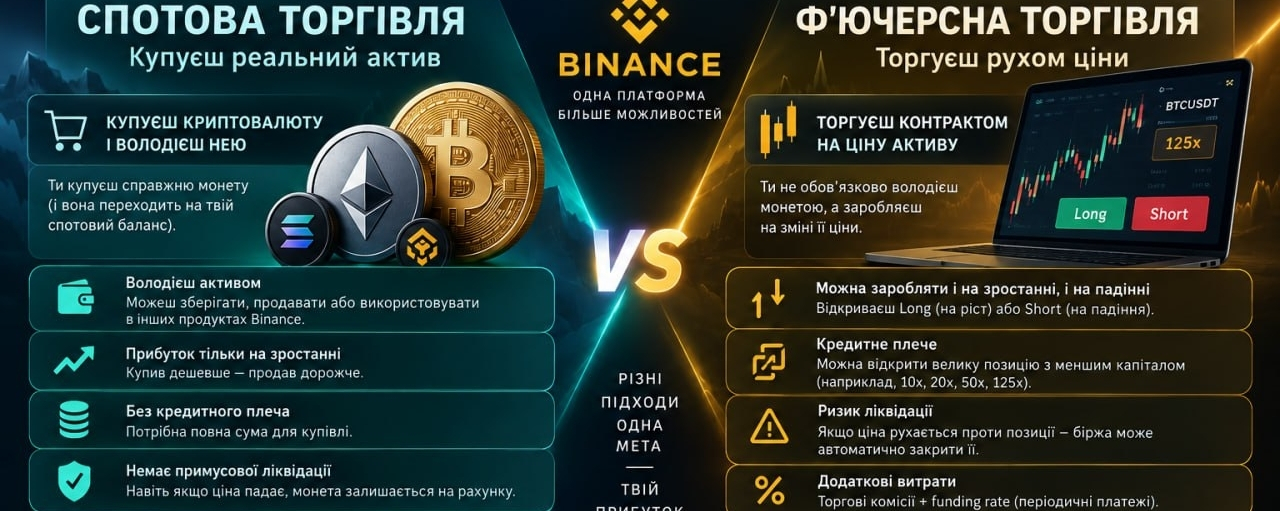

Spot and futures trading on #Binance — are two different ways of working with cryptocurrencies. Spot trading means that a user buys or sells the actual asset, for example Bitcoin, Ethereum, or another cryptocurrency. After the purchase, the coin effectively transfers to their spot balance and can be stored, sold, or used in other Binance products. Futures trading takes place via a contract whose value is linked to the price of the cryptocurrency, but as a result of the transaction the user may not receive the underlying asset itself.
The main difference lies in how profit is obtained. In the spot market, a trader typically buys cryptocurrency at a lower price and expects it to rise, after which they sell it at a higher price. For example, if Bitcoin is bought for $100,000 and sold for $110,000, the difference is $10,000 before commissions. On futures, you can open positions both #LONG✅ , when the trader expects the price to rise, and #SHORT📉 , when they expect it to fall. Therefore, futures make it possible to trade in both directions of market movement.
An important feature of futures is leverage. It allows you to control a position that is larger than the capital you initially contribute. For example, with 10× leverage, a $1,000 position can be opened with collateral of approximately $100. This increases potential profit, but at the same time increases potential loss. If the price moves against the position strongly enough, liquidation may occur—that is, the exchange will forcibly close the position.
In the spot market, there is no such liquidation mechanism for a normal purchased position. If a user bought Bitcoin for $100,000 and its price fell to $70,000, the Bitcoin remains in their account, even though its market value decreases. The trader can wait for the price to recover or sell the asset at a loss. On futures, the situation is different: due to the use of margin, even a relatively small price move against the position can lead to a significant loss.
Another difference is the ability to use capital more efficiently. On the spot market, to buy an asset worth $1,000, you usually need to have about $1,000 of the corresponding currency. On futures, you can use a smaller initial capital thanks to the margin mechanism. For example, a trader can open a position with a notional value of $1,000, using only part of that amount as margin. However, this does not mean the trading becomes cheaper or safer—the risk just becomes higher.
The structure of costs also differs. In spot trading, the main expenses are trading commissions, as well as a possible difference between the buy and sell prices—spread. In futures trading, in addition to trading commissions, an important role is played by the funding rate—a periodic payment between market participants that helps keep the price of the perpetual futures contract close to the spot price. Therefore, when holding a futures position for a long time, you need to consider not only price movements but also current costs.
Spot and futures also differ in their practical purpose. The spot market is better suited for situations where a person wants to directly own cryptocurrency. For example, they can buy ETH and hold it for several months or years. Futures are more often used for active trading, short-term strategies, working with Long and Short, as well as for hedging—reducing the impact of adverse price movements on other assets.
An important advantage of the futures market is a larger number of trading opportunities. A trader can use strategies for rising and falling prices, breakouts of levels, price movement after news, trading impulses, or liquidations. For example, if a trader expects a strong decline in a certain coin, on the spot market they might simply not buy it, whereas on futures they can open a Short position. At the same time, the complexity of such operations is higher, so you need to control the position size, leverage, margin, and the liquidation level.
If we compare the two markets very simply, spot means “buy the coin itself,” while futures means “trade the movement of its price.” Spot is characterized by a simpler logic and the absence of forced liquidation for a normal purchased position. Futures provide more tools: Long, Short, leverage, margin trading, and various trading strategies. But along with this, they require much more risk control.
So, spot and futures trading on Binance are focused on different trading approaches. Spot can be viewed as a more direct way to invest in a cryptocurrency asset, while futures are a tool for actively trading fluctuations in its price. The key difference is not just potential profit, but the level of risk and trading mechanics: futures allow you to use leverage and profit from movement in both directions, but at the same time create the risk of quickly losing margin. Therefore, the choice between spot and futures depends on the trader’s goals, their strategy, and their willingness to manage risks.