Spot/trading fees for CL/BTC/DOGE, funding rates—which are higher and which are lower? Is leverage proportional to fees? With 1000 USDT and 10x or 100x leverage, what are the fees? Even many traders who have been doing this for years often don’t really know—because money compounds on itself repeatedly and adds up to a lot. Still, you need to understand it.
First, distinguish two different kinds of money:
① Trading fees: charged once for opening and once for closing (both sides), based on the notional position size.
② Funding fees: during the holding period, longs and shorts pay each other, also based on the notional position size.
Trading fee (common tier for regular users; using Binance USDT-based as an example—VIP is lower):
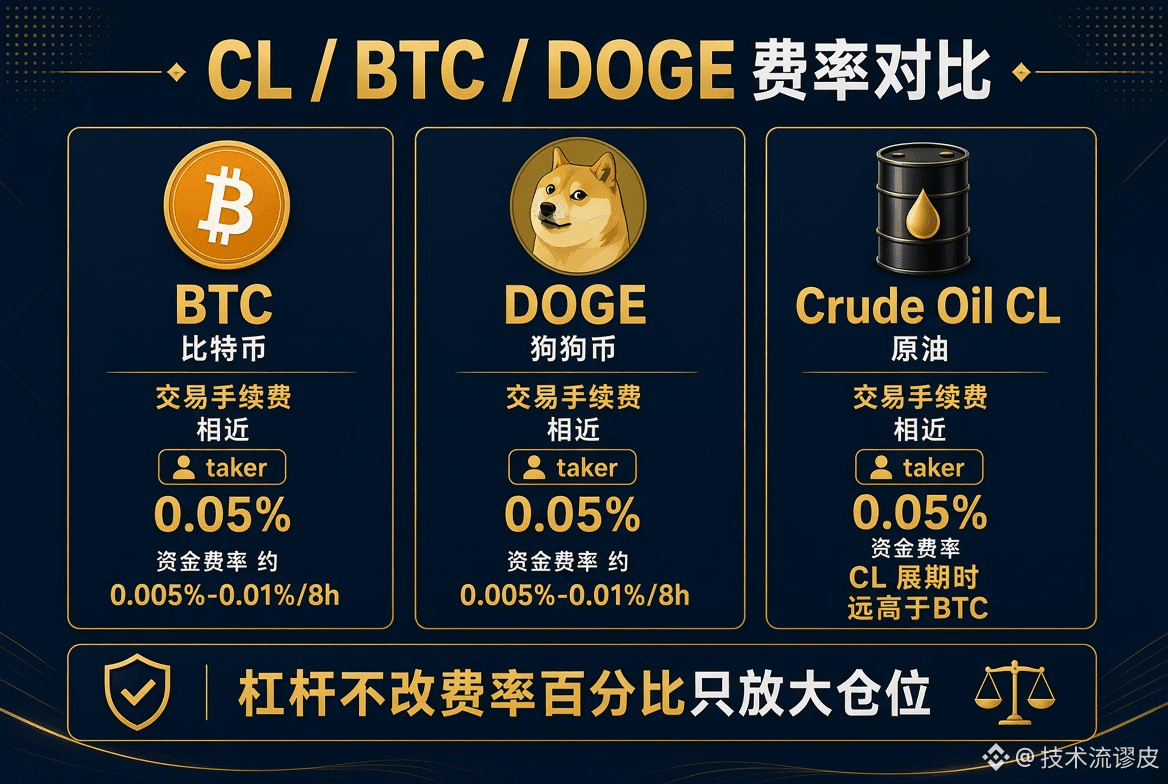
Typically maker 0.02%, taker 0.05%.
BTC, DOGE, and CL mostly use the same contract trading-fee structure. It’s not that crude oil fees are especially expensive. What truly creates the gap is the funding rate (recently stable but can change).
• BTC: about 0.005%~0.01% per 8 hours; annualized roughly 5%~11%—the most stable and lowest
• DOGE: roughly the same 0.005%~0.01% per 8 hours, but slightly easier to be swayed by sentiment
• CL (crude oil): settlement is often in 4-hour intervals; normally it can be close to 0, but once you enter a rollover/one-sided market, it can spike far above BTC (in extreme cases, hundreds of percent annualized have occurred)
Which is higher and which is lower?
Fees: the three are pretty similar
Funding: BTC ≈ DOGE (much lower) ≪ CL (CL is highest when it “goes crazy”)
Is leverage proportional to the fee rate?
The fee *percentage* is not proportional; the absolute amount is proportional.
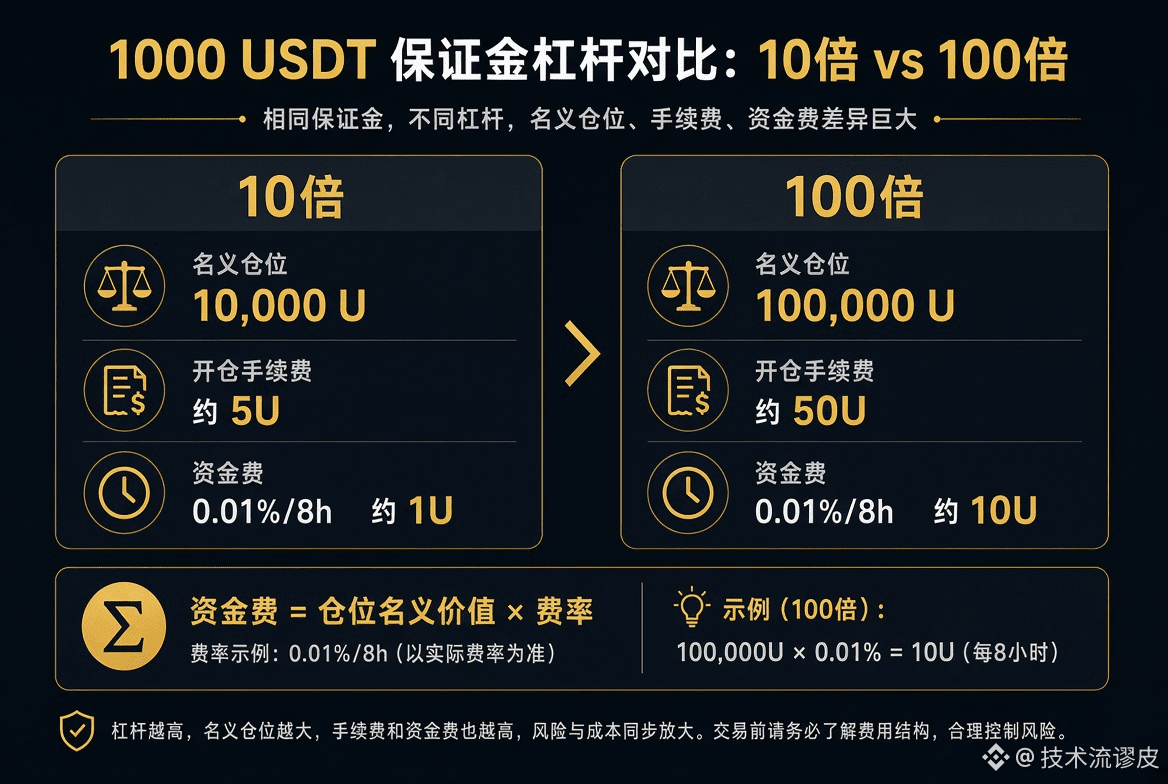
The higher the leverage, the larger the notional position opened with the same 1000 USDT, and both trading fees and funding fees are amplified by position size.
Rough example of 1000 USDT margin (using taker 0.05%, and counting only the opening trade once):
• 10x → notional 10,000 USDT → fee about 5 USDT
• 100x → notional 100,000 USDT → fee about 50 USDT
Closing charges the same fee again. So round-trip is 10 USDT vs 100 USDT.
Funding fees are similar: assume the period’s funding is 0.01% per 8 hours:
• 10x: about 1 USDT per 8 hours
• 100x: about 10 USDT per 8 hours
Conclusion
To save money: use fewer market orders, lower leverage, and avoid holding CL overnight.
BTC is suitable as a “fee-rate benchmark”; CL is suitable as a “structure tax”—not because the platform is charging randomly, but because futures roll/contango dynamics squeeze shorts together.
The above is not financial advice. Fee rates in real time are shown by the exchange and should be used as the reference.
First, distinguish two different kinds of money:
① Trading fees: charged once for opening and once for closing (both sides), based on the notional position size.
② Funding fees: during the holding period, longs and shorts pay each other, also based on the notional position size.
Trading fee (common tier for regular users; using Binance USDT-based as an example—VIP is lower):
Typically maker 0.02%, taker 0.05%.
BTC, DOGE, and CL mostly use the same contract trading-fee structure. It’s not that crude oil fees are especially expensive. What truly creates the gap is the funding rate (recently stable but can change).
• BTC: about 0.005%~0.01% per 8 hours; annualized roughly 5%~11%—the most stable and lowest
• DOGE: roughly the same 0.005%~0.01% per 8 hours, but slightly easier to be swayed by sentiment
• CL (crude oil): settlement is often in 4-hour intervals; normally it can be close to 0, but once you enter a rollover/one-sided market, it can spike far above BTC (in extreme cases, hundreds of percent annualized have occurred)
Which is higher and which is lower?
Fees: the three are pretty similar
Funding: BTC ≈ DOGE (much lower) ≪ CL (CL is highest when it “goes crazy”)
Is leverage proportional to the fee rate?
The fee *percentage* is not proportional; the absolute amount is proportional.
The higher the leverage, the larger the notional position opened with the same 1000 USDT, and both trading fees and funding fees are amplified by position size.
Rough example of 1000 USDT margin (using taker 0.05%, and counting only the opening trade once):
• 10x → notional 10,000 USDT → fee about 5 USDT
• 100x → notional 100,000 USDT → fee about 50 USDT
Closing charges the same fee again. So round-trip is 10 USDT vs 100 USDT.
Funding fees are similar: assume the period’s funding is 0.01% per 8 hours:
• 10x: about 1 USDT per 8 hours
• 100x: about 10 USDT per 8 hours
Conclusion
To save money: use fewer market orders, lower leverage, and avoid holding CL overnight.
BTC is suitable as a “fee-rate benchmark”; CL is suitable as a “structure tax”—not because the platform is charging randomly, but because futures roll/contango dynamics squeeze shorts together.
The above is not financial advice. Fee rates in real time are shown by the exchange and should be used as the reference.