🚀 Building an algorithmic trading bot from scratch
I’ve been working for several weeks on a modular quantitative trading system in Python, initially focused on BTC/USD and ETH/USD.
The project already includes technical analysis, risk management, position sizing, LONG/SHORT, backtesting, simulation of fees/spread/slippage, real-time paper trading, position persistence, performance metrics, and statistical analysis.
We’re currently at a key stage: extended paper trading and validation with real market data, but without using real money.
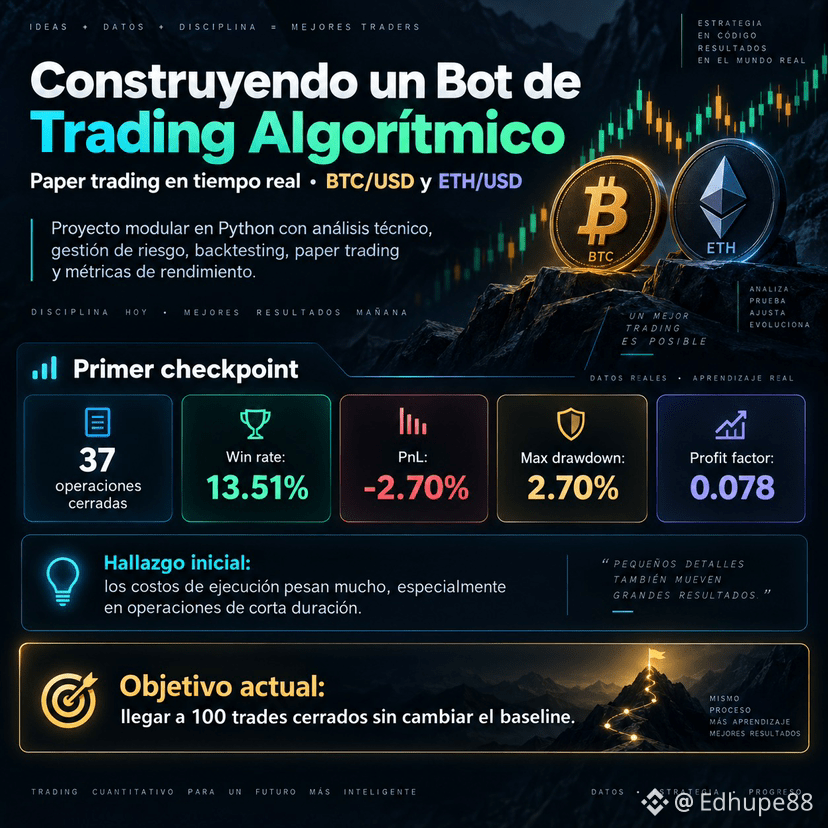
First checkpoint: 37 closed trades.
📊 Initial baseline results:
Win rate: 13.51%
PnL: -2.70%
Max drawdown: 2.70%
Profit factor: 0.078
The numbers aren’t good yet, and that’s exactly what’s interesting: instead of tweaking the strategy until a backtest “looks pretty,” we’re studying why it loses, how much commissions matter, what happens in BTC vs ETH, LONG vs SHORT, and what effect the duration of trades has.
An initial observation: execution costs are having a huge impact, especially on short-duration trades.
The next goal is to reach 100 closed trades without changing the baseline, to get a more representative sample before optimizing anything.
For me, building a bot isn’t about finding a strategy that always wins. It’s about creating a system that can be measured, challenged, fail in a controlled way, and improve with evidence.
We keep building. 📈🤖
#AlgorithmicTrading #TradingBot #Python #BTC #ETH $ #CryptoTrading #QuantTrading #PaperTrading #RiskManagement #BinanceSquare
I’ve been working for several weeks on a modular quantitative trading system in Python, initially focused on BTC/USD and ETH/USD.
The project already includes technical analysis, risk management, position sizing, LONG/SHORT, backtesting, simulation of fees/spread/slippage, real-time paper trading, position persistence, performance metrics, and statistical analysis.
We’re currently at a key stage: extended paper trading and validation with real market data, but without using real money.
First checkpoint: 37 closed trades.
📊 Initial baseline results:
Win rate: 13.51%
PnL: -2.70%
Max drawdown: 2.70%
Profit factor: 0.078
The numbers aren’t good yet, and that’s exactly what’s interesting: instead of tweaking the strategy until a backtest “looks pretty,” we’re studying why it loses, how much commissions matter, what happens in BTC vs ETH, LONG vs SHORT, and what effect the duration of trades has.
An initial observation: execution costs are having a huge impact, especially on short-duration trades.
The next goal is to reach 100 closed trades without changing the baseline, to get a more representative sample before optimizing anything.
For me, building a bot isn’t about finding a strategy that always wins. It’s about creating a system that can be measured, challenged, fail in a controlled way, and improve with evidence.
We keep building. 📈🤖
#AlgorithmicTrading #TradingBot #Python #BTC #ETH $ #CryptoTrading #QuantTrading #PaperTrading #RiskManagement #BinanceSquare