What Is a DEX and How Does It Work?
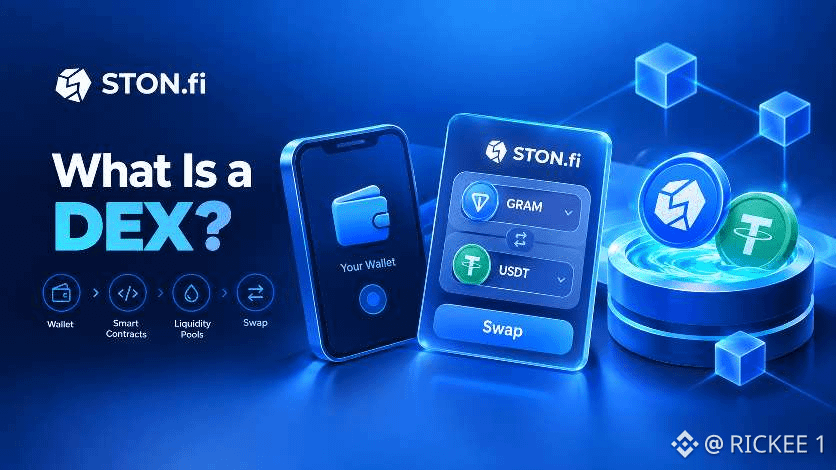
A decentralized exchange (DEX) is a system that lets users exchange digital assets without a central custodian. Users connect a self-custodial wallet and authorize smart-contract transactions.
Self-custody means the user controls the wallet’s keys and approves transactions directly. Smart contracts enforce the exchange rules, while the blockchain records and settles the result. On TON, token transfers and swaps use blockchain messages and contract logic.
Many DEXs use Automated Market Makers (AMMs). Instead of matching buyers and sellers through an order book, AMMs use liquidity pools funded by liquidity providers. Pricing follows the pool’s state and mathematical model. Trade size, liquidity and fees can affect execution, while larger trades can create greater price impact.
An order-book model works differently: traders submit bids and asks, and compatible orders are matched. An AMM lets users trade directly against pooled liquidity. Both require liquidity, but organize it differently.
DEX swap flow:
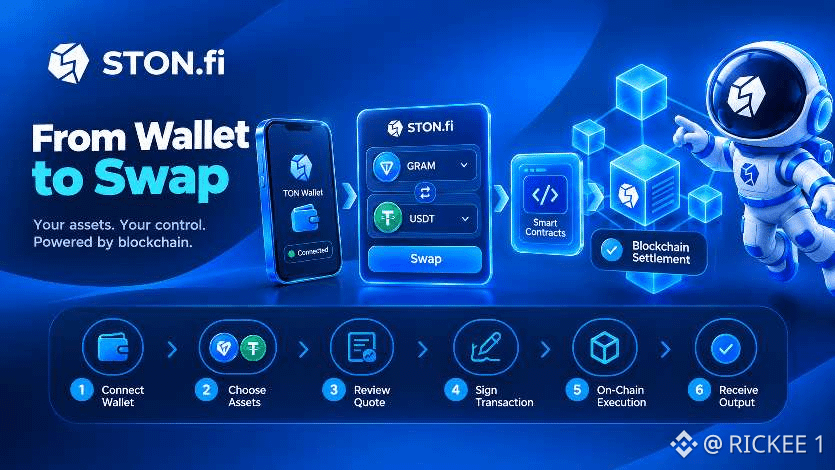
Connect wallet → select assets → receive a quote → review fees, slippage and price impact → sign → smart contracts execute → receive the output asset.
STON.fi provides a practical example on TON. A user connects a TON wallet, selects assets, reviews the quote and conditions, then approves the transaction. On-chain infrastructure executes the swap and delivers the result to the wallet.
STON.fi also shows that a DEX is more than a swap interface. Liquidity pools provide trading capital, liquidity providers supply assets, and routing infrastructure can connect available liquidity sources.
The key distinction is simple: STON.fi demonstrates DEX principles in practice; it is not the definition of a DEX.
Fundamentally, a DEX combines self-custody, blockchain settlement, smart-contract execution, liquidity and pricing mechanisms. The “Swap” button is the interface for an on-chain process.
$GRAM $BTC
A decentralized exchange (DEX) is a system that lets users exchange digital assets without a central custodian. Users connect a self-custodial wallet and authorize smart-contract transactions.
Self-custody means the user controls the wallet’s keys and approves transactions directly. Smart contracts enforce the exchange rules, while the blockchain records and settles the result. On TON, token transfers and swaps use blockchain messages and contract logic.
Many DEXs use Automated Market Makers (AMMs). Instead of matching buyers and sellers through an order book, AMMs use liquidity pools funded by liquidity providers. Pricing follows the pool’s state and mathematical model. Trade size, liquidity and fees can affect execution, while larger trades can create greater price impact.
An order-book model works differently: traders submit bids and asks, and compatible orders are matched. An AMM lets users trade directly against pooled liquidity. Both require liquidity, but organize it differently.
DEX swap flow:
Connect wallet → select assets → receive a quote → review fees, slippage and price impact → sign → smart contracts execute → receive the output asset.
STON.fi provides a practical example on TON. A user connects a TON wallet, selects assets, reviews the quote and conditions, then approves the transaction. On-chain infrastructure executes the swap and delivers the result to the wallet.
STON.fi also shows that a DEX is more than a swap interface. Liquidity pools provide trading capital, liquidity providers supply assets, and routing infrastructure can connect available liquidity sources.
The key distinction is simple: STON.fi demonstrates DEX principles in practice; it is not the definition of a DEX.
Fundamentally, a DEX combines self-custody, blockchain settlement, smart-contract execution, liquidity and pricing mechanisms. The “Swap” button is the interface for an on-chain process.
$GRAM $BTC