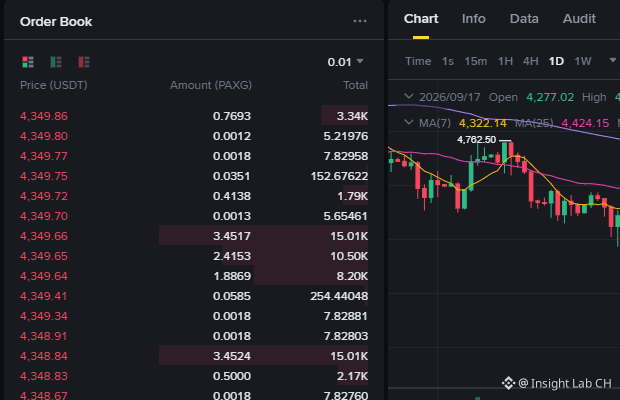
In the latest global financial market trading sessions, both safe-haven assets and the sovereign bond market saw notable fluctuations at the same time. The yield on UK 30-year government bonds plunged by 10 basis points to 5.76% during the day, marking the largest single-day decline since May last year. Meanwhile, the precious metals market saw strong buy-side momentum. Gold jumped by nearly $15 to $4,350 per troy ounce during the day, up 2.07%. Silver also rose in sync by $0.40, with its price climbing to $64.63 per troy ounce. The synchronized moves in these two representative assets clearly reflect that market funds are undergoing aggressive repricing.
The sharp drop in long-end government bond yields alongside the strong rally in precious metals is usually not a signal of healthy liquidity expansion. Instead, it reflects global funds adopting a defensive hedge as macro uncertainty intensifies and tail risks from stagflation increase. The sudden decline in long-term interest rates suggests the market has deep doubts about the growth momentum of the economy in the mid- to long term—potentially even pricing in recession risk ahead of time. At the same time, gold’s breakout rally highlights concerns that sovereign credit and fiat currencies are being eroded by inflation and geopolitical uncertainty. Compared with earlier market optimism about a soft landing, the asset-pricing trend right now more clearly indicates that safe-haven sentiment is rapidly heating up.
For traditional financial markets overall, this pattern of cross-asset linkage implies that risk appetite is contracting materially. Large swings in the bond yield curve often intensify liquidity differentiation across capital markets. Equity assets with rich valuations are likely to face valuation reassessment pressure. When gold and defensive fixed-income assets become the funds’ refuge, volatility in commodities and cyclical sectors will rise significantly, and any “crowding into defensive sectors” could further suppress the upside room for risk assets.
Translated to the cryptocurrency market, investors should remain highly cautious. Although some views attempt to classify crypto assets represented by $BTC as digital safe havens, in extreme liquidity conditions driven by macro risk aversion, crypto markets are often first categorized as high-beta risk assets. If risk-off sentiment leads to tighter external liquidity or triggers broad deleveraging, funds are more likely to withdraw from high-volatility assets and return to cash and hard defensive instruments. Faced with short-term macro headwinds, chasing prices blindly carries substantial pullback risk. Investors should be alert to downside pressure on crypto markets caused by liquidity being diverted away from them.
#Gold #BondYields #CryptoRisk
The sharp drop in long-end government bond yields alongside the strong rally in precious metals is usually not a signal of healthy liquidity expansion. Instead, it reflects global funds adopting a defensive hedge as macro uncertainty intensifies and tail risks from stagflation increase. The sudden decline in long-term interest rates suggests the market has deep doubts about the growth momentum of the economy in the mid- to long term—potentially even pricing in recession risk ahead of time. At the same time, gold’s breakout rally highlights concerns that sovereign credit and fiat currencies are being eroded by inflation and geopolitical uncertainty. Compared with earlier market optimism about a soft landing, the asset-pricing trend right now more clearly indicates that safe-haven sentiment is rapidly heating up.
For traditional financial markets overall, this pattern of cross-asset linkage implies that risk appetite is contracting materially. Large swings in the bond yield curve often intensify liquidity differentiation across capital markets. Equity assets with rich valuations are likely to face valuation reassessment pressure. When gold and defensive fixed-income assets become the funds’ refuge, volatility in commodities and cyclical sectors will rise significantly, and any “crowding into defensive sectors” could further suppress the upside room for risk assets.
Translated to the cryptocurrency market, investors should remain highly cautious. Although some views attempt to classify crypto assets represented by $BTC as digital safe havens, in extreme liquidity conditions driven by macro risk aversion, crypto markets are often first categorized as high-beta risk assets. If risk-off sentiment leads to tighter external liquidity or triggers broad deleveraging, funds are more likely to withdraw from high-volatility assets and return to cash and hard defensive instruments. Faced with short-term macro headwinds, chasing prices blindly carries substantial pullback risk. Investors should be alert to downside pressure on crypto markets caused by liquidity being diverted away from them.
#Gold #BondYields #CryptoRisk