

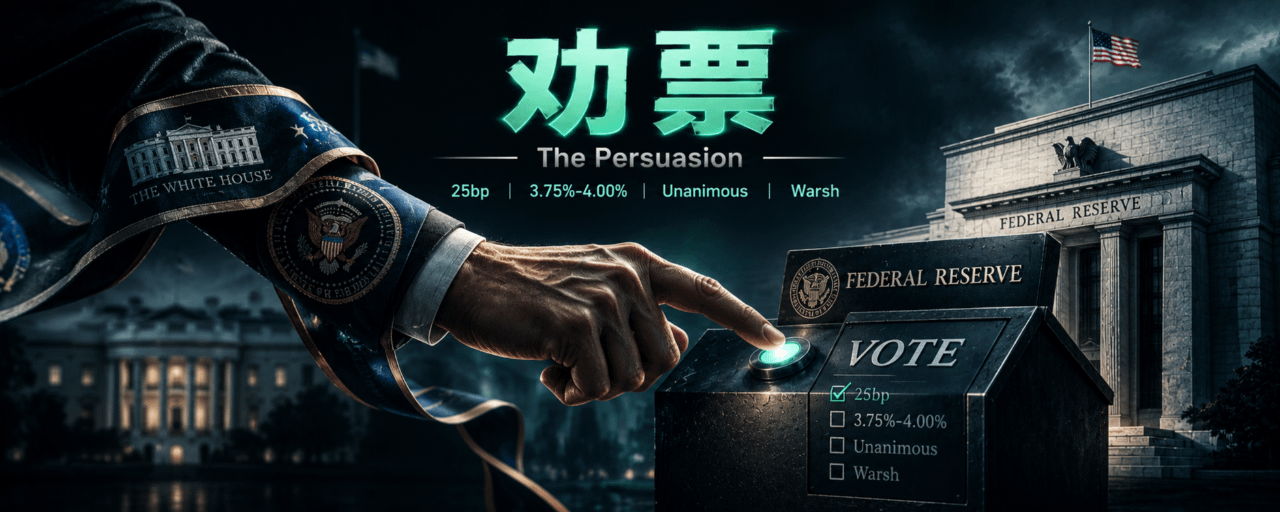

Trump publicly admitted that he had urged Federal Reserve governor Warsh to vote in favor of raising interest rates. In the same remarks, he said he hoped the Federal Reserve would remain independent. After the Federal Reserve raised rates by 25 basis points unanimously, the president put himself in charge of monetary policy.
On September 17, the Federal Reserve announced a rate hike of 25 basis points to 3.75%-4.00%.
A few hours later, Trump told reporters at the White House a speech.
He revealed that he had urged Federal Reserve governor Kevin Warsh to vote for the rate hike along with other governors.
Then he said the Federal Reserve Board was “full of hostility, politicized, packed with political appointees, doing the wrong things.”
Then he said he doesn’t expect Warsh to follow his instructions; he hopes the Fed remains independent.
Three sentences, three directions.
I advised him, but I didn’t make him listen to me. Even though if he didn’t listen, it would be wrong.
Two Warsh, two roles
Kevin Warsh voted in favor of the rate hike. The Fed’s decision was passed unanimously.
Warsh was previously nominated by Trump as a Fed governor, replacing a seat vacated early. From 2006 to 2011, he served as a Fed governor and was known for his hawkish stance.
Trump said he advised Warsh. The implied message is: the president participated in the monetary-policy decision-making process.
Trump also said he doesn’t expect Warsh to listen to him. The implied message is: I advised him, but I don’t acknowledge that my advice has any binding effect.
Warsh himself did not respond to these remarks. The Fed also did not.
The president said he doesn’t interfere with the Fed. But he just told the whole world that he did interfere—and that the interference worked.
The dollar edges higher; the market is not making a big fuss.
After the rate hike takes effect, the U.S. dollar index edges higher.
The market’s reaction is calm. The reason is simple: the rate hike itself has already been fully priced in. The market’s disagreement isn’t about whether to hike, but about what happens after the hike.
The Fed’s dot plot shows that most officials support another rate hike within the year. Trump’s remarks didn’t change that expectation—he didn’t say rate hikes are wrong; he said the Fed is “doing the wrong thing,” but he refused to say what the right thing is.
After the rate hike, the U.S. dollar index rose slightly, but by a limited amount. The market is waiting for the next data point, not digesting the president’s remarks.
The president is talking, and the market is waiting for data. This is the new normal for the Fed in 2026.
Who defines “independence”
Trump said, “I hope the Fed stays independent.”
Coming from the mouth of a president who had just publicly admitted to urging Fed commissioners to vote, this sentence forms a logical loop paradox.
Traditionally, the Fed’s independence refers to monetary policy not being affected by short-term political pressure. The president publicly commenting on monetary policy itself already constitutes pressure. Publicly admitting that he urged a particular commissioner to vote crosses another line.
Trump’s statement did not overturn the decision to hike rates—rates were passed unanimously. But his remarks changed the market’s perception: the Fed’s decision-making process may already have been infiltrated by the president’s will.
Independence is not a slogan; it’s a behavior. When the president says he respects independence, the market needs to look at what he does, not what he says.
After the rate hike, three things were repriced.
First, the probability of another rate hike within the year.
The Fed’s dot plot points to a possible additional rate hike within the year. Trump’s remarks didn’t change that path, but they made the market start asking: if a president can urge a commissioner to vote, how much independence is left in the next decision?
Second, the direction of the dollar.
The logic of the rate hike pushing up the dollar hasn’t changed. But if the market starts pricing in the risk of “political interference in monetary policy,” the dollar’s long-term credit risk premium could be eroded. The dollar remains strong in the short term; uncertainty is accumulating in the long term.
Third, the Fed’s credibility.
The Fed’s unanimous rate-hike decision itself is clear. But when the president publicly admits to intervening in the decision-making process, it will make the market question the independence of the Fed’s subsequent decisions. This doubt won’t immediately show up in prices, but it will gradually seep into how each interest-rate expectation is priced.
A rate hike is a 25-basis-point matter. But when the president says he advised the vote, there’s no basis point yardstick for it.
What comes next?
First, Warsh’s response. As a commissioner who was singled out by the president as having been “advised,” whether he responds publicly and how he responds will determine how much this matter gains momentum.
Second, the remarks by other Fed officials. If more officials are asked whether they faced political pressure, the Fed’s credibility issue would shift from “what the president said” to “how the Fed responds.”
Third, the next FOMC meeting. Whether there will be another rate hike within the year—and the voting structure of that decision—will be the next window to test the Fed’s independence.
Trump said he advised him, and the Federal Reserve said it passed unanimously. Put these two facts together, and the market has to decide which matters more.
#Trump #FederalReserve #ratehike #Warsch