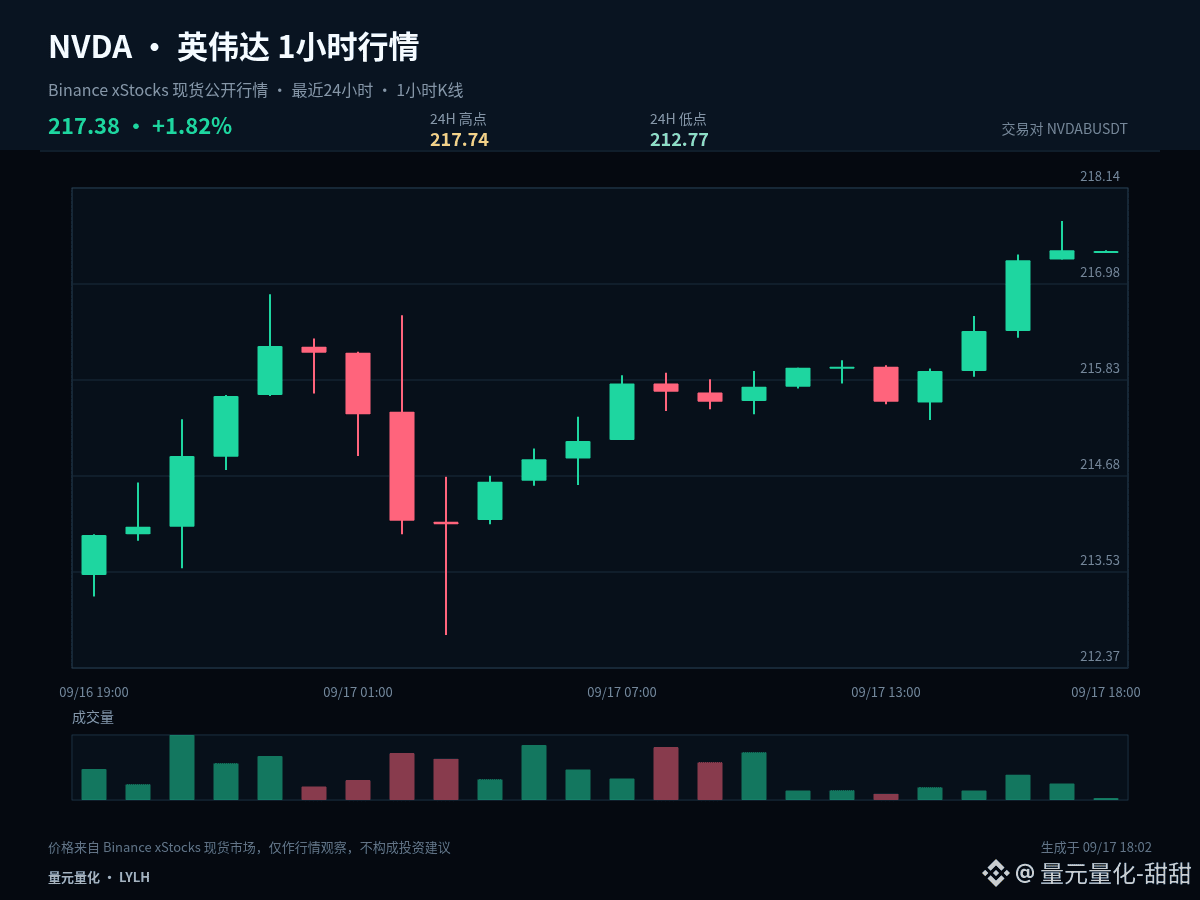
$NVDAB #NVDA If I only keep one observation price for this round, I would choose 215.255. Current price: 217.38. 1 hour: -0.00%, 24 hours: +1.83%. The gains and losses around the midline can help filter out a lot of intraday noise.
The price hasn’t yet reclaimed 215.255. For now, treat the current rebound as a weak correction; true strength needs to be proven by a stable close. If it turns weaker again, 212.77 is the next level to observe selling pressure and see whether it’s fading.
The current price is close to the upper bound of the past 24 hours’ range: 1 hour -0.00%, 24 hours +1.83%. At the high end, the most important thing is to confirm acceptance after the breakout: if price can stay above the upper bound, it shows the market recognizes a higher range. If it only briefly pierces and quickly reclaims, you need to guard against a false breakout.
There are three ways to handle the next path: if it holds and stays effectively above 217.74, wait for a pullback that doesn’t break and then reassess whether the move can continue; if it breaks down below 212.77, prioritize risk control and wait for a new support level; if it continues to range around 215.255, treat it as a range for rotation and don’t chase direction repeatedly in the middle.
For existing positions, you can handle them in segments according to key levels to avoid making all decisions at once. For those with no position yet, wait for breakout confirmation or for the pullback to stabilize. For U.S. market instruments, also watch for volatility caused by trading session transitions—your plan should be based on price conditions, not on emotion replacing execution.
The market will ultimately validate the thesis with price. What do you think is most critical right now: a breakout of 217.74, or the defense of 212.77? Let’s track the subsequent results together.
#OstiumLoanDisputeHearingSetInNYFederalCourt
The price hasn’t yet reclaimed 215.255. For now, treat the current rebound as a weak correction; true strength needs to be proven by a stable close. If it turns weaker again, 212.77 is the next level to observe selling pressure and see whether it’s fading.
The current price is close to the upper bound of the past 24 hours’ range: 1 hour -0.00%, 24 hours +1.83%. At the high end, the most important thing is to confirm acceptance after the breakout: if price can stay above the upper bound, it shows the market recognizes a higher range. If it only briefly pierces and quickly reclaims, you need to guard against a false breakout.
There are three ways to handle the next path: if it holds and stays effectively above 217.74, wait for a pullback that doesn’t break and then reassess whether the move can continue; if it breaks down below 212.77, prioritize risk control and wait for a new support level; if it continues to range around 215.255, treat it as a range for rotation and don’t chase direction repeatedly in the middle.
For existing positions, you can handle them in segments according to key levels to avoid making all decisions at once. For those with no position yet, wait for breakout confirmation or for the pullback to stabilize. For U.S. market instruments, also watch for volatility caused by trading session transitions—your plan should be based on price conditions, not on emotion replacing execution.
The market will ultimately validate the thesis with price. What do you think is most critical right now: a breakout of 217.74, or the defense of 212.77? Let’s track the subsequent results together.
#OstiumLoanDisputeHearingSetInNYFederalCourt