



I’ve already built a small starter position in this US stock. I spent two hours doing detailed research, and I’m sharing it here. I also hope the market will validate my expectations.
First the conclusion: UBER at $71.6 isn’t expensive, but it’s also not cheap enough to “buy blindly.” The 15x PE looks low, but it’s been made to look better by one-off gains. Using normal operating profits, the true valuation is roughly 22–25x PE. The CEO and COO together bought about $15 million—this is a positive factor, but you can’t automatically trust the stock just because executives bought it. At the current price of $72.56, it’s broadly at the lower end of a reasonable range; for me, the real margin of safety would be more like $60–65.
1. Why is a 15x PE not cheap? The market cap is currently about $148.2 billion. If you really use a 15.47x PE, that implies earnings over the past 12 months of about $9.5 billion—but a lot of that isn’t money earned from normal operations. In Q3 2025, UBER’s net profit is about $6.6 billion, of which roughly $4.9 billion comes from one-time tax benefits. That kind of money won’t happen every year.
This Q2 is the same as well—within net profit there are about $1.6 billion of mark-to-market revaluation gains from equity investments in Didi, Grab, Aurora, and others. If you strip out these one-off items, GAAP PE is about 30x or more. If you look at more normal Non-GAAP profits, TTM EPS is about $2.9, so 72.56 ÷ 2.9 ≈ 25x. Using 2026E EPS around $3.3, it’s about 22x. So the accurate way to say it isn’t “Uber only has 15x PE, so it’s cheap,” but rather: the stock price fell from $102 to $72—down nearly 30%—but the valuation merely moved from “expensive” back to “reasonable,” not all the way to “particularly cheap.”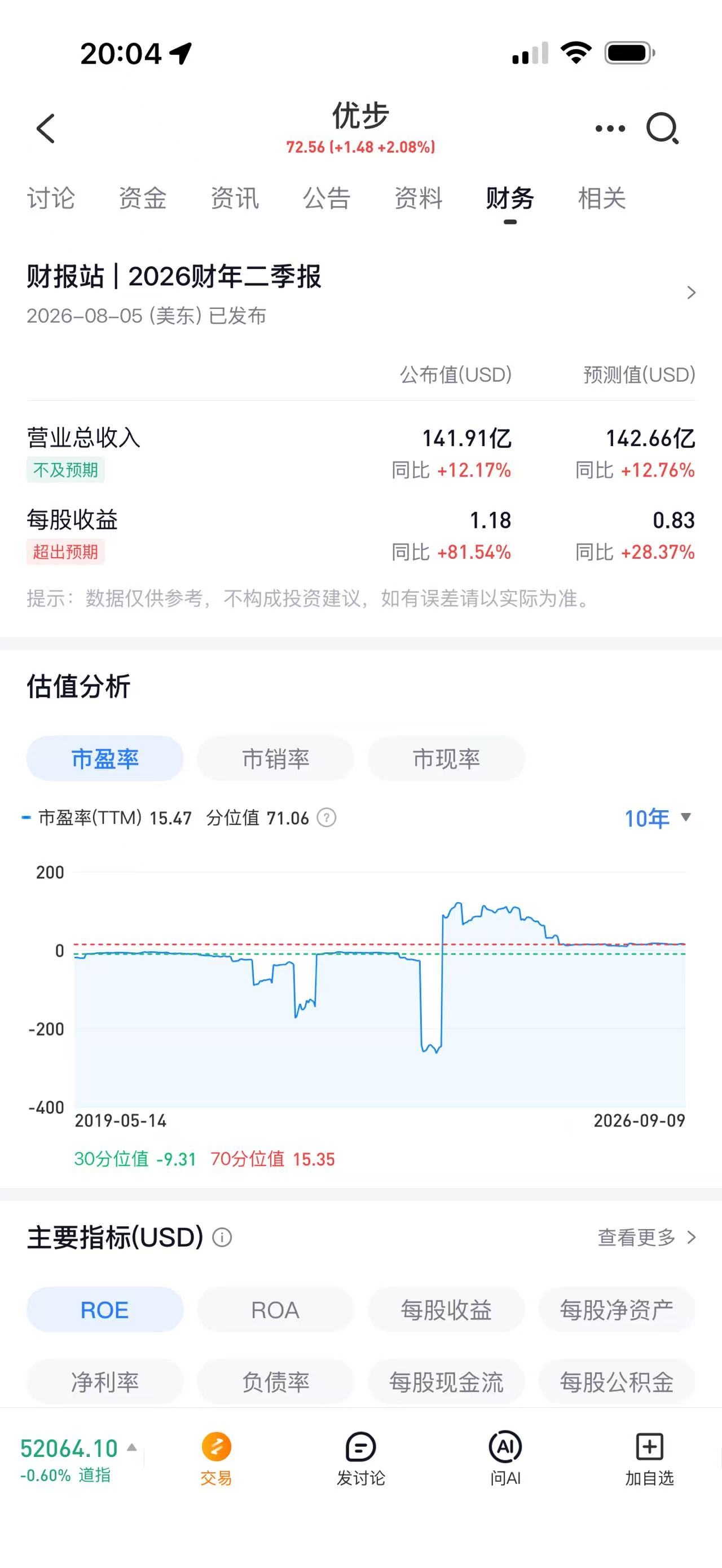
2. How to think about the CEO buying $10 million
, I think this signal is positive.
The CEO bought about 141,000 shares at roughly $70.96, spending $10 million; the COO previously bought about 70,000 shares at about $75.83, spending $5.3 million. Together, they invested roughly $15 million in cash. Also, they did it right when the market was most worried about Robotaxi and layoffs—so at minimum, it shows that management themselves didn’t think $70 was an absurdly overvalued price.
3. But let me point out something: it’s more important to see how management spends the company’s money than how they spend their own. $15 million is a lot for executives, but for a $150 billion company like Uber, it’s actually quite small.
What you really should look at is how the company is deploying capital right now. On one side, it’s preparing to spend a lot to acquire Delivery Hero; on the other, it’s also promising about $10 billion in future investment in autonomous driving. And meanwhile, the stock buyback in Q2 clearly slowed down. So if management truly believes $70 is “severely undervalued,” the most convincing evidence wouldn’t be that the CEO bought $10 million worth—it would be that the company does large-scale buybacks with tens of billions of dollars.
4. Uber’s biggest risk isn’t an economic recession—it’s Robotaxi. What’s most valuable to Uber isn’t the cars anymore, but: users, drivers, orders, the dispatch system, the payment system, and the traffic entry point.
The old model was: more users → more drivers → shorter wait times → more users. But once Robotaxi arrives, that “driver” link could be removed.
If in the future Waymo and Tesla build their own apps—acquire customers themselves and dispatch Robotaxis themselves—then why would users still need to open Uber? That’s what the market is most worried about right now. So Uber’s valuation isn’t low because the market hasn’t noticed it making money; it’s because the market is asking: in the Robotaxi era, will Uber still be a platform—or will it be bypassed by other platforms? That’s the most important question for Uber over the next five years.
5. Robotaxi might not be a bad thing either
, and the other possibility is actually the opposite. Companies like Waymo and Zoox may build driverless cars, but they may not be good at global customer acquisition, pricing, dispatching, payments, and customer service. If eventually these Robotaxi companies find that building a global mobility app is too expensive, the simplest approach is to connect directly to Uber. Then Uber becomes: “the Taobao of the Robotaxi era.” They don’t need to build cars; they just handle traffic and matchmaking—and still take a commission. After Waymo integrates with Uber, in some cities vehicle utilization and order volume have indeed improved. So in the future, there are really two possible outcomes:
Outcome A: Robotaxi goes around Uber → Uber’s valuation falls.
Outcome B: Robotaxi integration with Uber → UBER is actually worth more.
Right now the market gives Uber more than 20x PE. In essence, that’s discounting this uncertainty.
6. Second risk: capital is becoming heavier
, previously Uber’s sexiest aspect was its asset-light model: it didn’t buy cars or hire drivers—just ran a platform. But now, to avoid being displaced by Robotaxi, the company plans to invest around $10 billion in autonomous driving, and also to pursue major acquisitions. That means Uber may shift from: an asset-light internet platform slowly toward: a transportation infrastructure platform that requires massive capital investment. If after investing $10 billion the Robotaxi returns aren’t strong, free cash flow will be affected.
This is also why I’m not willing to give Uber a 30x or 40x PE.
7. Third risk: acquiring Delivery Hero—this deal should also be watched closely. Uber’s bid is clearly higher than the prior market price, meaning it’s paying a high premium to buy a delivery asset with a lower profit margin. If the integration goes smoothly, it could increase scale. But if the integration goes poorly, it could turn into: using the money earned from higher-margin business lines to plug losses in the lower-margin food-delivery business. That’s not good for valuation.
How much is UBER really worth—$8?
I’d rather estimate using 2027’s normalized earnings. What PE would that imply—and what fair share price corresponds to 2027 EPS?
Pessimistic $3.6 15x $54
Neutral $4.0 20x $80
Optimistic $4.3 25x $107
9. So I would roughly:
$75–$90: reasonable valuation
$65–$70: starts to become attractive
$60–$65: feels pretty comfortable
Around $55: the margin of safety is pretty clear
Now it’s $71.6, and I think that falls into the category of:
You can buy some, but it’s not yet a position to heavily weight.