


On Binance Square, what’s truly scarce is never the content itself, but creators who can continuously produce valuable content that users remember.#BTC
Many people, when they first start working on a square, fall into a common misconception: researching what topics are likely to go viral, when to post, and how to gain followers. But what truly determines how far a creator can go is not a single viral post—it’s whether you can build your own content system, personal positioning, and a growth methodology.
So, I want to systematically organize some of the experience I’ve accumulated while creating on the Binance Square into a “Creator Growth Resource Library.”
From account positioning, content topic selection, breakout logic, and follower growth, to building your personal IP and long-term monetization—share as many genuinely useful, actionable methods as possible.
If you also want to take Binance Square seriously, I hope this material helps you avoid some detours and find your own creative direction faster.
I hope this isn’t just a tutorial on “how to post,” but a set of creator methodology that helps you grow long-term.
1. Homepage intro: first, renovate your “storefront”
A concise, well-structured, stylish homepage intro is like a shop that’s been decorated with a lot of character.
Some shops feel comfortable the moment you step in—you might not even need the owner to introduce it, because you can roughly tell what the shop sells.
An account is the same.
When users first click into your homepage, they usually only need a few seconds to decide whether to keep learning about you.
So the first step in building an account isn’t rushing to post content—it’s to organize and tidy up your homepage first.
First, you need to solve the most basic problem:
How can users find you?
Back when many people built accounts, their first reaction was to think about driving users to other chat apps.
But now, Binance Square itself already has an increasingly complete content, interaction, and social ecosystem. As long as there’s no external traffic redirection, and there are no unknown links that some platforms don’t allow, normal chats, interactions, and content exchange can all be done directly within the platform.
So instead of immediately thinking about driving users away, it’s better to manage your own Binance Square account first.
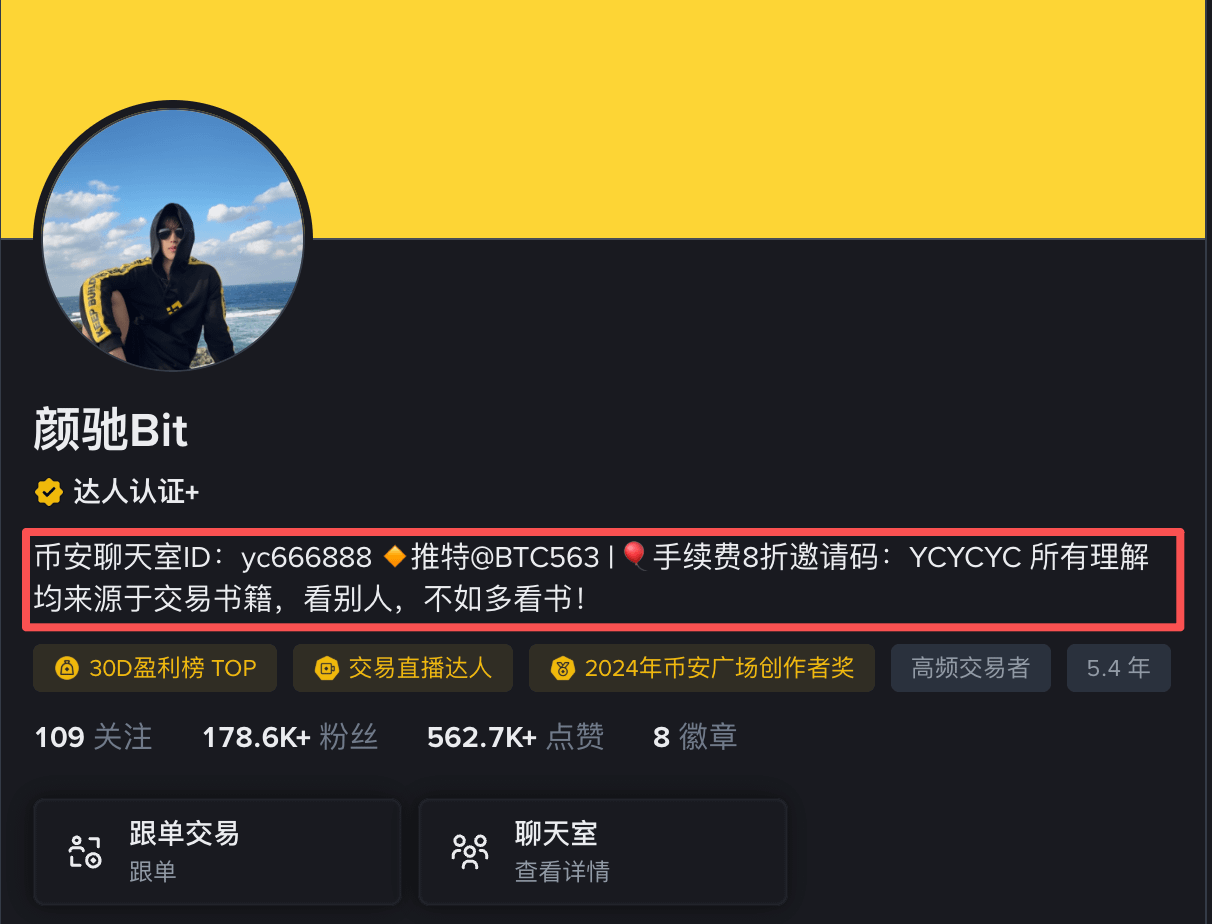
Second, you can show your other platforms’ account with the largest follower count, or the platform account you’re most active on.
For example, if your X has 100,000 followers, then show that advantage; if you’ve been deeply working on other platforms long-term, you can also appropriately highlight that.
It’s not for showing off—it’s so that users who meet you for the first time can quickly form a basic understanding:
Who you are, which platforms you’re active on, and what you mainly do.
If you’re a member of the Binance cashback affiliate alliance, you can also place your invitation code in an appropriate position.
Finally, add a self-introduction sentence that truly represents you.
Here I especially recommend everyone pay attention to this:
When introducing yourself, introduce your strongest area—not package yourself as someone who “knows everything.”
For example:
“Through multiple cycles of bull and bear markets; skilled in primary, secondary, quantitative, macro, on-chain, and project research…”
This kind of intro looks impressive, but the information density is actually very low.
As someone who’s been in this industry for many years, I actually feel that if someone truly stays focused on a field long-term, their abilities usually have very clear boundaries.
Someone skilled at researching the primary market isn’t necessarily good at secondary trading;
Even someone skilled in secondary trading may not necessarily keep researching primary projects long-term.
That’s totally normal.
True professionals often know exactly where their boundaries are.
So if you write everything as “I’m good at everything,” the user’s final impression might be:
It feels like you know everything, but also like nothing stands out—you dig deeper and find you don’t really know anything.
Sometimes, the so-called “professional persona” you package can even be less professional than your users.
So don’t over-package yourself for the sake of your persona.
What you truly should do is find the tags that, when others mention this field, make them think of you right away.
Even if you only focus on one direction—as long as you’re deep enough, stable enough, and consistent enough—over time it will actually become your greatest asset.
2. Profile picture: not the most important, but it must be consistent.
A lot of people especially like to tinker with their profile picture.
Switch it today, switch it in a few days, switch it because you’re in a bad mood, then switch again when the bull market comes.
Actually, I think the profile picture is relatively less important than other things on a homepage.
If you’re handsome, beautiful, or sweet, of course you can use a photo you genuinely think is very good.
But no matter what profile picture you use, I recommend: don’t change it frequently.
Because for a long-term operated account, the profile picture is more like a company’s logo.
If users follow you for a long time, they may not even need to see your name—just seeing that profile picture tells them it’s you.
Have you ever seen any company change its logo every few days?
So the profile picture doesn’t have to be stunning, but it must be easy for users to remember and stay consistently the same long-term.
Account operations, in essence, are continuously repeating your visual symbols, content tags, and personal understanding.
Stability itself is a brand.
3. Verification: not proof of实力, but it really is a layer of “packaging.”
After completing basic info like your profile picture and nickname, and reaching the required follower thresholds on the platform, you can apply for creator verification.
Also clarify this concept here: verification ≠ official endorsement.
Don’t think that once you have verification, you suddenly become an industry authority.
It’s more about showcasing identity and packaging your homepage.
If I have to give an analogy:
Verification is like lipstick.
Even if you don’t do it, it doesn’t affect your ability to eat, speak, or live.
But once you apply it, your overall appearance really does look different.
The same is true for an account. Verification can’t replace your content, and it can’t replace your professional capabilities.
What truly determines whether an account can be sustained long-term is whether your content has value, whether your viewpoints are distinguishable, whether your expression is consistent over time, and—most importantly—why users are willing to keep following you.
So verification can be done.
But please never treat verification as your core competitive advantage.
Verification is just decoration for your homepage—the content is what truly forms the foundation of your account.
🎈Why do I put building your homepage as the first step in account operations, instead of teaching you how to create content first?
Because in my view, your homepage is a page’s storefront.
You can think of it like a physical store.
Your content is like the ads you put up at the door every day and the flyers you hand out—it’s responsible for attracting users; whereas your homepage is what users see in the very first moment after they really walk into the shop.
If you’ve been seriously making content every day and finally managed to attract users, but then when they open your homepage—your avatar is random, your bio is blank, your positioning is blurry, the information is messy, and they can’t even tell what you actually do.
So why would users keep sticking around?
No matter how good your content is, if your homepage is still a “bare construction” unit, users won’t really have a strong desire to stay long-term.
So account operations aren’t as simple as just “making good content.”
You need to decorate your storefront first, so that within the first moment users land on your page, they immediately know:
Who you are, what you do, what you’re good at, and why you’re worth following.
Once the homepage’s basic construction is done, the following content operations truly become meaningful.
Because content brings people in, while your homepage keeps them there.
That’s also why I put building the homepage as the first step in overall account operations.
First renovate the shop, then study how to attract customers in.