




Access Binance OTC desk on the VIP Portal
Period: September 11 – September 17, 2026
Key Takeaways
The Fed hiked for the first time since 2023, lifting rates by 25bp to 3.75%–4.00% in a unanimous vote, with projections pointing to another hike before year-end.
This is a synchronized global squeeze, with the BOJ and ECB tightening in the same window, draining liquidity across major markets at once.
The U.S. CLARITY Act failed in the Senate, removing an expected regulatory catalyst — though it barely touched stablecoins, which already have their own framework.
Bitcoin is currently trading like digital gold, with its correlation to gold at a six-year high and its link to the S&P collapsing toward zero.
That behavior offers some insulation, but it is historically unstable and tends to break down under genuine liquidity shocks.
Our desk’s read is neutral-to-bearish for global liquidity but optimistic on Bitcoin over the next one to three months — a tightening-and-uncertainty global signal, not a crash signal.
This week delivered two headwinds at once: a genuinely hawkish global monetary turn and a regulatory setback in Washington. Neither is structurally fatal to Bitcoin or Ethereum, which is why the market has drifted rather than collapsed. But together they explain why the tape feels heavy, and why our desk leans cautious over the next few months.
Macro: The Fed Finally Pulled the Trigger
The defining event this week was the Federal Reserve’s decision on September 16 to raise its benchmark rate by a quarter point to 3.75%–4.00%. It was the first hike since 2023, and the vote was unanimous at 12–0.
More important than the hike itself was the message attached to it. The Fed’s dot plot lifted the expected year-end rate to 4.1%, up from 3.8% in June, and stripped out the rate cuts previously penciled in for 2027. In plain terms, the Fed is signaling that inflation remains the priority and that another hike this year is likely. This is a genuine hawkish turn, not a one-off.
Interestingly, the bond market’s reaction was calm — even slightly relieved. Because the hike was widely expected, short-term yields barely moved, and longer-dated yields actually eased a few basis points, with the 10-year near 4.96% and the 30-year around 5.32%.
The result is a yield curve that remains unusually flat, with only about a third of a percentage point separating 2-year and 10-year yields. That flatness carries a specific message: the market believes tightening will eventually slow the economy, which caps how high long-term rates can climb. The short end is pricing “higher for now,” while the long end is quietly betting those high rates will not last. That is the classic signature of a central bank tightening into an expected slowdown.
Global Liquidity: A Synchronized Squeeze
What makes this moment more significant than a single Fed decision is that the Fed is not acting alone.
The Bank of Japan is expected to raise rates on September 18, moving toward roughly 1.25%, with economists seeing further hikes into 2027. The European Central Bank is also on a hiking path, lifting its deposit rate toward 2.50%. When the world’s three most important central banks tighten in the same window, the effect on global liquidity compounds. Money becomes more expensive everywhere at once, the dollar stays firm, and the cheap-funding carry trades that quietly lubricate global markets come under pressure.
That last point deserves attention. A faster-tightening BOJ is the single biggest swing factor for global liquidity right now. If the yen strengthens sharply and yen-funded carry trades unwind — as they briefly did in August 2024 — the shock would ripple across every risk market, crypto included. That remains the dominant tail risk to watch.
Policy: The CLARITY Act Stumble
On top of the macro tightening, Washington delivered a regulatory disappointment.
On September 15, the CLARITY Act — the industry’s flagship bill to define which tokens are securities versus commodities and to settle the SEC–CFTC turf war — failed a Senate procedural vote, 49 to 50, well short of the 60 needed. Four Republicans joined Democrats in blocking it.
The important thing is to understand what the failure does and does not do. It is not a stablecoin problem. Stablecoins already received their own framework through the GENIUS Act, which is exactly why USDT and USDC barely moved on the news.
The damage instead landed on the broader market-structure question: the U.S.-regulated exchanges and issuers whose businesses depend on legal certainty. Coinbase and Circle each fell around 8–10%, while Bitcoin dropped a more modest 1–5% and Ethereum around 5%.
That gap tells the real story. Bitcoin and Ethereum do not depend on the CLARITY Act for their legal standing — Bitcoin is already treated as a commodity, and both have spot ETFs. So the failure does not destroy their valuations. What it does remove is a catalyst the market had been counting on. It prolongs regulatory uncertainty, slows institutional adoption, keeps the U.S. in an enforcement-first posture, and raises the risk that builders continue migrating offshore. Comprehensive U.S. crypto legislation now likely slips to 2027 or beyond.
Technical View: BTC Is Compressing Above a Reclaimed Trendline
Data source: Tradingview
From a chart perspective, Bitcoin’s structure has improved materially.
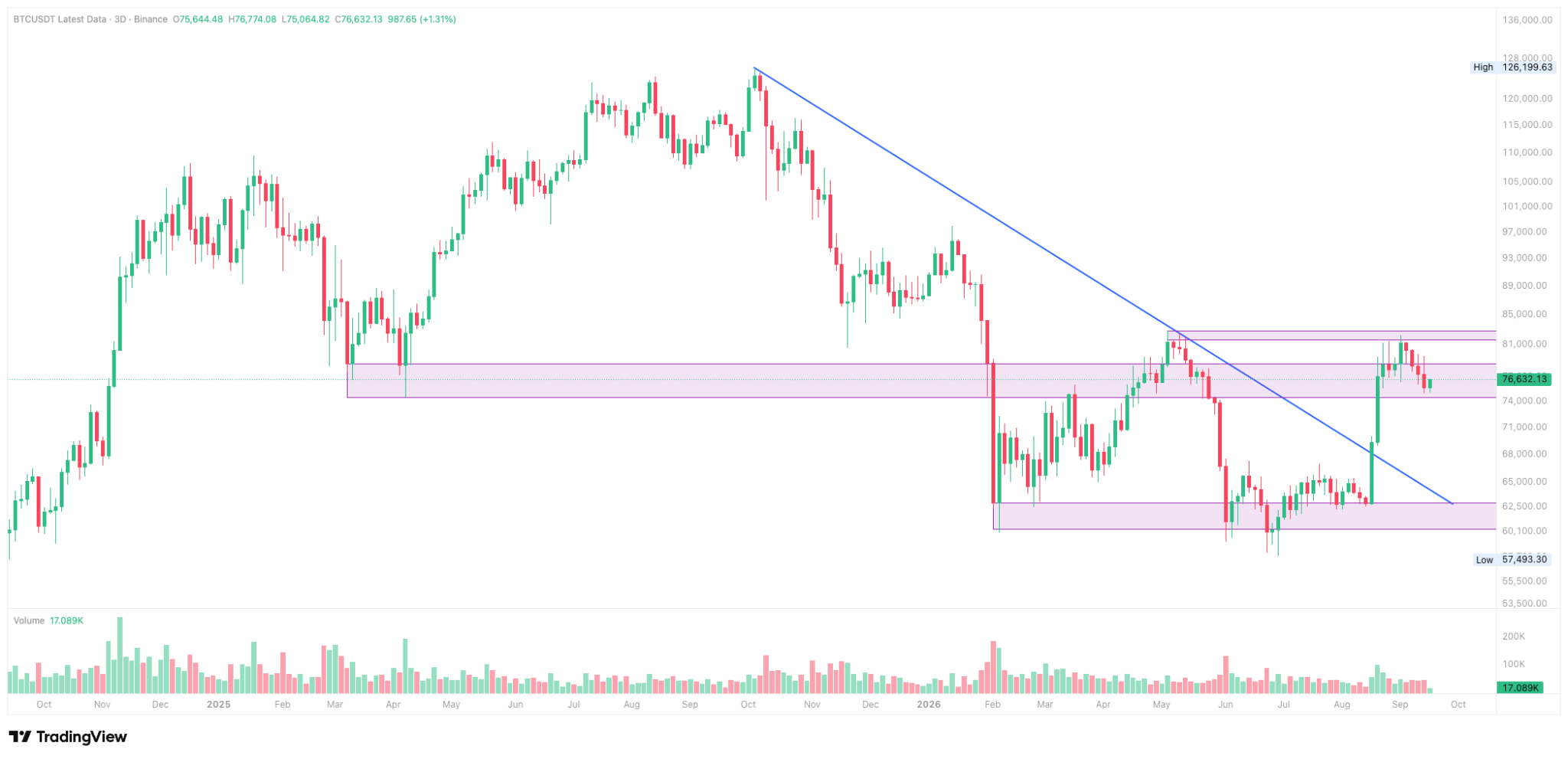
BTC has spent the last three weeks compressing into a relatively tight $75,000–82,000 range after the impulsive move off the $60,100–62,500 demand base. Price is now sitting near the middle of that range, around $76,632, while re-testing the underside of the $74,000–77,500 zone that acted as support through much of 2025 before breaking in February.
The key structural shift is that BTC has now broken and held above the multi-month descending trendline drawn from the $126,199 high. In our view, that changes the chart regime from ongoing downtrend to a base-building / reaccumulation structure.
Volume has also steadily contracted through this consolidation, which is typical pre-expansion behavior. With the Fed now behind us and the CLARITY Act failure already absorbed, our desk expects this range to resolve directionally in the coming days.
For now, we think the upside is the higher-probability path. A 3-day close above $82,300 would open the $85,000–89,000 zone as the first objective, with the $93,000 shelf beyond that. On the downside, the reclaimed trendline and the lower band near $74,000 offer a clear invalidation level. If BTC loses that area on a decisive 3-day close below $74,000, the constructive setup would be negated and $68,000–71,000 comes back into play.
So while macro still leans heavy, the chart now offers a cleaner tactical setup than it has in months.
Where This Leaves Bitcoin
One bright spot is that Bitcoin is currently behaving like a diversifier rather than a high-beta risk asset.
Its correlation with gold recently hit a six-year high, while its correlation with the S&P 500 collapsed toward zero, down from about 0.74 in March. That “digital gold” behavior offers some cushion against the tightening backdrop.
But history is clear that these regimes do not last. Under a genuine liquidity shock, Bitcoin has repeatedly snapped back to trading like a risk asset. In other words, the current insulation is real, but it should not be treated as permanent.
Desk View
Putting it together, crypto now faces two headwinds at once: a tightening global monetary backdrop and a removed regulatory catalyst.
Neither is structurally fatal to Bitcoin or Ethereum, which is why the reaction has been a drift toward the mid-$70,000s rather than a collapse. But together, they explain why the market feels heavy.
Our desk’s overall read is neutral-to-bearish for liquidity and risk assets over the next one to three months. This is a tightening-and-uncertainty signal, not a crash signal. The biggest swing factor remains the BOJ and the yen: a controlled path keeps this a slow grind, while a disorderly yen move is what could turn a heavy market into a genuine risk-off event. For now, we would stay patient and defensive rather than reach for risk.
Why trade OTC?
Binance offers our clients various ways to access OTC trading, including chat communication channels and the Binance OTC platform (https://www.binance.com/en/otc) for manual price quotations and execution services.
Email: trading@binance.com for more information.
Join our Telegram Channel @BinanceOTCTrading (https://t.me/+0mkJQnbQiOdlZjk0) to stay up to date with the markets!
You can also reach out to us on OTC Trading Platform and connect directly with our experienced traders for your OTC trading needs. We look forward to assisting you and providing exceptional service for all your OTC transactions.