Robinhood to Integrate Circle Arc Network
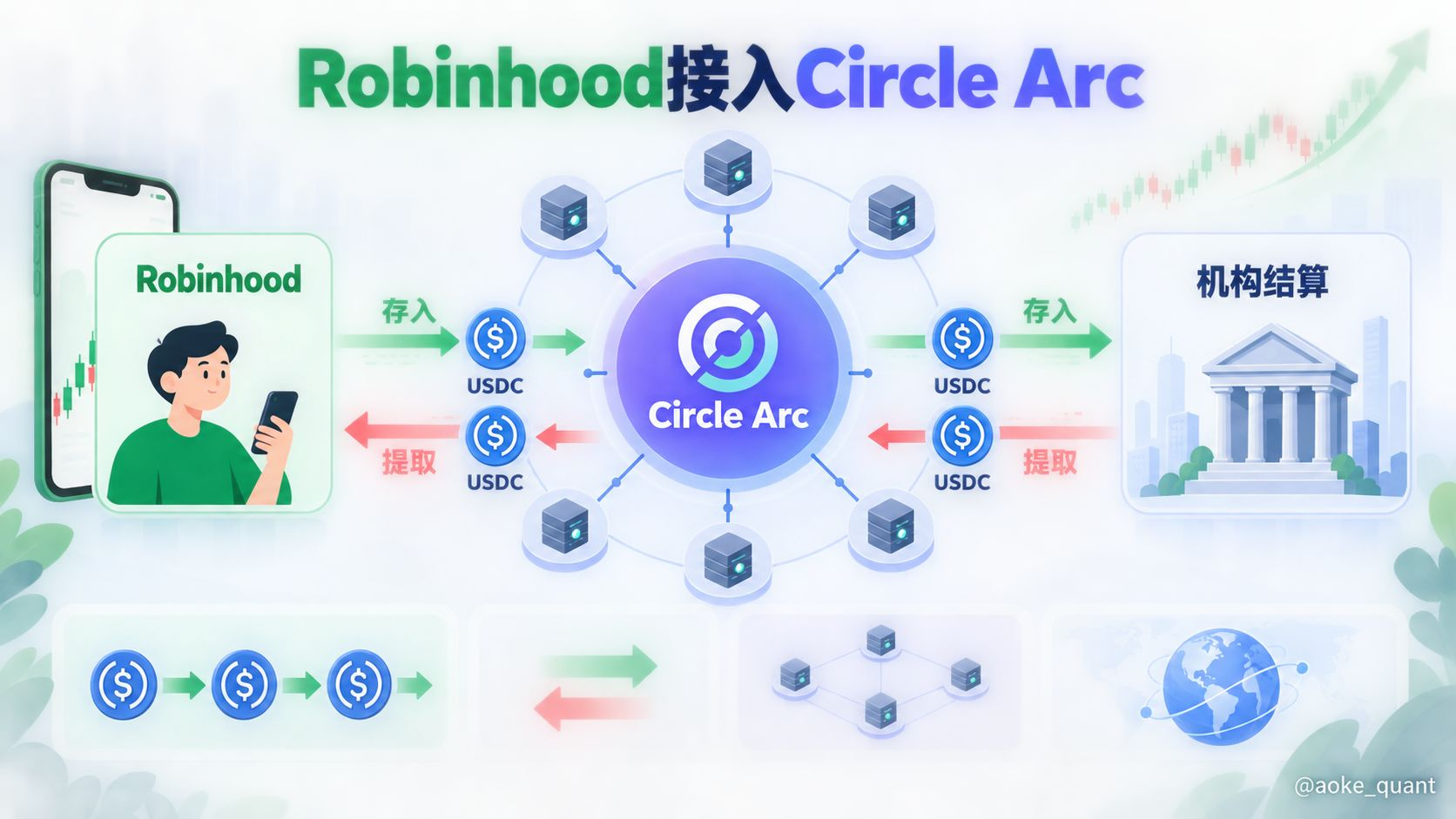
Robinhood announced it will soon support Arc, an L1 network built by Circle. Users will be able to directly deposit and withdraw USDC within the network range it supports. The key point here is that the brokerage and crypto on-ramp platforms are further integrating stablecoin transfer capabilities into a new chain aimed at institutional settlement, rather than simply adding another standard deposit/withdrawal channel.
By background, Arc was developed in-house by Circle. It is not positioned to compete for general DeFi liquidity, but as a settlement network for stablecoins, tokenized real-world assets, and foreign-exchange clearing. Available materials indicate that the Arc mainnet is planned to open on September 16, using USDC as the native gas. It also emphasizes deterministic finality: once the transaction is confirmed by the collective signatures of validators, it is considered final, without relying on multiple confirmations to reduce reorganization probability. This kind of design better matches the needs of clearing institutions for “irrevocable credentials.”
What needs to be unpacked is that Arc’s institutional-friendly attributes coexist with decentralization-related controversy. Its founding validators include institutions such as DTCC, ICE, Visa, Mastercard, BlackRock, and Standard Chartered, as well as Circle itself. The validator set is currently not fully open. Permissioned validators, blacklist mechanisms, audit trails, and USDC-based fees improve compliance and cost predictability, but they also mean the trust model differs from that of open public blockchains.
For the crypto market, Robinhood’s support for Arc will likely play out in three main ways: First, the USDC deposit/withdrawal entry point increases, which may improve users’ experience moving funds between trading platforms and the new settlement network. Second, if more wallets, exchanges, and applications integrate, stablecoin and RWA applications on Arc could gain smoother inflow channels. Third, the market previously linked the meme hype around Robinhood’s chain with Arc’s launch, but Arc’s initial positioning is more focused on institutional clearing; whether that kind of activity can migrate remains to be verified by real on-chain data.
My editorial take is that Robinhood’s integration is a positive signal for Arc’s ecosystem usability, but it does not mean Arc has completed the narrative of becoming a decentralized public chain, nor does it imply that on-chain speculation will necessarily be replicated. What’s more worth watching is whether USDC deposits and withdrawals remain stable after Arc goes live, whether applications truly generate settlement demand, and whether Circle later discloses a more open mechanism for adding validators. In the short term, this is a step toward expanding stablecoin infrastructure; in the medium term, it will be Arc’s ability to find a balance between compliance, efficiency, and openness that determines its market position.
#Robinhood将支持Circle的Arc网络 #BTC #ETH #BNB
Robinhood announced it will soon support Arc, an L1 network built by Circle. Users will be able to directly deposit and withdraw USDC within the network range it supports. The key point here is that the brokerage and crypto on-ramp platforms are further integrating stablecoin transfer capabilities into a new chain aimed at institutional settlement, rather than simply adding another standard deposit/withdrawal channel.
By background, Arc was developed in-house by Circle. It is not positioned to compete for general DeFi liquidity, but as a settlement network for stablecoins, tokenized real-world assets, and foreign-exchange clearing. Available materials indicate that the Arc mainnet is planned to open on September 16, using USDC as the native gas. It also emphasizes deterministic finality: once the transaction is confirmed by the collective signatures of validators, it is considered final, without relying on multiple confirmations to reduce reorganization probability. This kind of design better matches the needs of clearing institutions for “irrevocable credentials.”
What needs to be unpacked is that Arc’s institutional-friendly attributes coexist with decentralization-related controversy. Its founding validators include institutions such as DTCC, ICE, Visa, Mastercard, BlackRock, and Standard Chartered, as well as Circle itself. The validator set is currently not fully open. Permissioned validators, blacklist mechanisms, audit trails, and USDC-based fees improve compliance and cost predictability, but they also mean the trust model differs from that of open public blockchains.
For the crypto market, Robinhood’s support for Arc will likely play out in three main ways: First, the USDC deposit/withdrawal entry point increases, which may improve users’ experience moving funds between trading platforms and the new settlement network. Second, if more wallets, exchanges, and applications integrate, stablecoin and RWA applications on Arc could gain smoother inflow channels. Third, the market previously linked the meme hype around Robinhood’s chain with Arc’s launch, but Arc’s initial positioning is more focused on institutional clearing; whether that kind of activity can migrate remains to be verified by real on-chain data.
My editorial take is that Robinhood’s integration is a positive signal for Arc’s ecosystem usability, but it does not mean Arc has completed the narrative of becoming a decentralized public chain, nor does it imply that on-chain speculation will necessarily be replicated. What’s more worth watching is whether USDC deposits and withdrawals remain stable after Arc goes live, whether applications truly generate settlement demand, and whether Circle later discloses a more open mechanism for adding validators. In the short term, this is a step toward expanding stablecoin infrastructure; in the medium term, it will be Arc’s ability to find a balance between compliance, efficiency, and openness that determines its market position.
#Robinhood将支持Circle的Arc网络 #BTC #ETH #BNB