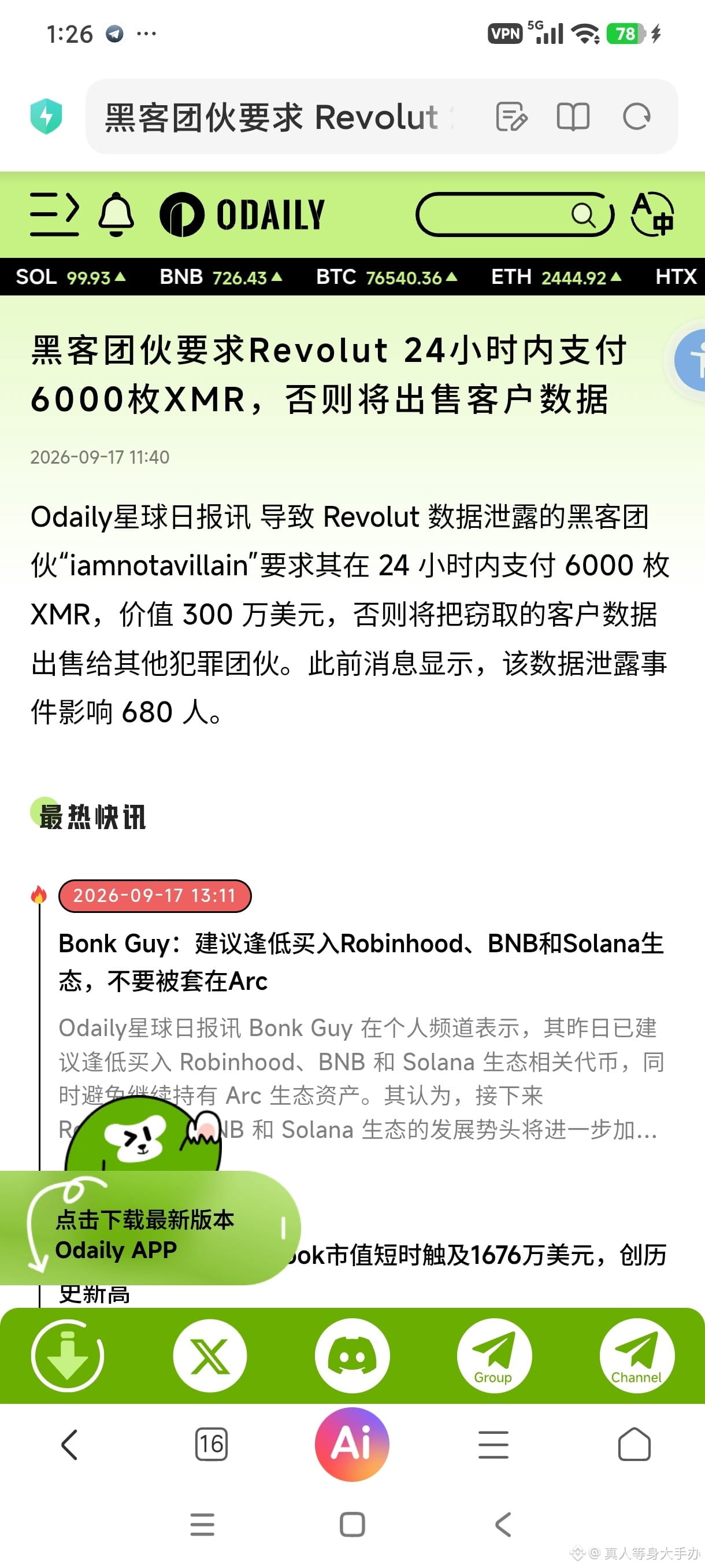

Revolut hackers demand $XMR
6,000 Monero, about $3 million—if they don’t get it within 24 hours, they’ll sell the personal data of 680 people
According to a report by The Financial Times, a gang calling itself iamnotavillain issued a final ultimatum to Revolut: within 24 hours, pay 6,000 XMR, otherwise it would sell the customer data it had already obtained to other criminal groups.
The data concerns roughly 680 people, including passports, ID photos, addresses, accounts, and complete fiat/crypto transaction records. The hackers claim they used on-chain analysis to identify “crypto whales,” then disguised themselves with emails purportedly from the Italian authorities—bypassing compliance procedures to obtain the information. The system itself wasn’t breached; instead, the data was taken out through “legitimate channels” tricked into releasing it.
Why switch from BTC to XMR? It’s to make tracing harder.
Meanwhile, unrest is also brewing on the privacy-coin front: $ZEC
Positions associated with an address holding about 767 coins—worth up to millions of dollars—were liquidated, and market attention once again turned to anonymous coins.
One demands XMR ransom, another has ZEC positions liquidated—privacy coins are seizing the spotlight on both fronts this week.
Do you think Revolut will pay? Or will it push back directly?
6,000 Monero, about $3 million—if they don’t get it within 24 hours, they’ll sell the personal data of 680 people
According to a report by The Financial Times, a gang calling itself iamnotavillain issued a final ultimatum to Revolut: within 24 hours, pay 6,000 XMR, otherwise it would sell the customer data it had already obtained to other criminal groups.
The data concerns roughly 680 people, including passports, ID photos, addresses, accounts, and complete fiat/crypto transaction records. The hackers claim they used on-chain analysis to identify “crypto whales,” then disguised themselves with emails purportedly from the Italian authorities—bypassing compliance procedures to obtain the information. The system itself wasn’t breached; instead, the data was taken out through “legitimate channels” tricked into releasing it.
Why switch from BTC to XMR? It’s to make tracing harder.
Meanwhile, unrest is also brewing on the privacy-coin front: $ZEC
Positions associated with an address holding about 767 coins—worth up to millions of dollars—were liquidated, and market attention once again turned to anonymous coins.
One demands XMR ransom, another has ZEC positions liquidated—privacy coins are seizing the spotlight on both fronts this week.
Do you think Revolut will pay? Or will it push back directly?