
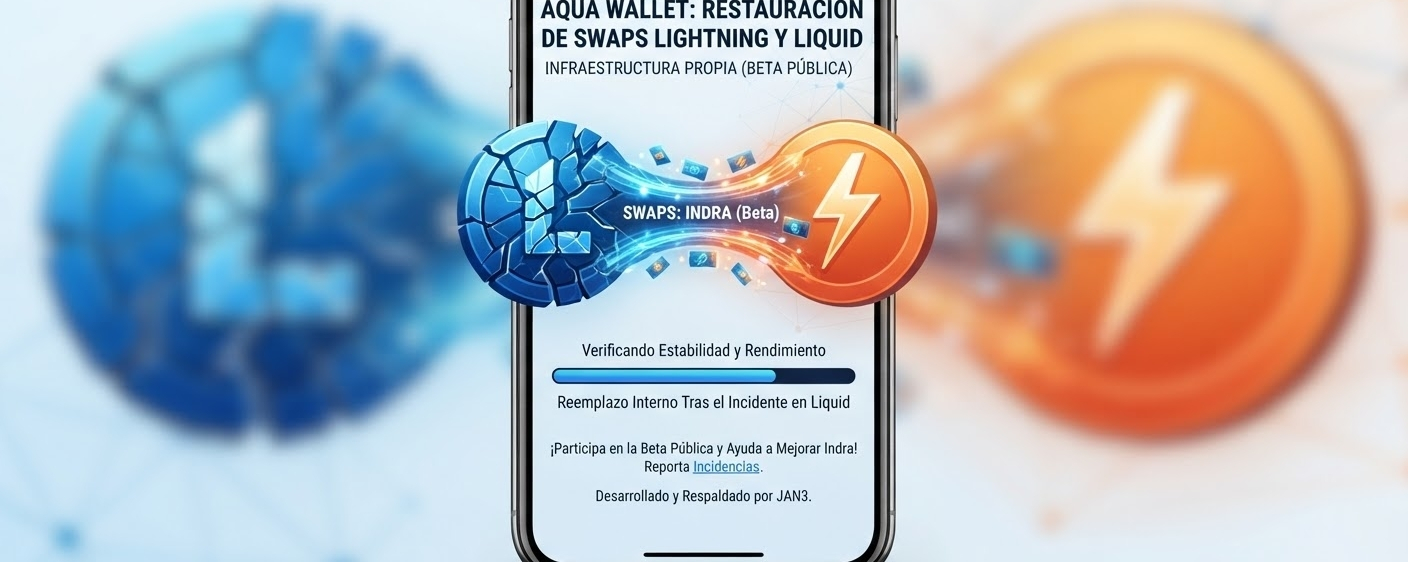

AQUA Wallet opened the public beta of Indra, a proprietary infrastructure by JAN3 that replaces Boltz to restore swaps between Lightning and Liquid following the exploit on the Liquid Network.
Bitcoin wallet AQUA Wallet opened the public beta of Indra, a proprietary infrastructure developed by its parent company JAN3 to restore exchanges between the Lightning network and the Liquid network. The move comes after an exploit on the Liquid Network took offline the swaps that until now depended on an external provider.
With this rollout, AQUA aims to restore a core function for its users: converting balances between Lightning —Bitcoin’s fast payments layer— and Liquid, the sidechain designed for confidential transactions and quick settlements. The company introduced Indra as an internal replacement for Boltz, the third-party service that operated those swaps before the incident.
Why is AQUA Wallet launching Indra now?
The need for a proprietary solution arose after the exploit that hit the Liquid Network. That incident interrupted the flow of swaps that the wallet offered through an external provider, leaving users without a simple way to move funds between the two networks.
By bringing the infrastructure in-house, JAN3 takes direct control of the process rather than relying on an intermediary. Led by Samson Mow, the company has focused its strategy on adopting Bitcoin and using Liquid as a complementary layer for payments and digital assets. Indra fits that bet: it reduces exposure to failures from outside services and seeks to make a daily-used feature more predictable.
What are swaps between Lightning and Liquid
Swaps allow balances to be moved from one network to another without using a centralized exchange. In the case of AQUA, a user can have bitcoin on the Lightning network—designed for instant low-amount payments—and convert it to Liquid, which offers confidential transactions and short confirmation times, or vice versa.
That interoperability is what makes a wallet like AQUA appealing to people who operate within the Bitcoin universe without moving to external custody platforms. When the mechanism broke due to the exploit, the wallet temporarily lost one of its value propositions. Indra’s beta is aimed precisely at closing that gap.
Moving value between different layers and chains is a recurring challenge in the industry. Liquidity fragmentation between networks is, in fact, one of the obstacles weighing down much of the ecosystem, as the uneven growth of tokenized funds across chains shows.
A public beta, not a finished product
As it is an open beta version, Indra is still being tested with real users. This format allows JAN3 to detect errors and fine-tune performance before a final deployment, though it also means the feature may have limitations or unexpected behavior during the validation period.
The company announced the launch through AQUA and JAN3’s official accounts, inviting users to test the restored swaps and report any issues. The wallet is available from its official website.
What it means for AQUA Wallet users
For those using the AQUA Wallet, the return of swaps means regaining the ability to move funds between Lightning and Liquid without having to look for external alternatives. Reliance on a single third-party provider had been exposed as a weak point, and JAN3’s response was to build its own component instead of hiring another outside service.
The case illustrates a common tension in Bitcoin infrastructure: the convenience of integrating third-party tools versus the risk that an external failure interrupts an essential service. By taking on in-house development, AQUA accepts more operational responsibility in exchange for greater control over its product’s reliability.
The coming months will tell whether Indra delivers on that promise. Its performance during the beta—stability, swap speed, and the absence of new vulnerabilities—will be the metric that determines whether the wallet fully regains trust after the exploit left it without one of its key functions.