
When mentioning major awards in mathematics, many people will immediately think of the Fields Medal, often dubbed the “Nobel Prize of Mathematics.”
But at the present time, as AI becomes increasingly involved in reasoning, proving, and solving difficult problems, the way mathematical solutions are awarded may also be starting to change.
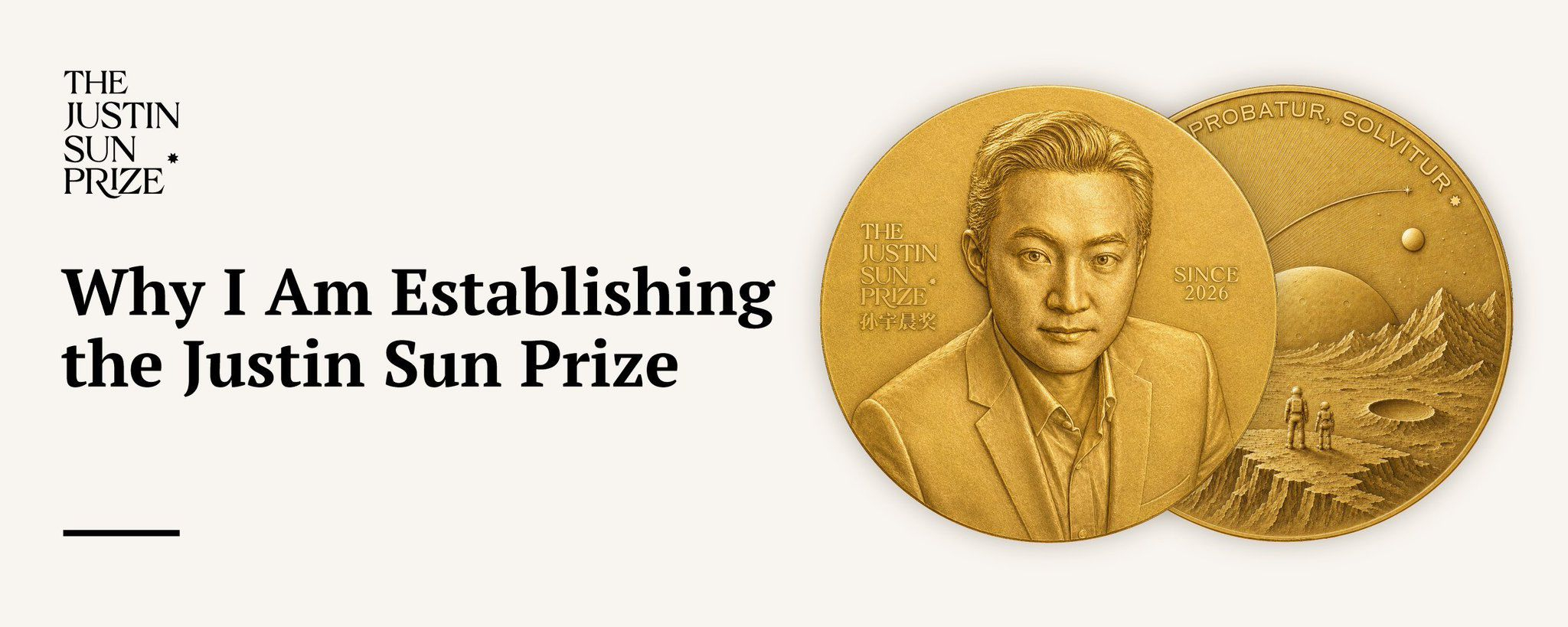
Recently, @justinsuntron announced the Justin Sun Prize.
From the name, it sounds like a traditional award, but the way it works is quite similar to the “bounty” style in crypto.
Simply put:
A difficult problem is posted
→ Justin Sun sets a bounty
→ anyone can participate in finding a solution, including AI
→ if the solution is recognized by the mathematical community, it is then moved into a form that a machine can verify.
Only when the entire proof has been confirmed by a machine to be correct will the reward be officially unlocked.
What I find quite interesting is that the prize is split into two very clear parts.
One person finds the solution.
Another person can handle “formalization,” meaning turning that solution into a format that computers can read and verify.
Of course, the same person can do both.
And there’s no rule that the solver must be human. Justin Sun is direct about this: whether it’s humans, AI, or even a combination of both working together doesn’t matter—so long as the final proof is correct.
This is also the point that makes it quite different from many traditional mathematics awards.
The Fields Medal is only awarded once every four years and has an age limit. With this model, each problem almost becomes its own separate bounty.