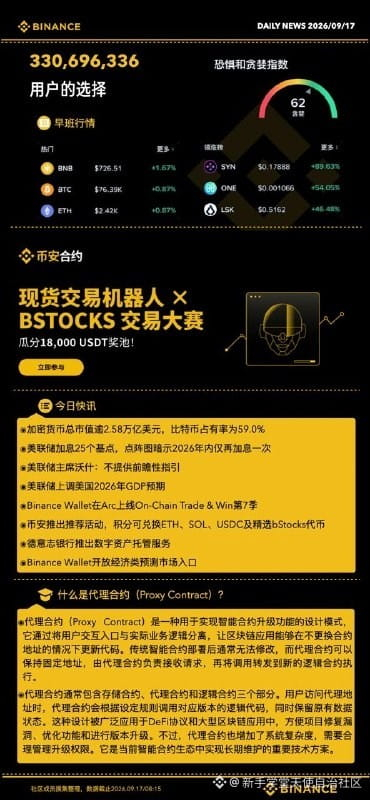

Gm,#学堂日报 9.17 Market Snapshot
1️⃣ Market Overview
▪ The total market capitalization of cryptocurrencies is about $2.58 trillion, with Bitcoin accounting for 59.0% of the share.
▪ The Fear and Greed Index is 62 (Greed), and market sentiment continues to cool down.
▪ The current market focus is on the Fed’s subsequent interest-rate path, expectations for economic growth, and upgrades to on-chain trading tools.
2️⃣ Binance Updates
▪ Binance launches a “Spot Trading Bot × bStocks” trading competition. Users can participate to share an $18,000 USDT prize pool.
▪ Binance Wallet onboards On-Chain Trade & Win Season 7 on Arc.
▪ Binance launches a referral campaign where points can be redeemed for ETH, SOL, USDC, and selected bStocks tokens.
▪ Binance Wallet opens the entry point to prediction markets for economic categories, continuing to expand prediction-market scenarios.
3️⃣ Industry Hot Topics
▪ The Fed cuts rates by 25 basis points; the dot plot suggests that within 2026, there may be only one more rate cut.
▪ Fed Chair Powell said they do not provide forward-looking guidance.
▪ The Fed raised its 2026 U.S. GDP growth forecast.
▪ Deutsche Bank launches digital asset custody services, as traditional financial institutions continue to加码 crypto infrastructure.
4️⃣ Today’s Quick Learn: What Is a Proxy Contract?
▪ A proxy contract is a design pattern that allows smart contracts to be “upgraded.”
▪ Users always interact with the same proxy contract address, and the proxy contract forwards requests to the underlying logic contract for execution.
Why use a proxy contract?
▪ After deploying a smart contract, it typically can’t be modified directly.
▪ If a vulnerability is found or new functionality is needed, you can change the underlying logic contract while keeping the original address and user data.
Common Structure
▪ Proxy contract: receives user requests.
▪ Logic contract: handles execution.
▪ Data storage: keeps user assets and state.
Things to note
▪ While proxy contracts make upgrades convenient, concentrating upgrade authority can also create risks—so they are usually combined with multi-sig, timelocks, or DAO governance.
Simple analogy: A proxy contract is like a fixed entrance, while the “program version” behind it can be upgraded.
Follow @新手学堂天使自治社区 for more info 🚀
1️⃣ Market Overview
▪ The total market capitalization of cryptocurrencies is about $2.58 trillion, with Bitcoin accounting for 59.0% of the share.
▪ The Fear and Greed Index is 62 (Greed), and market sentiment continues to cool down.
▪ The current market focus is on the Fed’s subsequent interest-rate path, expectations for economic growth, and upgrades to on-chain trading tools.
2️⃣ Binance Updates
▪ Binance launches a “Spot Trading Bot × bStocks” trading competition. Users can participate to share an $18,000 USDT prize pool.
▪ Binance Wallet onboards On-Chain Trade & Win Season 7 on Arc.
▪ Binance launches a referral campaign where points can be redeemed for ETH, SOL, USDC, and selected bStocks tokens.
▪ Binance Wallet opens the entry point to prediction markets for economic categories, continuing to expand prediction-market scenarios.
3️⃣ Industry Hot Topics
▪ The Fed cuts rates by 25 basis points; the dot plot suggests that within 2026, there may be only one more rate cut.
▪ Fed Chair Powell said they do not provide forward-looking guidance.
▪ The Fed raised its 2026 U.S. GDP growth forecast.
▪ Deutsche Bank launches digital asset custody services, as traditional financial institutions continue to加码 crypto infrastructure.
4️⃣ Today’s Quick Learn: What Is a Proxy Contract?
▪ A proxy contract is a design pattern that allows smart contracts to be “upgraded.”
▪ Users always interact with the same proxy contract address, and the proxy contract forwards requests to the underlying logic contract for execution.
Why use a proxy contract?
▪ After deploying a smart contract, it typically can’t be modified directly.
▪ If a vulnerability is found or new functionality is needed, you can change the underlying logic contract while keeping the original address and user data.
Common Structure
▪ Proxy contract: receives user requests.
▪ Logic contract: handles execution.
▪ Data storage: keeps user assets and state.
Things to note
▪ While proxy contracts make upgrades convenient, concentrating upgrade authority can also create risks—so they are usually combined with multi-sig, timelocks, or DAO governance.
Simple analogy: A proxy contract is like a fixed entrance, while the “program version” behind it can be upgraded.
Follow @新手学堂天使自治社区 for more info 🚀