
AllScale 2026-09-17 Crypto x Macro Daily
1. The Fed hikes for the first time in three years, and risk assets are repriced
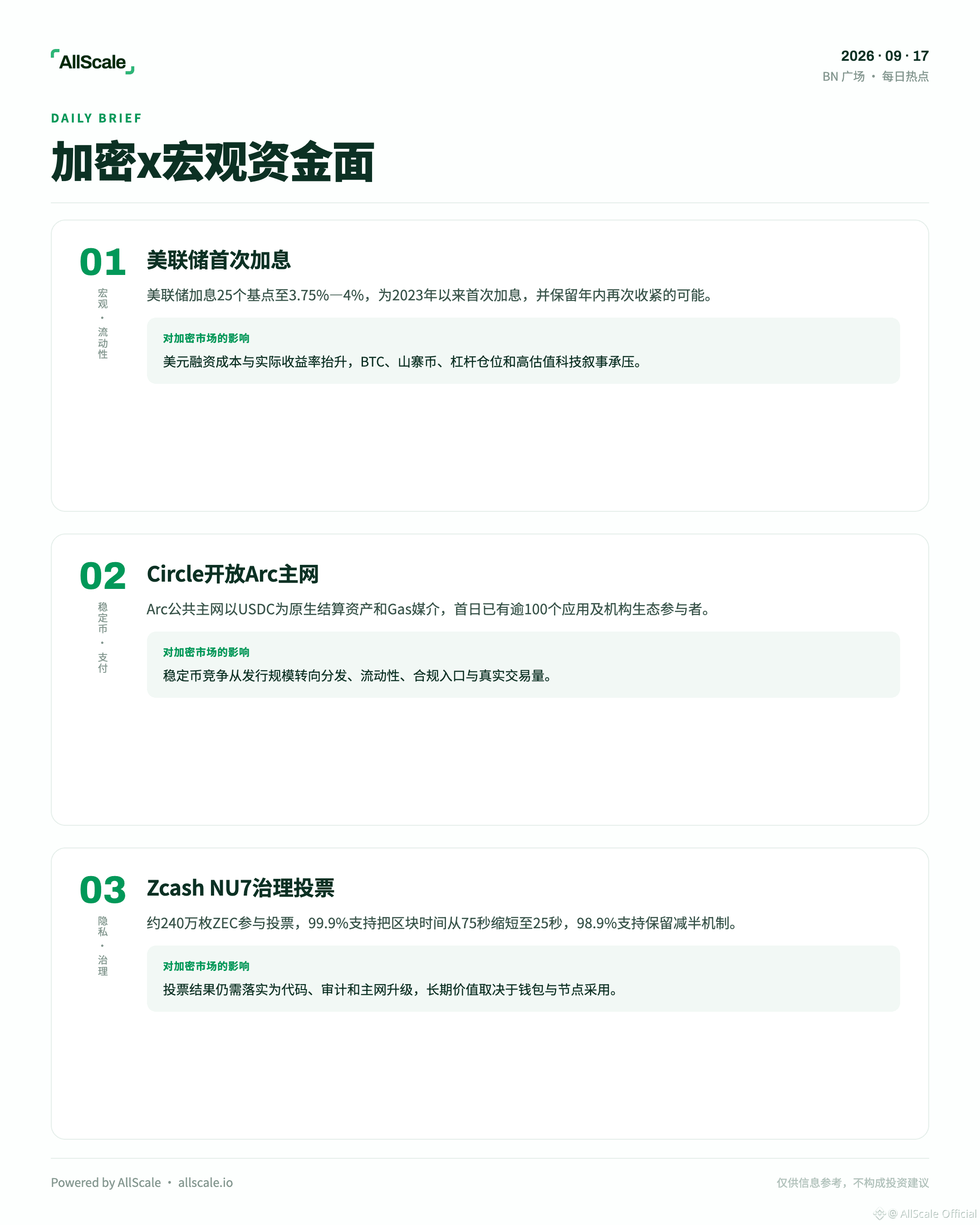
The Federal Reserve unanimously approved a 25-basis-point rate hike, raising the target range for the federal funds rate to 3.75%–4%. This is the first hike since 2023. Policy guidance still leaves open the possibility of additional tightening later this year. The backdrop is inflation running above target, with energy prices rising while consumption and capital expenditures remain resilient. The impact is that US dollar funding costs and U.S. Treasury real yields are lifting again. BTC is no longer priced solely by spot demand; if long-end rates continue to climb, altcoins, leveraged positions, and high-valuation tech narratives will feel pressure first.
2. Circle launches the Arc mainnet, as stablecoins enter competition for dedicated settlement networks
Circle officially opened the public Arc mainnet. Using USDC as the native settlement asset and as the Gas medium, the first day already saw more than 100 applications and ecosystem participants from institutions. This validates node coverage across payments, clearing, banks, and asset management institutions. The backdrop is that the stablecoin issuer is extending toward an underlying settlement layer for payments, cross-border FX, and tokenized assets. The impact is that competition shifts from issuance scale to distribution, liquidity, and compliant access points. For the crypto market, whether Arc can generate real trading and payment volume is more important than new-chain narratives or short-term token hype.
3. Zcash uses NU7 to vote-test privacy governance and performance upgrades
Zcash coin holders completed voting on the NU7 range. About 2.4 million ZEC participated, representing roughly two-thirds of the eligible balance. 99.9% of participating votes supported shortening block time from 75 seconds to 25 seconds, while 98.9% supported preserving the Bitcoin-style halving mechanism. The backdrop is that a privacy chain must improve confirmation efficiency while balancing trade-offs among stable monetary policy, engineering progress, and governance representation. The impact is that NU7 provides a highly participatory governance experiment, but the outcome still needs to be implemented in code, audited, and upgraded on the mainnet. Long-term value will depend on wallet support, node compatibility, and sustained usage.
The above content is a consolidation of publicly available information only and does not constitute any investment advice.
1. The Fed hikes for the first time in three years, and risk assets are repriced
The Federal Reserve unanimously approved a 25-basis-point rate hike, raising the target range for the federal funds rate to 3.75%–4%. This is the first hike since 2023. Policy guidance still leaves open the possibility of additional tightening later this year. The backdrop is inflation running above target, with energy prices rising while consumption and capital expenditures remain resilient. The impact is that US dollar funding costs and U.S. Treasury real yields are lifting again. BTC is no longer priced solely by spot demand; if long-end rates continue to climb, altcoins, leveraged positions, and high-valuation tech narratives will feel pressure first.
2. Circle launches the Arc mainnet, as stablecoins enter competition for dedicated settlement networks
Circle officially opened the public Arc mainnet. Using USDC as the native settlement asset and as the Gas medium, the first day already saw more than 100 applications and ecosystem participants from institutions. This validates node coverage across payments, clearing, banks, and asset management institutions. The backdrop is that the stablecoin issuer is extending toward an underlying settlement layer for payments, cross-border FX, and tokenized assets. The impact is that competition shifts from issuance scale to distribution, liquidity, and compliant access points. For the crypto market, whether Arc can generate real trading and payment volume is more important than new-chain narratives or short-term token hype.
3. Zcash uses NU7 to vote-test privacy governance and performance upgrades
Zcash coin holders completed voting on the NU7 range. About 2.4 million ZEC participated, representing roughly two-thirds of the eligible balance. 99.9% of participating votes supported shortening block time from 75 seconds to 25 seconds, while 98.9% supported preserving the Bitcoin-style halving mechanism. The backdrop is that a privacy chain must improve confirmation efficiency while balancing trade-offs among stable monetary policy, engineering progress, and governance representation. The impact is that NU7 provides a highly participatory governance experiment, but the outcome still needs to be implemented in code, audited, and upgraded on the mainnet. Long-term value will depend on wallet support, node compatibility, and sustained usage.
The above content is a consolidation of publicly available information only and does not constitute any investment advice.