

The CLARITY Act was not passed
The Senate procedural vote failed (the CLARITY Act), making this the biggest short-term negative catalyst for ETH this week. After the bill failed, ETH briefly dropped to $2,388, then rebounded slightly to around $2,400. Spot Ethereum ETFs listed in the US recorded their largest single-day net outflow since January; the stalling of the bill was the main trigger.
The Federal Reserve’s rate hike is implemented, with a clearly hawkish stance
The Federal Reserve announced that it will raise the federal funds rate to 3.75%-4%, the first hike since 2023. The new chair, Kevin Warsh, clearly stated, "Inflation is too high and has persisted for too long; this summer’s inflation data does not indicate that the underlying trend has improved significantly." After the rate hike, Bitcoin fell first and then stabilized, down nearly 4% for the week. For ETH, a high-rate environment means tighter liquidity, putting overall pressure on risk assets.
Liquidity flows: ETF outflows vs. institutional bottom-fishing
Retail is selling, institutions are buying—this is exactly the same signal as during the last ETH pullback.
BlackRock today withdrew 5,150 ETH from Coinbase Prime (about $12.28 million), and also withdrew 656.71 BTC (about $49.79 million), totaling roughly $62 million. In times of market panic, accumulating against the trend is an acknowledgment by institutions of ETH’s long-term value.
Ethereum ecosystem: the long-term supply structure is tightening
Short-term bearishness can’t hide an important fact: ETH’s on-chain supply is continuing to tighten.
Exchange reserves have fallen to 14.60 million ETH, the lowest level since 2016. Since 2022, reserves have continued to decline. This week’s inflow is almost negligible compared with this long-term trend.
Total staking has reached 43 million ETH, a historical high, accounting for about 35% of the supply. ETH in staking cannot be sold; the tradable ETH liquidity pool is smaller than in any previous cycle.
The MVRV ratio has risen above 1, and ETH has continued trading above the realized price around $2300. Analysts point out that if this condition persists, June–July may already have been marked as the cycle low.
Additionally, the Ethereum mainnet officially went live on September 16 with the Multi-Party Block Construction (MPBC) mechanism. This is an important evolution of the PBS mechanism, further optimizing coordination and efficiency in block space.
⚡ Liquidation map: leveraged positions piled up both ways—volatility is one trigger away
According to Coinglass data, ETH is currently in a dense two-way liquidation zone:
Resistance: If ETH breaks above $2528, the cumulative liquidation strength of shorts on major CEXs could reach $987 million. Once broken, it may trigger an accelerated short squeeze upward.
Support: If ETH falls below $2290, the cumulative liquidation strength of longs could reach $959 million. A break could trigger long-position stampedes.
In the past 24 hours, the crypto market saw $261.73 million worth of leveraged positions liquidated in total. Shorts accounted for 54.46% of liquidations, about 1.2 times the longs, indicating that short-term shorts are also being squeezed.
📋 Trading reference (for reference only, not investment advice)
Bullish bias (oversold repair):
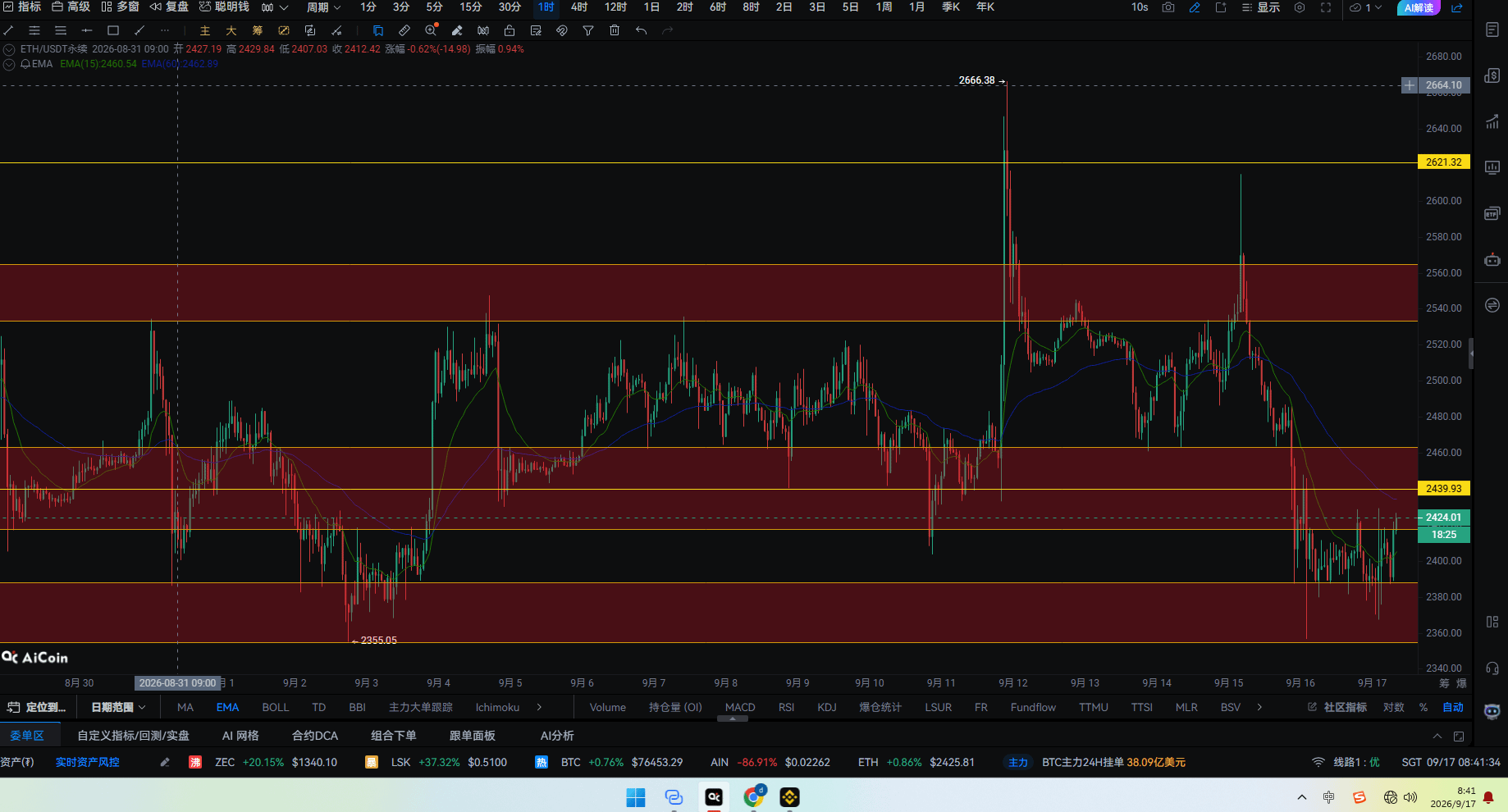
Entry reference: Pull back to 2355–2370, stabilize, and try a small long position, or follow through after an effective breakout above 2439.
Stop loss: Below 2310 (4-hour yellow line).
Targets: First target 2439–2460; after holding above, look for 2528 (the short liquidation trigger zone).
Bearish bias (follow the trend):
Entry reference: If price rebounds to the 2439–2460 moving-average band and meets resistance, try a small short position.
Stop loss: Above 2500.
Targets: 2355 → 2310 → 2290.
Current status: 2412 is below the short-term moving average but above the 4-hour support, representing a low-level grind phase after bearish macro pressure has played out. The downside follow-through is limited (not far from the 2290 liquidation zone), while chasing longs needs to wait for a moving-average repair signal. 2355 is the key level to watch—if it holds, a short-term bottom may form; if it breaks, it will most likely test the 2290 dense liquidation zone.
In the short term, look to the macro; in the medium term, look to supply. The failure of the CLARITY bill + the Fed’s hawkish rate hikes have made sentiment clearly bearish in the short term. However, key structural signals will determine ETH’s medium-term direction: exchange reserves are at a 10-year low, 35% of supply is locked up, and institutions are buying aggressively against the trend. Currently, price 2412 is caught between the short-term moving average (bearish) and the 4-hour support (bullish). The breakout window is narrowing—focus on a break above 2439 and how 2355 support performs.
#ETH #行情分析📈 #比特币ETF净流出4.5亿美元 #美联储会议 $ETH $BTC

