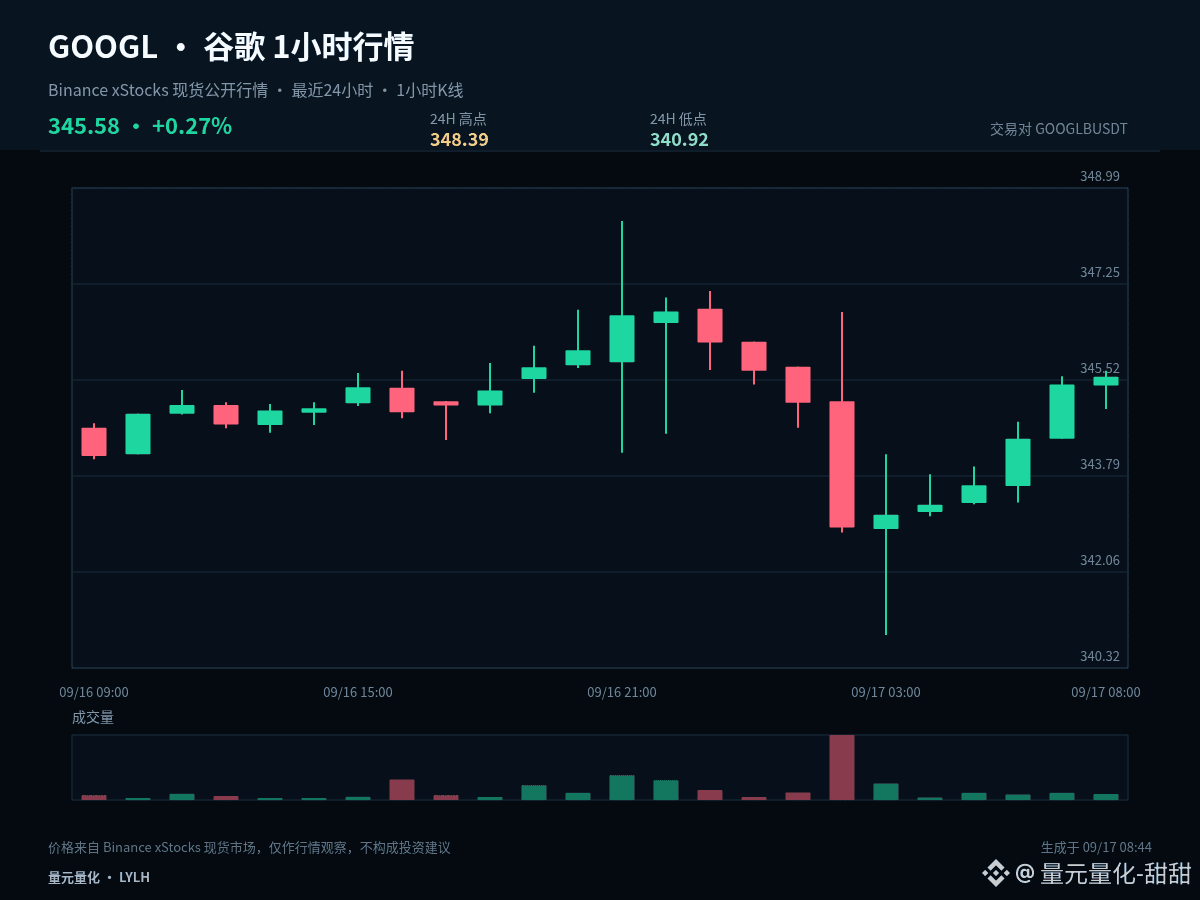
$GOOGLB #GOOGL At the moment, it’s more appropriate to first confirm a rebound rather than define a reversal in advance. Current price: 345.58; 1 hour: +0.04%, 24 hours: +0.30%. Whether the two timeframes realign in the same direction is the key focus going forward.
Currently, 1 hour is +0.04% and 24 hours is +0.30%, but the two timeframes have not formed a sufficiently clear alignment in the same direction. In range-bound conditions, the margin for error when chasing or selling aggressively is low. It’s better to confirm direction using the upper boundary, confirm support using the lower boundary, and use the midline only as the strength/weakness dividing line.
If the rebound can reclaim 344.655 and further hold above 348.39, it would indicate that buying pressure is starting to shift away from the prior weakness. If price bounces up toward the midline and then falls back again—especially if it drops back toward 340.92—that would look more like a failed repair, and you shouldn’t continue to rely on a “trend strengthening” expectation.
Even if the rebound fails, you still need evidence. Don’t immediately chase a short just because there was one spike high followed by a pullback. A more sensible sequence is to observe whether the resistance level is rejected, whether the lows resume moving lower, and then decide the next action based on whether subsequent rebounds reclaim key levels.
Existing positions can be handled in stages according to key levels, so you don’t have to make all decisions at once. Those with no position should wait for a confirmed breakout or for a pullback to stabilize. For U.S. market instruments, also be mindful of volatility caused by trading session transitions. Your plan should be based on price conditions—not emotions.
For short-term positions, the focus isn’t predicting every single candlestick. It’s to ensure there’s a basis for entry, trimming, and exiting. If there’s no confirmation, do less. If a key level fails, redo the plan: control single-trade risk first, then discuss potential upside/downside.
#MSTRTradingVolumeSurpassesMorganStanley
Currently, 1 hour is +0.04% and 24 hours is +0.30%, but the two timeframes have not formed a sufficiently clear alignment in the same direction. In range-bound conditions, the margin for error when chasing or selling aggressively is low. It’s better to confirm direction using the upper boundary, confirm support using the lower boundary, and use the midline only as the strength/weakness dividing line.
If the rebound can reclaim 344.655 and further hold above 348.39, it would indicate that buying pressure is starting to shift away from the prior weakness. If price bounces up toward the midline and then falls back again—especially if it drops back toward 340.92—that would look more like a failed repair, and you shouldn’t continue to rely on a “trend strengthening” expectation.
Even if the rebound fails, you still need evidence. Don’t immediately chase a short just because there was one spike high followed by a pullback. A more sensible sequence is to observe whether the resistance level is rejected, whether the lows resume moving lower, and then decide the next action based on whether subsequent rebounds reclaim key levels.
Existing positions can be handled in stages according to key levels, so you don’t have to make all decisions at once. Those with no position should wait for a confirmed breakout or for a pullback to stabilize. For U.S. market instruments, also be mindful of volatility caused by trading session transitions. Your plan should be based on price conditions—not emotions.
For short-term positions, the focus isn’t predicting every single candlestick. It’s to ensure there’s a basis for entry, trimming, and exiting. If there’s no confirmation, do less. If a key level fails, redo the plan: control single-trade risk first, then discuss potential upside/downside.
#MSTRTradingVolumeSurpassesMorganStanley