03 Turtle Trading Rules|Let Trends Decide When to Exit
RICHARD DENNIS & WILLIAM ECKHARDT
Core Idea
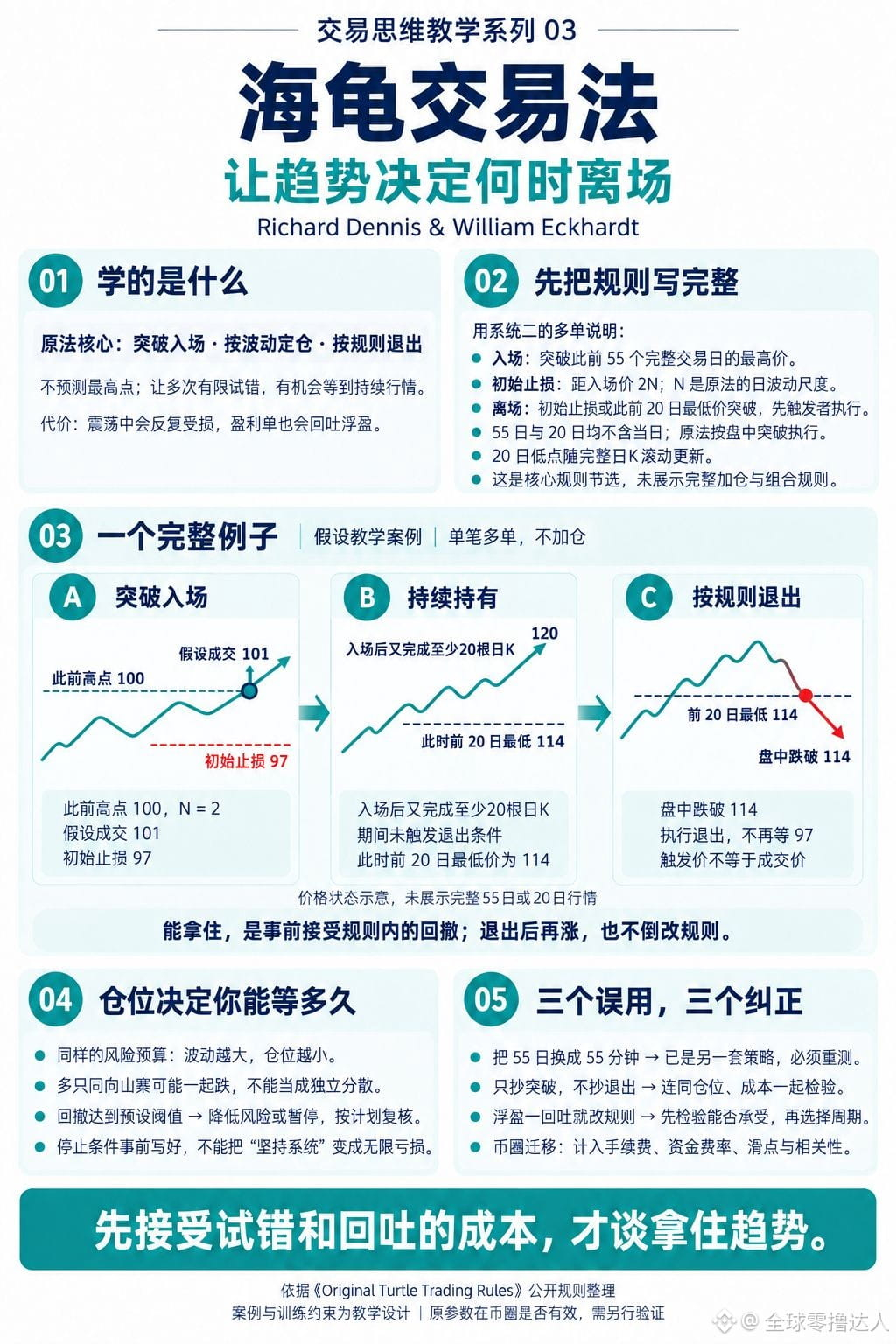
Enter on a breakout, size positions by volatility, and exit according to the rules. Allow for multiple limited attempts at error to participate in sustained market trends; the price is repeatedly getting damaged during choppy periods and giving back some floating profits on winning trades.
Part of the Original System Two: Long-Position Core Rules
- Entry: Break through the highest price of the previous 55 complete trading days during the session.
- Initial stop-loss: 2N below the entry price; N is the daily volatility scale as defined in the original rules.
- Trend exit: During the session, fall below the lowest price of the previous 20 complete trading days.
- Initial stop-loss and trend exit: whichever triggers first is executed.
The 55-day and 20-day counts do not include the current day. The 20-day low updates as each complete day’s K-line rolls forward. This is only a core excerpt; it does not show the full rules for adding positions, combinations, and risk.
Hypothetical Example: How to Hold, How to End
The previous 55-day highest price is 100, and N=2. After the breakout, suppose the trade occurs at 101, so the initial stop-loss is 97.
After entry, at least 20 daily K-bars are completed, and no exit is triggered during that time. Suppose the price later rises to 120; at that moment, the lowest price of the previous 20 complete trading days is 114.
If, during the session, the price breaks below 114, then exit is executed immediately; no need to wait for 97. 114 is a trigger reference price; it does not guarantee the actual execution price.
Not selling at 120 does not automatically mean failure: this holding approach already accepts giving back some floating profits in advance.
The Most Common Pitfalls
Copy only the breakout, not the exit; change 55 days to 55 minutes and think it’s the same method; buy several aligned altcoins and think you’ve achieved diversification; turn “sticking to the rules” into unlimited trial-and-error.
Corrective Actions
The greater the volatility, the smaller the number of units for the same risk budget; also check the total risk of the related positions. Set drawdown-recheck conditions in advance—once the threshold is reached, reduce risk according to the plan or pause. If parameters, fees, or the market change, re-test.
Only after accepting the cost of trial-and-error and profit givebacks can you talk about holding onto trends.
Source: Original Turtle Trading Rules official public entry (https://tradingblox.com/originalturtles/originalturtlerules.htm) and a mirror of the original rules PDF (https://www.kagels-trading.de/wp-content/uploads/2016/09/turtle-trading-rules.pdf). The numerical example and training constraints are instructional designs; whether the original parameters work in crypto requires separate verification.
How to Learn Together
- Miller: practice picking strong stocks and waiting for entry.
- Linda: practice false breakouts within ranges and short-term exits.
- Turtle: practice trend following and rule-based holding.
Practice the three methods separately and record separately. The same trade cannot change its exit rationale temporarily just because it starts going against you.
The following is a public-method instructional distillation. Numerical examples, filtering conditions, and practice time windows are instructional designs; they do not represent the trader’s complete system or unified parameters. R is the initial planned risk for this trade; actual losses may exceed the plan due to slippage and fees.
RICHARD DENNIS & WILLIAM ECKHARDT
Core Idea
Enter on a breakout, size positions by volatility, and exit according to the rules. Allow for multiple limited attempts at error to participate in sustained market trends; the price is repeatedly getting damaged during choppy periods and giving back some floating profits on winning trades.
Part of the Original System Two: Long-Position Core Rules
- Entry: Break through the highest price of the previous 55 complete trading days during the session.
- Initial stop-loss: 2N below the entry price; N is the daily volatility scale as defined in the original rules.
- Trend exit: During the session, fall below the lowest price of the previous 20 complete trading days.
- Initial stop-loss and trend exit: whichever triggers first is executed.
The 55-day and 20-day counts do not include the current day. The 20-day low updates as each complete day’s K-line rolls forward. This is only a core excerpt; it does not show the full rules for adding positions, combinations, and risk.
Hypothetical Example: How to Hold, How to End
The previous 55-day highest price is 100, and N=2. After the breakout, suppose the trade occurs at 101, so the initial stop-loss is 97.
After entry, at least 20 daily K-bars are completed, and no exit is triggered during that time. Suppose the price later rises to 120; at that moment, the lowest price of the previous 20 complete trading days is 114.
If, during the session, the price breaks below 114, then exit is executed immediately; no need to wait for 97. 114 is a trigger reference price; it does not guarantee the actual execution price.
Not selling at 120 does not automatically mean failure: this holding approach already accepts giving back some floating profits in advance.
The Most Common Pitfalls
Copy only the breakout, not the exit; change 55 days to 55 minutes and think it’s the same method; buy several aligned altcoins and think you’ve achieved diversification; turn “sticking to the rules” into unlimited trial-and-error.
Corrective Actions
The greater the volatility, the smaller the number of units for the same risk budget; also check the total risk of the related positions. Set drawdown-recheck conditions in advance—once the threshold is reached, reduce risk according to the plan or pause. If parameters, fees, or the market change, re-test.
Only after accepting the cost of trial-and-error and profit givebacks can you talk about holding onto trends.
Source: Original Turtle Trading Rules official public entry (https://tradingblox.com/originalturtles/originalturtlerules.htm) and a mirror of the original rules PDF (https://www.kagels-trading.de/wp-content/uploads/2016/09/turtle-trading-rules.pdf). The numerical example and training constraints are instructional designs; whether the original parameters work in crypto requires separate verification.
How to Learn Together
- Miller: practice picking strong stocks and waiting for entry.
- Linda: practice false breakouts within ranges and short-term exits.
- Turtle: practice trend following and rule-based holding.
Practice the three methods separately and record separately. The same trade cannot change its exit rationale temporarily just because it starts going against you.
The following is a public-method instructional distillation. Numerical examples, filtering conditions, and practice time windows are instructional designs; they do not represent the trader’s complete system or unified parameters. R is the initial planned risk for this trade; actual losses may exceed the plan due to slippage and fees.