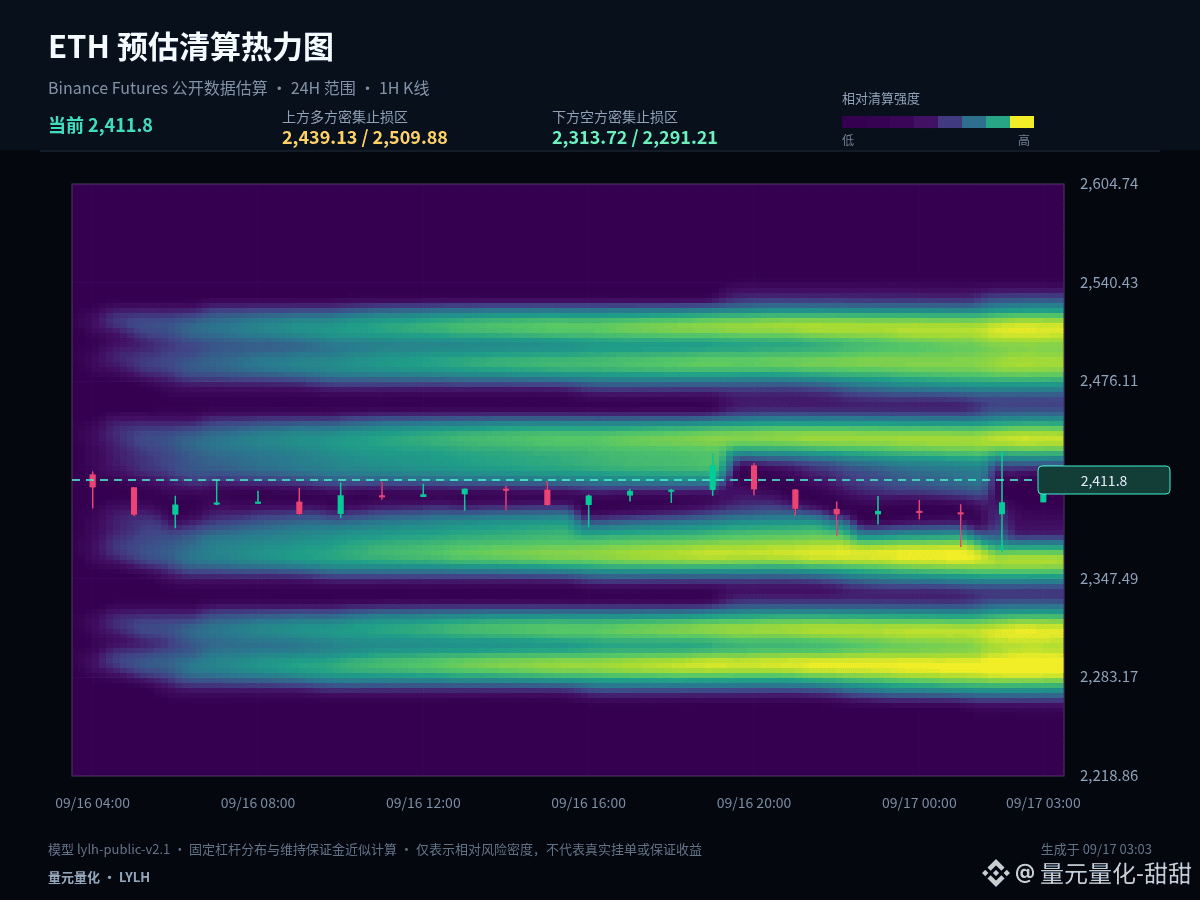
$ETH #ETH If I had to keep only one observation price for this round, I would choose 2,399.88. Current price: 2,412.29. In the past 1 hour: +0.59%, in the past 24 hours: +0.05%. The gains and losses around the central axis can help filter out a lot of intraday noise.
As long as the price stays above 2,399.88, it indicates that pullbacks are still being controlled by the bulls. The next target is to test the pressure at 2,430.64. If the price falls back below the central axis again, the previous strength will be discounted—and we should also prevent a further move back toward 2,369.11.
Current 1-hour +0.59%, 24-hour +0.05%: the two timeframes have not formed a sufficiently clear alignment in the same direction. In a range-bound market, the tolerance for chasing or cutting trades is lower. It’s better to confirm the direction using the upper boundary, and confirm the follow-through and support using the lower boundary. The central axis is only used as the line dividing strength and weakness.
There are three ways to handle the next path: If price moves up and holds effectively above 2,430.64, wait for a pullback that does not break before reassessing whether to continue. If price breaks down below 2,369.11, prioritize risk control and wait for fresh support. If it continues to oscillate around 2,399.88, treat it as a range rotation—don’t repeatedly chase direction in the middle of the range.
For people who already hold positions, the key is to manage based on whether support fails, rather than being carried along by every fluctuation. For people who are currently in no position, prioritize waiting for a breakout with a pullback, or confirmation of support. For spot holdings, you can scale in; for futures, you should shorten the decision chain: first determine the stop-loss level, then decide whether to participate.
If the next 1-hour candle closes above 2,399.88, the structure will become more proactive; if it closes below, continue to trade cautiously. Which path are you leaning toward right now?
#CircleOpensArcMainnet
As long as the price stays above 2,399.88, it indicates that pullbacks are still being controlled by the bulls. The next target is to test the pressure at 2,430.64. If the price falls back below the central axis again, the previous strength will be discounted—and we should also prevent a further move back toward 2,369.11.
Current 1-hour +0.59%, 24-hour +0.05%: the two timeframes have not formed a sufficiently clear alignment in the same direction. In a range-bound market, the tolerance for chasing or cutting trades is lower. It’s better to confirm the direction using the upper boundary, and confirm the follow-through and support using the lower boundary. The central axis is only used as the line dividing strength and weakness.
There are three ways to handle the next path: If price moves up and holds effectively above 2,430.64, wait for a pullback that does not break before reassessing whether to continue. If price breaks down below 2,369.11, prioritize risk control and wait for fresh support. If it continues to oscillate around 2,399.88, treat it as a range rotation—don’t repeatedly chase direction in the middle of the range.
For people who already hold positions, the key is to manage based on whether support fails, rather than being carried along by every fluctuation. For people who are currently in no position, prioritize waiting for a breakout with a pullback, or confirmation of support. For spot holdings, you can scale in; for futures, you should shorten the decision chain: first determine the stop-loss level, then decide whether to participate.
If the next 1-hour candle closes above 2,399.88, the structure will become more proactive; if it closes below, continue to trade cautiously. Which path are you leaning toward right now?
#CircleOpensArcMainnet