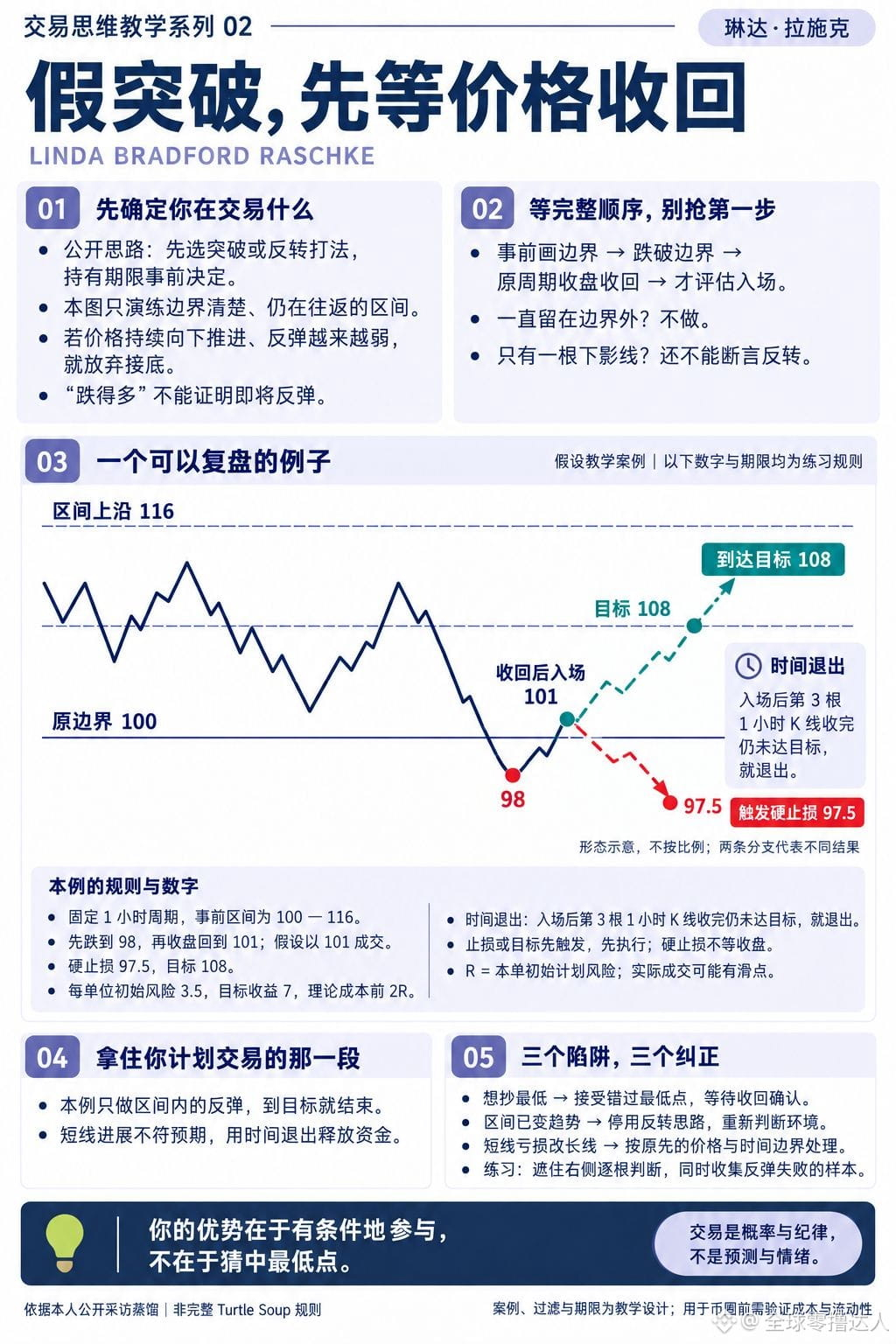
02 Linda Bradford Raschke|Fake Breakout, Wait for Price to Retrace First
LINDA BRADFORD RASCHKE
Core Thinking
First determine whether you’re trading a breakout or a reversal. Before entering, decide on the rationale and the holding period. In this chart exercise, the boundaries are clear and the price is still oscillating within the range.
How to Identify Opportunities
Draw the boundary in advance → price breaks below → the prior cycle closes back in → only then evaluate whether to enter.
Stay outside the boundary at all times; don’t act. If there are only lower wicks, you can’t assert a reversal directly. If price continues pushing lower and the rebounds keep getting weaker, abandon the idea of catching the bottom.
Hypothetical Case: Write Three Exits Together
Set a fixed 1-hour timeframe, with an initial range of 100—116. Price first drops to 98, then closes back to 101; assume entry fills at 101.
- Stop-loss: If it touches 97.5, execute immediately.
- Target exit: At 108, exit according to plan.
- Time-based exit: After entry, if the 3rd subsequent 1-hour candlestick closes and the target hasn’t been reached, exit.
- If the stop-loss or the target triggers first, execute first; a hard stop-loss does not wait for the close.
Initial risk per unit is 3.5, target reward is 7, theoretical cost is the first 2R. Actual fills may include slippage. If price never closes back above 100, you are not eligible to enter at any point.
The Easiest Trap to Fall Into
Trying to buy the lowest; reversing immediately after a stop; the range has already turned into a trend, yet you keep guessing bottoms; your short-term progress isn’t what you expected, so you keep extending the position indefinitely.
Corrective Actions
Accept missing the lowest point in exchange for a confirmed retrace. After stopping out, wait for the full conditions again. In this example, you only hold the rebound within the range—when you hit the target or the time limit, you’re done.
Your advantage is participating conditionally—not guessing the exact lowest point.
Source: Interview with the author’s hosted site, “The Discerning Trader” (https://lindaraschke.net/wp-content/uploads/2026/01/Discerning-trader.pdf) and “The Rituals of Trading” (https://lindaraschke.net/wp-content/uploads/2026/01/rituals.pdf). This is a simplified educational walkthrough of the fake-breakout approach, not a complete Turtle Soup ruleset; the numbers, range filters, and time limits are all designed for teaching.
The following is an instructional distillation of a public method. The numeric example, filtering conditions, and practice duration are teaching design choices and do not represent the trader’s complete system or a unified set of parameters. R refers to the initial planned risk for this round; actual losses may exceed the plan due to slippage and fees.
LINDA BRADFORD RASCHKE
Core Thinking
First determine whether you’re trading a breakout or a reversal. Before entering, decide on the rationale and the holding period. In this chart exercise, the boundaries are clear and the price is still oscillating within the range.
How to Identify Opportunities
Draw the boundary in advance → price breaks below → the prior cycle closes back in → only then evaluate whether to enter.
Stay outside the boundary at all times; don’t act. If there are only lower wicks, you can’t assert a reversal directly. If price continues pushing lower and the rebounds keep getting weaker, abandon the idea of catching the bottom.
Hypothetical Case: Write Three Exits Together
Set a fixed 1-hour timeframe, with an initial range of 100—116. Price first drops to 98, then closes back to 101; assume entry fills at 101.
- Stop-loss: If it touches 97.5, execute immediately.
- Target exit: At 108, exit according to plan.
- Time-based exit: After entry, if the 3rd subsequent 1-hour candlestick closes and the target hasn’t been reached, exit.
- If the stop-loss or the target triggers first, execute first; a hard stop-loss does not wait for the close.
Initial risk per unit is 3.5, target reward is 7, theoretical cost is the first 2R. Actual fills may include slippage. If price never closes back above 100, you are not eligible to enter at any point.
The Easiest Trap to Fall Into
Trying to buy the lowest; reversing immediately after a stop; the range has already turned into a trend, yet you keep guessing bottoms; your short-term progress isn’t what you expected, so you keep extending the position indefinitely.
Corrective Actions
Accept missing the lowest point in exchange for a confirmed retrace. After stopping out, wait for the full conditions again. In this example, you only hold the rebound within the range—when you hit the target or the time limit, you’re done.
Your advantage is participating conditionally—not guessing the exact lowest point.
Source: Interview with the author’s hosted site, “The Discerning Trader” (https://lindaraschke.net/wp-content/uploads/2026/01/Discerning-trader.pdf) and “The Rituals of Trading” (https://lindaraschke.net/wp-content/uploads/2026/01/rituals.pdf). This is a simplified educational walkthrough of the fake-breakout approach, not a complete Turtle Soup ruleset; the numbers, range filters, and time limits are all designed for teaching.
The following is an instructional distillation of a public method. The numeric example, filtering conditions, and practice duration are teaching design choices and do not represent the trader’s complete system or a unified set of parameters. R refers to the initial planned risk for this round; actual losses may exceed the plan due to slippage and fees.