01 Miller Vinny|First pick the stronger one, then wait for the tightening
MARK MINERVINI
Core thinking
First confirm the uptrend, then find issues that are relatively stronger than the broader market, and finally wait for volatility to contract and break out. Low price and percentage drop cannot substitute for evidence of strength.
How to identify opportunities
1. Check whether highs and lows are rising, and compare relative performance in the same period.
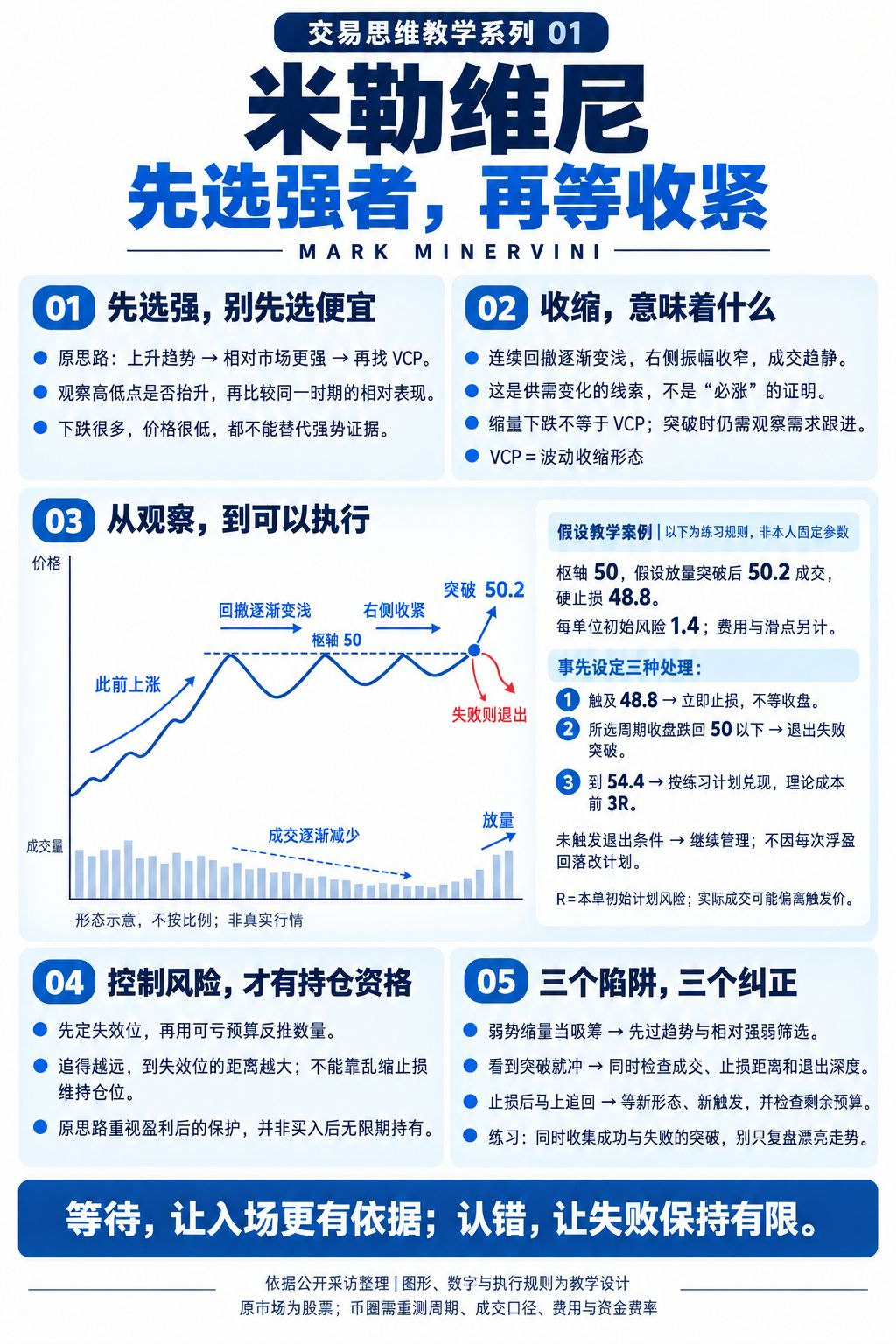
2. Look for whether successive pullbacks are gradually getting shallower, whether the amplitude on the right side is tightening, and whether volume is becoming quieter.
3. Mark in advance the top of the final consolidation area and the invalidation level.
4. When a breakout occurs, observe whether there is follow-through demand; only assess execution after confirming the stop-loss distance and the budget are suitable.
VCP is a volatility contraction pattern. Falling on declining volume is not the same as a VCP; contraction also does not guarantee an upside breakout.
Hypothetical case: how to enter, and how to manage
Pivot 50. Assume that after a breakout on volume, the trade at 50.2 occurs, with a hard stop at 48.8. Initial risk per unit is 1.4.
Before opening the position, fix the management timeframe and agree:
- If, during the session, it touches 48.8: execute the stop loss immediately; do not wait for the close.
- If the chosen period’s close falls back below 50: exit as the breakout has failed.
- If it reaches 54.4: realize profits according to the practice plan, with theoretical cost of the first 3R.
- If none of the above conditions is triggered: continue managing; do not change the plan just because floating gains pull back each time.
These are practice rules, not the take-profit/stop-loss parameters Miller Vinervini fixedly uses. Trigger prices do not guarantee the fill prices.
The easiest traps to fall into
Weakness on declining volume as “accumulation”; chasing too far after a breakout; using an overly wide stop loss to buy more; and after a failure, turning a short-term trade into a long-term position.
Corrective actions
First filter by trend and relative strength, then decide whether to study the pattern. First set the invalidation level, then use the “maximum you can lose” budget to back-calculate the quantity you can take. Also review both successful and failed breakouts—don’t only save the pretty charts.
Wait, so there is more basis for entry; admit mistakes, so the failure remains limited.
Source: Michael Sincere’s public interview with Minervini (https://michaelsincere.com/articles/my-marketwatch-interview-with-stock-market-wizard-mark-minervini). The original experience mainly comes from stocks; using it for crypto requires re-testing the timeframe, trade volume conventions, liquidity, and fees.
The following is a teaching distillation of the public methods. The numerical examples, filtering conditions, and practice time limits are instructional designs and do not represent the trader’s complete personal system or unified parameters. R refers to the initial planned risk for this trade; actual losses may exceed the plan due to slippage and fees.
MARK MINERVINI
Core thinking
First confirm the uptrend, then find issues that are relatively stronger than the broader market, and finally wait for volatility to contract and break out. Low price and percentage drop cannot substitute for evidence of strength.
How to identify opportunities
1. Check whether highs and lows are rising, and compare relative performance in the same period.
2. Look for whether successive pullbacks are gradually getting shallower, whether the amplitude on the right side is tightening, and whether volume is becoming quieter.
3. Mark in advance the top of the final consolidation area and the invalidation level.
4. When a breakout occurs, observe whether there is follow-through demand; only assess execution after confirming the stop-loss distance and the budget are suitable.
VCP is a volatility contraction pattern. Falling on declining volume is not the same as a VCP; contraction also does not guarantee an upside breakout.
Hypothetical case: how to enter, and how to manage
Pivot 50. Assume that after a breakout on volume, the trade at 50.2 occurs, with a hard stop at 48.8. Initial risk per unit is 1.4.
Before opening the position, fix the management timeframe and agree:
- If, during the session, it touches 48.8: execute the stop loss immediately; do not wait for the close.
- If the chosen period’s close falls back below 50: exit as the breakout has failed.
- If it reaches 54.4: realize profits according to the practice plan, with theoretical cost of the first 3R.
- If none of the above conditions is triggered: continue managing; do not change the plan just because floating gains pull back each time.
These are practice rules, not the take-profit/stop-loss parameters Miller Vinervini fixedly uses. Trigger prices do not guarantee the fill prices.
The easiest traps to fall into
Weakness on declining volume as “accumulation”; chasing too far after a breakout; using an overly wide stop loss to buy more; and after a failure, turning a short-term trade into a long-term position.
Corrective actions
First filter by trend and relative strength, then decide whether to study the pattern. First set the invalidation level, then use the “maximum you can lose” budget to back-calculate the quantity you can take. Also review both successful and failed breakouts—don’t only save the pretty charts.
Wait, so there is more basis for entry; admit mistakes, so the failure remains limited.
Source: Michael Sincere’s public interview with Minervini (https://michaelsincere.com/articles/my-marketwatch-interview-with-stock-market-wizard-mark-minervini). The original experience mainly comes from stocks; using it for crypto requires re-testing the timeframe, trade volume conventions, liquidity, and fees.
The following is a teaching distillation of the public methods. The numerical examples, filtering conditions, and practice time limits are instructional designs and do not represent the trader’s complete personal system or unified parameters. R refers to the initial planned risk for this trade; actual losses may exceed the plan due to slippage and fees.