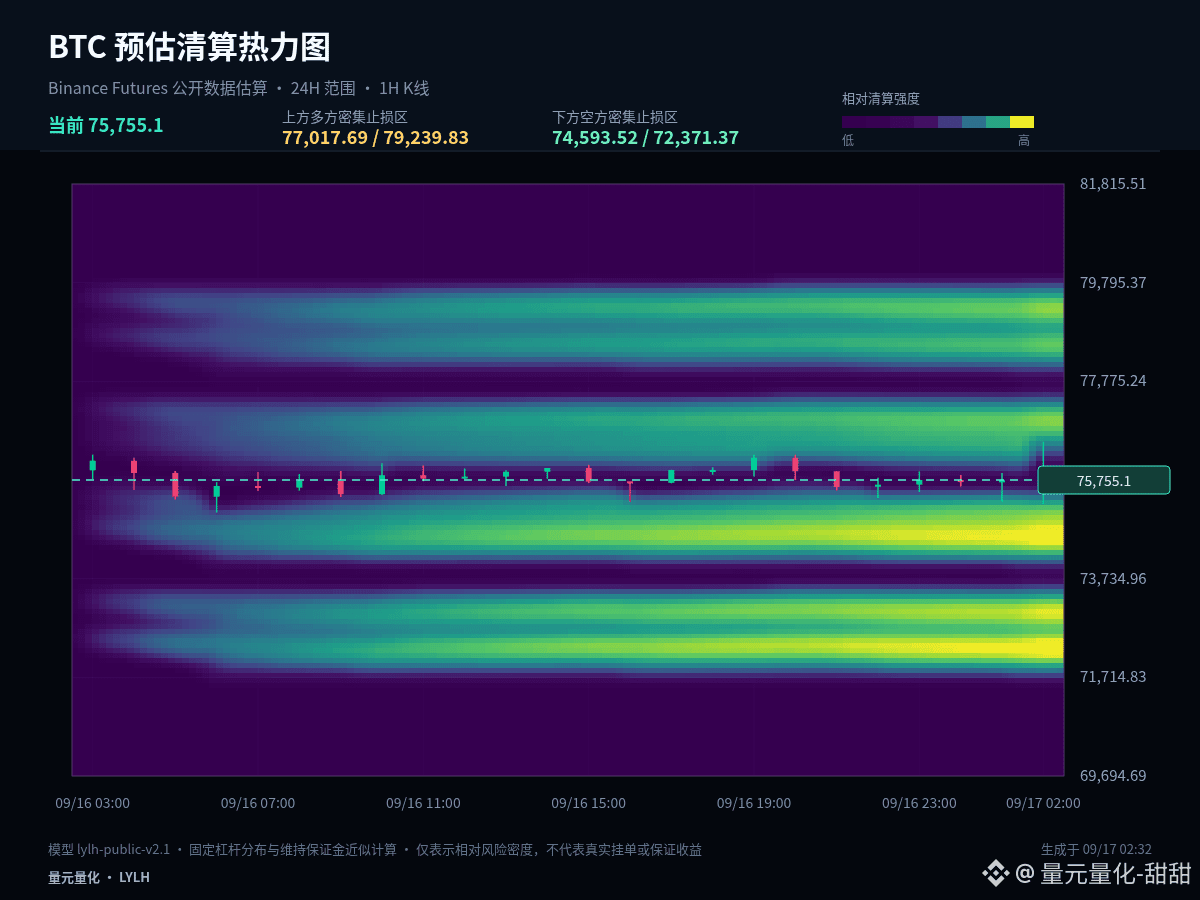
$BTC #BTC After the momentum heats up, it’s only then that you should consider entering—more importantly, you need to evaluate the position first. In the current 1 hour, it’s -0.10%, and over 24 hours, it’s -1.49%. Once the space that has already been traveled is gone, it can’t be directly treated as the next segment’s space that you can simply copy.
$BTC #BTC A clear one-sided trend hasn’t formed yet; the 1-hour and 24-hour rhythms are still pulling against each other. At this stage, focus your attention on the boundaries of the range rather than the color of every single candlestick.
In a weak phase, the easiest mistake is to misjudge a rebound as a reversal. As long as 75,850.7 hasn’t been reclaimed, observe the repair first. If it breaks again below 75,140.64, it indicates that there is still a lack of effective support underneath.
There are three ways to handle the subsequent path: if it moves upward and holds above 76,560.76, wait for a pullback that does not break, then reassess for continuation; if it falls and breaks below 75,140.64, prioritize controlling risk and wait for new support; if it continues to trade around 75,850.7 in consolidation, treat it as rotation within the range and don’t chase direction repeatedly in the middle.
In terms of position sizing, you need to distinguish between spot and derivatives (futures/contract). Existing spot positions can be managed in segments around key levels, without frequently flipping your direction due to every single 1-hour candlestick. If you’re currently flat, waiting for confirmation and then entering in batches is more composed. Contracts place more emphasis on the entry location and invalidation conditions. When volatility increases, actively reduce leverage to avoid turning a short-term judgment into passive holding.
Missing a segment of the market won’t directly cause losses. Only chasing at the end of volatility without a plan will force your position to become passive. For contracts, the focus isn’t to predict every candlestick—it’s to ensure that your entry, scaling down, and exit all have a basis. Do less without confirmation; if a key level fails, redo the plan. Control single-trade risk first, and only then talk about potential space.
#SKHynixInTalksToMakeMemoryChipsInUS
$BTC #BTC A clear one-sided trend hasn’t formed yet; the 1-hour and 24-hour rhythms are still pulling against each other. At this stage, focus your attention on the boundaries of the range rather than the color of every single candlestick.
In a weak phase, the easiest mistake is to misjudge a rebound as a reversal. As long as 75,850.7 hasn’t been reclaimed, observe the repair first. If it breaks again below 75,140.64, it indicates that there is still a lack of effective support underneath.
There are three ways to handle the subsequent path: if it moves upward and holds above 76,560.76, wait for a pullback that does not break, then reassess for continuation; if it falls and breaks below 75,140.64, prioritize controlling risk and wait for new support; if it continues to trade around 75,850.7 in consolidation, treat it as rotation within the range and don’t chase direction repeatedly in the middle.
In terms of position sizing, you need to distinguish between spot and derivatives (futures/contract). Existing spot positions can be managed in segments around key levels, without frequently flipping your direction due to every single 1-hour candlestick. If you’re currently flat, waiting for confirmation and then entering in batches is more composed. Contracts place more emphasis on the entry location and invalidation conditions. When volatility increases, actively reduce leverage to avoid turning a short-term judgment into passive holding.
Missing a segment of the market won’t directly cause losses. Only chasing at the end of volatility without a plan will force your position to become passive. For contracts, the focus isn’t to predict every candlestick—it’s to ensure that your entry, scaling down, and exit all have a basis. Do less without confirmation; if a key level fails, redo the plan. Control single-trade risk first, and only then talk about potential space.
#SKHynixInTalksToMakeMemoryChipsInUS